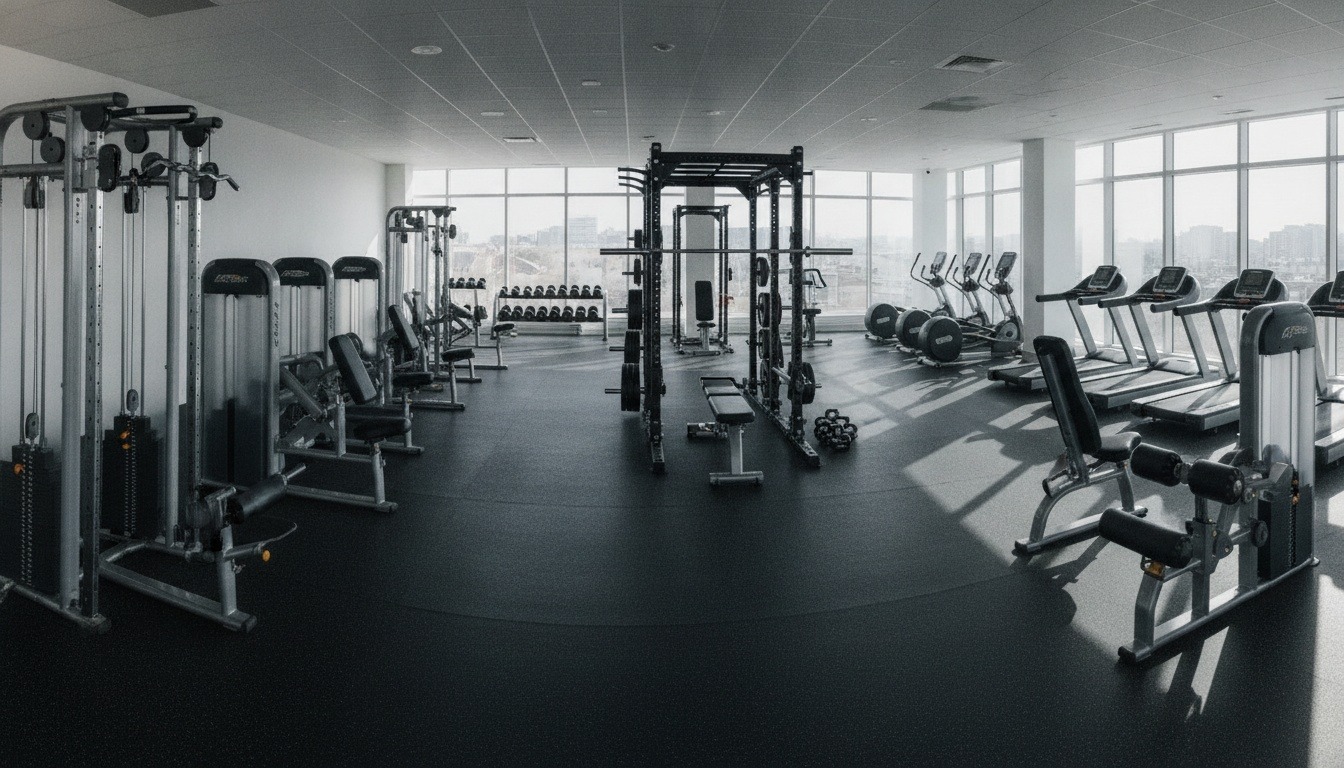
The gym equipment for opening a gym should be chosen zone by zone, starting from the square meters you have available and the type of members you want to attract, not from a generic list of machines. Spend your budget first on the areas that generate the most usage and sign-ups, leaving room for flooring, accessories and future expansion.
This guide is designed for those opening or renovating a fitness center, a functional training box or a gym in a hotel or residential building. You will find a checklist for each area, a method for estimating space and a table to set spending priorities, without made-up figures: prices vary and must be checked on product pages or with a quote.
We do not go into detail on requirements for restrooms and changing rooms, which depend on local regulations and must be verified with a licensed technician and your local council.
In this article
Where should you start before buying gym equipment?
Start with three data points: net usable floor area, target clientele and service model (open access memberships, classes, personal training). These three elements determine how many zones you need and how much weight to give each one.
A general gym for beginner members needs guided machines and cardio. A functional training box focuses on rigs, weightlifting and durable flooring. If you want to explore space planning in more depth, you will find a broader comparison in how to choose space and equipment for opening a gym.
- Dimensioned floor plan showing heights, columns, doors and emergency exits.
- Floor load capacity, if the space is not on the ground floor.
- Number of members you expect at the same time during peak hours.
- Additional services: classes, stretching area, personal training.
- Opening phases: what you need on day one and what you can add later.
How do you estimate square meters per zone?
For each piece of equipment, add up the footprint stated by the manufacturer and the movement and safety clearance required in the instructions. These values are on the product page: use them instead of generic averages, which vary greatly from model to model.
Then add the circulation aisles, calculated on traffic flow during peak hours. A common mistake is filling the room and leaving aisles that are too narrow: this worsens both the experience and safety. If space is tight, look at vertical solutions such as wall-mounted plate and barbell storage.
| Zone | What counts for calculating space | Budget weight |
|---|
| Selectorized machines | Footprint of each machine plus access and use space | High |
| Racks and rigs | Structure footprint, barbell length, loading and unloading area for plates | Medium-high |
| Cardio | Length and width of each machine, rear safety clearance | High |
| Free weights and benches | Benches, dumbbells and weight storage, with room to move | Medium |
| Flooring | Covered surface, load type and noise | Medium, but plan it immediately |
| Stretching and functional | Open area, mats, small equipment | Low |
The budget column is an indicative order of priority, not a percentage: the actual split depends on your project and should be defined with a quote.
Which selectorized machines do you need?
You need machines that cover the major muscle groups with simple adjustment, so members can train without constant assistance. Every additional machine should be justified by real use, not just by its visual impact on the gym floor.
In the catalogue you will find selectorized machines in weight stack, plate-loaded and multi-station versions. Multi-station machines take up less space but serve fewer people at the same time.
- Upper body: chest, back, shoulders.
- Lower body: leg press, leg extension, leg curl.
- Core and stabilization, if your target requires it.
- One multi-station machine for peak hours, if space is limited.
- Check loads, adjustments and planned maintenance on the product pages.
Racks, rigs and free weight area: what do you need?
A serious free weight area needs at least racks, benches, barbells, plates and an orderly system for storing everything. In a functional training box, the rig becomes the main structure of the entire space.
The rigs can be adapted to the length and layout of the room, and it is best to size them based on your space and the number of athletes per session. If you need a non-standard solution, ask for a custom configuration.
- Racks or rigs with a sufficient number of working stations for your classes.
- Flat and adjustable benches.
- Barbells and plates that are compatible with each other, with consistent sleeve diameter.
- Plate trees and barbell holders to keep things tidy and safe.
- Dumbbells in a progressive range, chosen according to your target.
Cardio and flooring: what not to overlook?
Cardio takes up a lot of space and attracts beginner members, so it deserves a dedicated, well-ventilated zone. Flooring is the most commonly underestimated item: it protects the structure, equipment and floor slabs, and affects noise and comfort.
For the weight room and functional zones, consider rubber gym flooring in rolls or tiles, choosing thickness and density based on loads and the drops of barbells and plates. To learn more about materials, also read EVA material and its uses.
- Treadmills, ellipticals, exercise bikes and rowers in proportion to your target.
- Power outlets and connections planned from the design stage.
- Flooring installed before machines and rigs.
- Air exchange zone and, if needed, acoustic insulation.
How do you split the budget without surprises?
Divide the spending into three blocks: essential equipment for opening, completing the offer and future expansion. With this structure you will not tie up all your capital in the first month, and you can add machines based on actual use.
- List the zones and the number of pieces of equipment you need on day one.
- Request quotes for every item, including flooring, transport and assembly.
- Add a reserve for unexpected costs, accessories and maintenance.
- Prioritize the zones that bring in the most members.
- Plan later purchases based on attendance.
Do not confuse purchase price with total cost: consider durability, maintenance and after-sales support. For financing terms and delivery times, always contact Donatif for an updated quote.
No suitable space? The container gym
A container gym is a turnkey solution for those who do not have a building or want to open in an outdoor area. It arrives already configured, with equipment included depending on the version. Always verify the permits required for installation with your local council and a technician.
In the container gym category you will find, for example, the Container Gym 40FT with Pilates equipment and the Container Gym 40FT with boxing equipment, both available to order. Check the equipment list and specifications on the product pages.
Frequently asked questions
How much equipment do you need to open a small gym?
It depends on floor area and target. In a limited space, it is best to focus on multi-station machines, a compact rack, dumbbells and a small cardio area, avoiding cluttered aisles.
How many square meters does a gym need?
There is no single value that applies to every case. Add up the footprints of the individual pieces of equipment, including the safety clearances specified by the manufacturer, and then add aisles and services.
Is it better to buy everything at once or in phases?
Phasing is usually better: buy the essentials for opening and expand based on attendance. Flooring and systems, however, should be planned from the start.
Do you need a plan before ordering?
Yes, at least a floor plan showing the zones and clearances. It prevents sizing mistakes and orders that have to be corrected.
Where to start, in practice
Draw the floor plan, assign space to each zone and choose first what brings the most use. Then complete the project with flooring and accessories.
If you want a proposal tailored to your gym, request a consultation or a quote from Donatif: we will help you turn your floor plan into a coherent equipment list.


 Budgets
 Dumbers
 Discs
 Benches
 Racks and Rigs
 Weights Holders
 Isotonic machines
 Calisthenics
 Cardio
 Kettlebells
 Flooring
 Gym Set
 Accessories
 Combat
 ARTI MARZIALI
 CONTAINER GYM
 Tug-Of-War
 Used Gym Equipment
 PILATES MACCHINARI
 GINNASTICA ARTISTICA
 CAMPI DA PADEL
 Prodotti in Pronta Consegna
 Informazioni
 IRONMAN
 Gift Card





Comments (0)