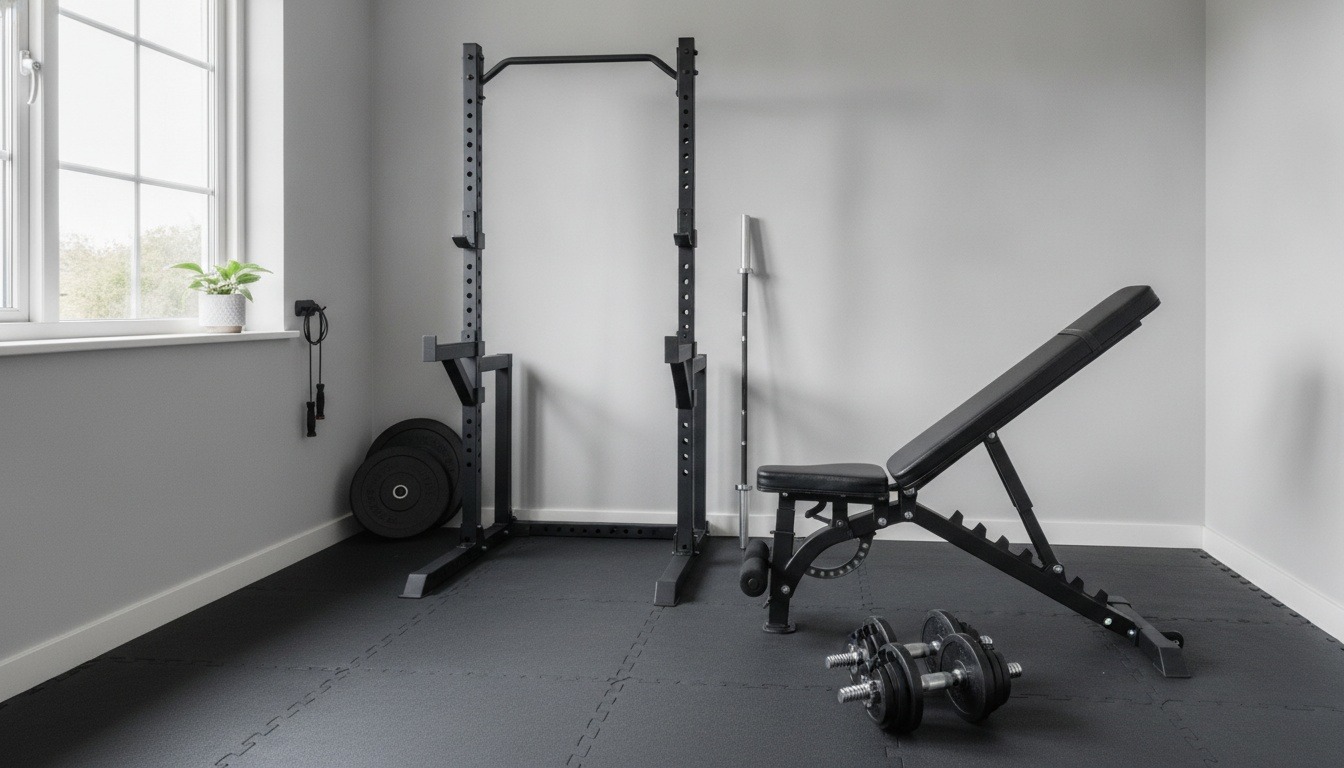
A small home gym needs only a few square metres if you choose a few pieces of equipment that do many jobs: an adjustable bench, adjustable dumbbells or a compact rack, and suitable flooring. With a free area of about 2 x 2 m you can already train well. With 2.5 x 3 m you can add a bench and barbell supports.
The most common mistake is buying based on what you would like to have rather than the space you actually have, ignoring the footprint of each piece, the room needed to move, and the ceiling height. In this guide you will find the measurements to take, the buying priorities, and how to use your space without turning the room into a storage area.
The measurements are indicative and meant for planning: always check the dimensions on each product page.
In this article
How much floor space do you really need?
It depends more on what you want to do than on the square metres themselves. The table gives an order of magnitude for the free working area, excluding anything that stays folded or stored away.
| Goal | Indicative free area | Typical equipment |
|---|
| Bodyweight and functional training | about 2 x 2 m | adjustable dumbbells, exercise mat, protective flooring |
| Free weights with a bench | about 2 x 2.5 m | adjustable bench, adjustable dumbbells |
| Barbell with rack or supports | about 2.5 x 3 m | squat supports, bench, barbell, weight plates |
These are planning values, not manufacturer requirements. If the equipment stays assembled, count its footprint at rest. If you move it, count the space in use plus the space needed to store it.
To start from the absolute minimum, also read the essential set for training in 2 square metres.
Which measurements should you check before buying?
A tape measure and a squared sheet of paper are worth more than any advice. Mark the training area on a floor plan or on the floor with tape, then check these points:
- Free length and width, excluding doors that swing open, radiators and furniture.
- Usable height: for overhead presses or high bars, measure the distance to the ceiling, including lamps and beams.
- Barbell length: standard Olympic barbells are about 2.2 m long, and the plates stick out from the sides. For tight spaces, see how to choose between a 2 m and a 1.5 m barbell.
- Access route: doors, stairs and lifts must allow the packaging to pass through.
- Safety clearance around the equipment, so you can move freely and bail out of an exercise that goes wrong.
What is the essential equipment, in order of priority?
In limited space, it is best to buy step by step, starting with what covers the most exercises for the least footprint.
- Flooring: protects the floor, the neighbours and the equipment.
- Adjustable dumbbells: they replace an entire dumbbell rack.
- Adjustable bench: multiplies the number of exercises you can do with the dumbbells.
- Squat supports or rack: only needed if you want to train with a barbell.
- Barbell and plates: the last step, because it also requires storage space.
For a broader but still streamlined list, see the checklist of essential equipment for a home gym that doesn't become clutter.
Racks and benches: how to choose them for limited space
Adjustable bench or foldable bench?
The bench is the piece of equipment you use most, so stability and footprint both matter. A foldable bench such as the foldable bench with barbell holder PPB5 can be stored away after training. A combined solution such as the multi-function bench with adjustable rack P50 brings the bench and the barbell support together in a single piece of equipment. In the adjustable benches category you will find other options: compare backrest, incline settings and dimensions on the product pages.
Full rack or squat supports?
A four-post rack takes up more space and requires adequate height. If space is tight, consider more compact solutions such as the adjustable squat stand RS5 or the barbell squat stand RS1. To see what is available and how the models differ, check the racks category.
When you train alone with heavy loads, safety comes before space: choose a structure suited to your use and follow the manufacturer's instructions. If you have doubts about technique, ask a qualified coach.
Why adjustable dumbbells are the foundation
A pair of adjustable dumbbells replaces many fixed pairs, takes up the space of a single box and is easy to move. They are ideal for bench work, functional training and bodyweight exercises with added load. For the adjustment systems available, look at the quick-change adjustable dumbbells.
If you prefer fixed or modular weights instead, storage becomes the issue: find ideas in how to organise dumbbells in a small home gym. To choose between adjustable dumbbells, multi-function equipment or a compact rack, read the comparison for limited space.
What flooring do you need in a small home gym?
At home, flooring does three things: it protects the subfloor from impacts and loads, reduces noise and vibration for people below, and gives the equipment a stable base. In a small room the advantage is that only a few pieces are needed to cover the working area.
Rubber gym tiles interlock like puzzle pieces and fit any size. They are practical for renters or for rooms with an irregular shape. Explore rubber gym flooring and choose thickness and surface according to use: for functional training alone, less protection is needed than for activities with weights that may be dropped.
Mistakes to avoid
- Buying a large rack for a room where you cannot then fit a full-length barbell.
- Forgetting to leave space for storing plates and the barbell.
- Choosing a bench only for its price, without checking stability and load capacity.
- Placing equipment directly on the home's floor.
- Not measuring doors and stairs before buying.
Frequently asked questions
How many square metres do you need for a minimal home gym?
For dumbbell and bodyweight training, a free area of about 2 x 2 m is enough. With a bench and barbell, it is best to aim for at least 2.5 x 3 m, checking the dimensions of each piece of equipment.
Can I train with a barbell in a small room?
Yes, as long as the area is large enough for the barbell length with plates and you have suitable supports. Also consider shorter barbells and enough usable height for your exercises.
Is a foldable bench better than a fixed one?
If the room is also used for other purposes, a foldable bench lets you free up space. If the home gym is dedicated and you want maximum rigidity, consider a fixed bench. Always check load capacity and construction on the product page.
Do I really need flooring at home?
It is strongly recommended: it protects the floor and stabilises the equipment. Rubber gym tiles are the simplest solution for a small room.
What should I buy first if I have a small budget and limited space?
Flooring, adjustable dumbbells and an adjustable bench cover most exercises. A rack and barbell can come later, once you have checked your space.
How to proceed
Start with a floor plan of the room, mark the free area and choose one piece of equipment at a time, following the priorities: flooring, dumbbells, bench, then rack. This way you avoid duplicate purchases and only occupy the space you use.
If you want advice on the right combination for your room, write to Donatif with your measurements and training style: we will help you put together a tailored proposal.


 Budgets
 Dumbers
 Discs
 Benches
 Racks and Rigs
 Weights Holders
 Isotonic machines
 Calisthenics
 Cardio
 Kettlebells
 Flooring
 Gym Set
 Accessories
 Combat
 ARTI MARZIALI
 CONTAINER GYM
 Tug-Of-War
 Used Gym Equipment
 PILATES MACCHINARI
 GINNASTICA ARTISTICA
 CAMPI DA PADEL
 Prodotti in Pronta Consegna
 Informazioni
 IRONMAN
 Gift Card