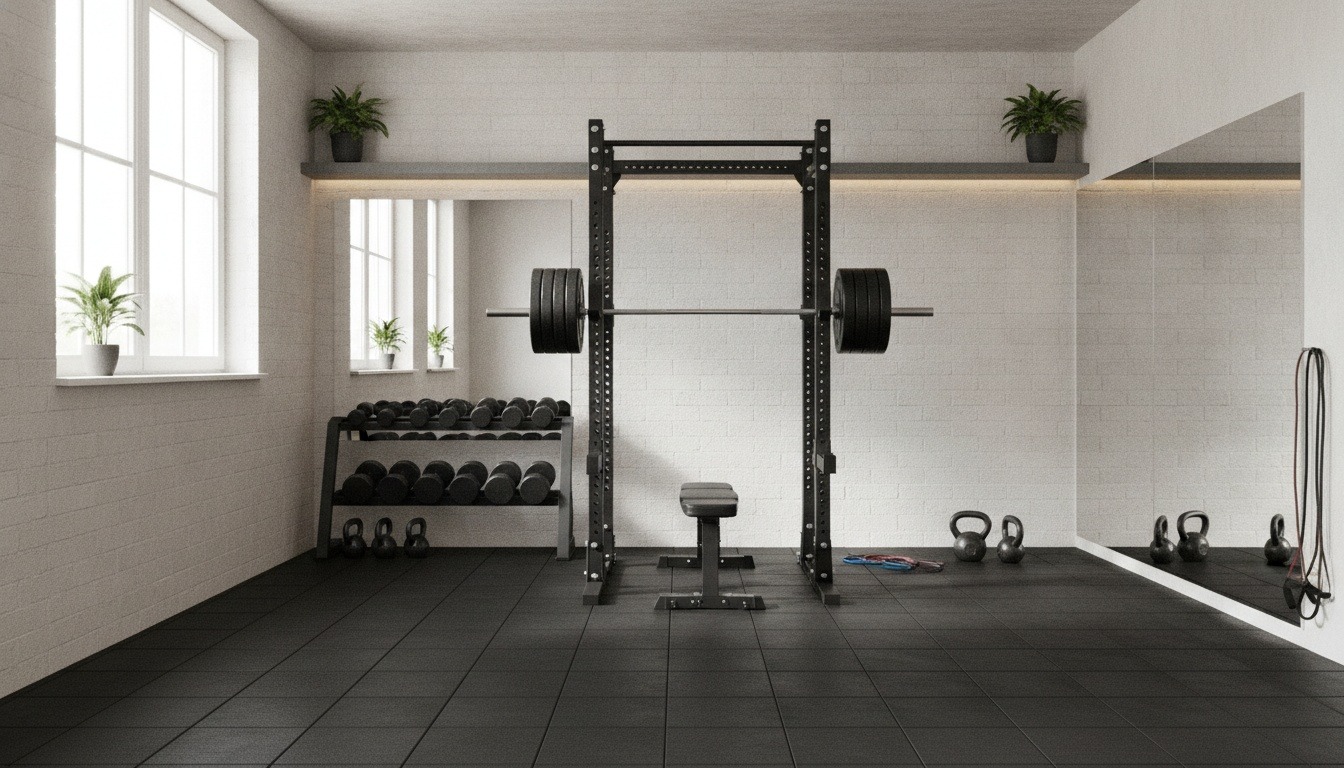
The thickness of rubber gym flooring depends on what drops, how often it drops, and what is underneath. As a practical rule, cardio equipment needs only moderate thickness, free weights require more, and repeated barbell drops call for a dedicated solution, often more than a single thick layer. Thickness is only one of three factors: density and subfloor quality matter just as much.
In this guide you will find a chart by training zone, the checks to carry out before ordering, and the installation steps, for both a commercial gym and a garage gym. The values are indicative: always refer to the technical data sheet and the manufacturer's instructions for each product.
If you want to explore the theory of thickness and density in more depth, you will find details in other articles on our blog, which we point to at the relevant places. Here the goal is to help you decide and reach installation without mistakes.
In this article
What really matters beyond thickness?
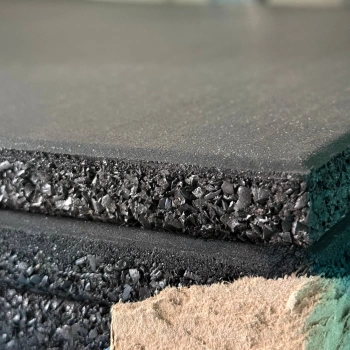
Thickness alone guarantees nothing. At equal thickness, a denser material resists concentrated loads better, such as the foot of a rack or a heavy machine, while a softer one absorbs more impact but may give way under support points.
Before choosing, clarify three things:
- What load falls or rests on the floor: plates, dumbbells, barbell, heavy machines.
- How often it happens: a dumbbell set down now and then is very different from dozens of drops per session.
- Who uses the area: experienced, independent users or general members, with a higher risk of accidental falls.
For a wider comparison of thickness and density, read our guide to rubber flooring thickness and density, and for an overview of the gym as a whole, see what thickness a gym floor should have.
What thickness for each gym zone?
The table below is an orientation guide, not a prescription. Actual performance depends on the product, its density and the subfloor: always check the product data sheet.
| Zone | Indicative thickness | Density/rubber type | Usage notes |
|---|
| Cardio (treadmills, ellipticals, bikes) | Moderate, usually 1 cm or slightly more | Compact, anti-slip | Stability and noise and vibration reduction matter most |
| Selectorized machines and walkways | Medium, about 1-1.5 cm | Dense, to avoid marks under feet | Concentrated static load: choose a compact material |
| Free weights (dumbbells, benches, racks) | About 1.5-2 cm | Dense and impact-resistant | Protects the floor beneath from dropped dumbbells and plates |
| Cross training and functional | At least 2 cm, often more | High density | Consider how the weights are loaded and unloaded |
| Barbell drop area | Dedicated solution (platform or multiple layers) | High density | With bumper plates and repeated drops, a standard layer may not be enough |
If your business focuses on cross training, see how to choose the right thickness for barbell drops: there you will find the full reasoning that we have kept deliberately brief here.
When a deadlift platform is better than more thickness
If drops are concentrated in one or two spots, a dedicated deadlift platform is often the better choice, with standard flooring for the rest of the room. It costs less than bringing the whole room up to a high thickness and protects exactly where it is needed.
Garage gym: what is different from a commercial gym?
In a garage you usually have fewer users, but high concentrated loads in a small area. Concrete is hard and often uneven, so rubber flooring here has a dual role: it protects the plates and the slab, and it makes the surface more comfortable and less cold.
A practical rule: only cover the area you really need, namely the rack and bench zone, the cardio zone and a margin of movement around them. For these areas, a rubber tile works well, as you can install it yourself and replace individual tiles.
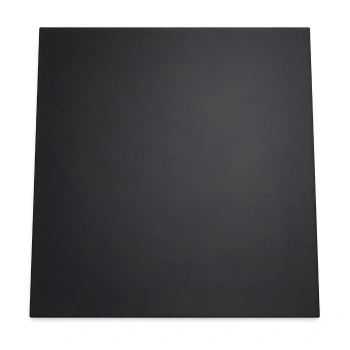
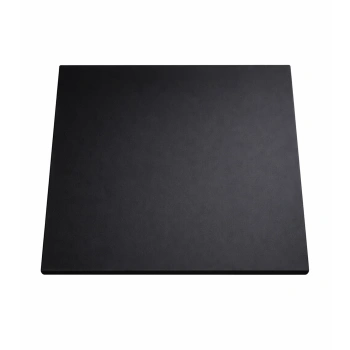
Among the available products, for example, the professional 50x50x2 cm tile suits lifting zones, while the 1x1 m, 1.5 cm fine-grain anti-slip tile can serve less stressed areas. Check availability and specifications on the product page.
If you have a limited budget and a secondary area to cover, you might also consider the damaged rubber flooring in various sizes: these are used or defective pieces, suitable for uses where appearance matters less. Always check condition and sizes on the product page.
What should the subfloor be like?
Rubber flooring does not correct a faulty subfloor. Before ordering, check these points:
- Flatness: no obvious dips or steps, otherwise the joints will lift.
- Cleanliness: cement dust, oil and residues must be removed.
- Moisture: a damp subfloor can cause adhesion problems and odours; if in doubt, ask a technician.
- Cracks and joints: repair them, or consult a professional before installation.
- Level changes and thresholds: transition pieces are needed, such as the custom rubber ramp, to prevent trips.
How to install rubber gym flooring?
The procedure varies by product: follow the manufacturer's instructions. As a general outline:
- Measure the area and add a margin for cutting.
- Prepare the subfloor: clean, level, and confirm it is dry.
- Acclimatise the material in the room, as the manufacturer specifies.
- Start from a corner or a reference line, checking alignment.
- Lay the tiles or unroll the roll, following any interlocking system or adhesive recommendations.
- Cut the edges with suitable tools and finish the transitions.
- Check the joints before loading equipment, then position racks and machines.
If you are unsure whether to choose tiles or a roll, read rubber flooring in rolls or tiles. In general, you can also explore rubber rolls for large areas with few seams.
Which mistakes cost you twice?
- Choosing thickness based only on price, without considering drops and concentrated loads.
- Installing over a dirty or uneven subfloor.
- Using the same flooring everywhere, instead of reinforcing only the lifting area.
- Forgetting transition pieces at thresholds and level changes.
- Ordering without checking the density and resistance data on the technical sheet.
On safety, remember that suitable flooring reduces certain risks but does not eliminate them: qualified instructors and correct use of equipment remain essential.
Frequently asked questions
Is 1 cm of rubber enough for a garage gym?
For light loads and cardio zones, it can be enough. If you use a barbell and plates with floor drops, a greater thickness or a dedicated platform is usually recommended.
Does thickness guarantee protection from drops?
No. Density, type of plates, drop height and drop frequency also matter. For intensive use, consider a platform and follow the manufacturer's guidance.
Can rubber flooring be installed without glue?
It depends on the product and the context. Some tiles can be laid loose, but in high-stress areas fixing may be needed: follow the manufacturer's instructions.
Tiles or roll: which is better?
Tiles are easy to install and replace piece by piece; a roll reduces seams over large areas. The choice depends on area, budget and maintenance.
What if the flooring is already damaged?
If the damage is localised, you can replace only the affected parts; first check that the subfloor is sound.
Conclusion
Choose thickness based on what happens on the floor: cardio and machines need stability, free weights need more protection, and repeated drops need a dedicated solution. Then check the subfloor and install methodically.
To compare the available solutions, browse the rubber flooring category. For a gym with specific requirements or a project that needs sizing, you can also request a consultation or a quote from Donatif.


 Budgets
 Dumbers
 Discs
 Benches
 Racks and Rigs
 Weights Holders
 Isotonic machines
 Calisthenics
 Cardio
 Kettlebells
 Flooring
 Gym Set
 Accessories
 Combat
 ARTI MARZIALI
 CONTAINER GYM
 Tug-Of-War
 Used Gym Equipment
 PILATES MACCHINARI
 GINNASTICA ARTISTICA
 CAMPI DA PADEL
 Prodotti in Pronta Consegna
 Informazioni
 IRONMAN
 Gift Card