Black Friday is an interesting opportunity to improve your home gym, especially if you already train regularly and know the possibilities of your equipment well. However, when you own a well-established setup, adding a new product does not automatically mean training better. The real advantage comes from the ability to identify what is currently limiting your routine and choose an investment capable of solving that problem.
Taking advantage of black friday home gym therefore requires a different approach compared to setting up a gym from scratch. You do not necessarily have to buy more equipment, but rather figure out whether your next improvement should concern load progression, movement safety, available surface area, or space organization. A targeted choice can make even the equipment you have been using for years more functional.
In this guide, you will discover how to analyze your home gym, recognize the main bottlenecks, and compare three concrete improvement scenarios. The goal is to arrive at the promotions with a precise priority, checking compatibility, dimensions, and real utility before proceeding with the purchase.
How to evaluate your home gym before Black Friday
Before browsing the promotions, look at the gym you have already built. A home gym used regularly contains valuable information about your needs: the exercises you perform most often, the equipment you use daily, and the items that remain unused. Analyzing these habits allows you to distinguish a truly necessary improvement from a purchase motivated solely by curiosity.
The starting point is a simple but accurate inventory. Record dumbbells, barbells, weight plates, benches, supports, and accessories, indicating the main characteristics for each element. Also note any potential limits: maximum available load, insufficient adjustments, storage difficulties, or the condition of the training surface.
This initial snapshot is crucial because every new component must integrate with what you already own. Buying a barbell without checking compatible plates, for example, could lead to additional expenses. Similarly, choosing a bulky structure without measuring the environment risks reducing your freedom of movement.
Creating an inventory of existing equipment
Divide your equipment into functional categories: loading equipment, exercise supports, protective surfaces, and organization systems. For each category, identify what you use, what is missing, and what could be improved. If you already own an adequate barbell but few plates, for example, the problem might be load availability rather than the quality of the barbell.
Also consider the frequency of use. A component used four times a week may have a higher priority than an accessory intended for an occasional exercise. This criterion helps you focus your budget on the elements that most impact the continuity of your training.
Measuring the truly usable space
Measure the length, width, and height of the room, but do not stop at the total surface area. You must consider the space needed to perform movements, load equipment, reach supports, and store materials. Doors, windows, furniture, and fixed obstacles can limit the installation of products that are seemingly compatible with the room's dimensions.
A practical check consists of marking out the expected footprint of new equipment on the floor and simulating your usual movements. This operation allows you to identify interferences before purchasing and to understand whether the desired improvement also requires a different layout for the gym.
Identifying the true limit of your workouts
The most important step consists of distinguishing what you want to buy from what is concretely preventing you from training the way you would like. An interesting tool can expand the theoretical possibilities of your home gym, but not necessarily solve the difficulties you encounter during sessions.
To identify the main problem, think back to the last few weeks of training. Did you have to modify exercises because the necessary load was missing? Did you avoid certain movements for fear of damaging the floor? Did you waste time moving equipment before starting a set? These episodes represent more reliable indicators than a simple desire for novelty.
The fundamental criterion for an effective upgrade home gym is the ability to remove a recurring obstacle. If a problem occurs frequently and affects a major part of the program, solving it can have a higher value than purchasing a more expensive but less used product.
Five questions to identify your priority
Ask yourself which exercise you would like to perform better, which component forces you to modify your program, how much time you waste preparing for sessions, which limits depend on space, and which purchases could make the already present equipment more useful. Answering concretely allows you to turn a generic preference into a verifiable need.
If multiple problems emerge, assign them a priority considering frequency, impact on training, and ease of solution. It is not necessary to intervene on everything at once. Often, a single well-chosen change produces practical benefits across several exercises.
Distinguishing a necessity from an interesting purchase
A good method consists of imagining buying the product at full price. If you would still consider it useful because it solves a specific limit, it probably deserves attention. If, on the other hand, your interest depends almost exclusively on the discount percentage, it might be a less urgent choice.
Also evaluate whether you can achieve the same result by modifying your existing setup. Repositioning a bench, making better use of supports, or revising the distribution of loads could solve some problems without requiring an immediate investment.
Scenario 1: improving load progression
Imagine training regularly with dumbbells and a barbell, following a strength or hypertrophy program. Your equipment works properly, but you have reached the limit of available weights or the possible increments are too large to comfortably manage progression. In this case, purchasing a new machine might be less useful than expanding your supply of loads.
Progression does not depend solely on increasing weight: you can also intervene on repetitions, volume, technique, and other programming variables. However, when the available load becomes a concrete constraint, adding plates or choosing dumbbells with more suitable adjustments can give you greater flexibility.
During Black Friday, therefore, evaluate equipment based on the exercises you perform and the loads you plan to use. The goal is not to buy the largest possible number of kilograms, but to have increments consistent with your level and the structure of your program.
When to choose adjustable dumbbells
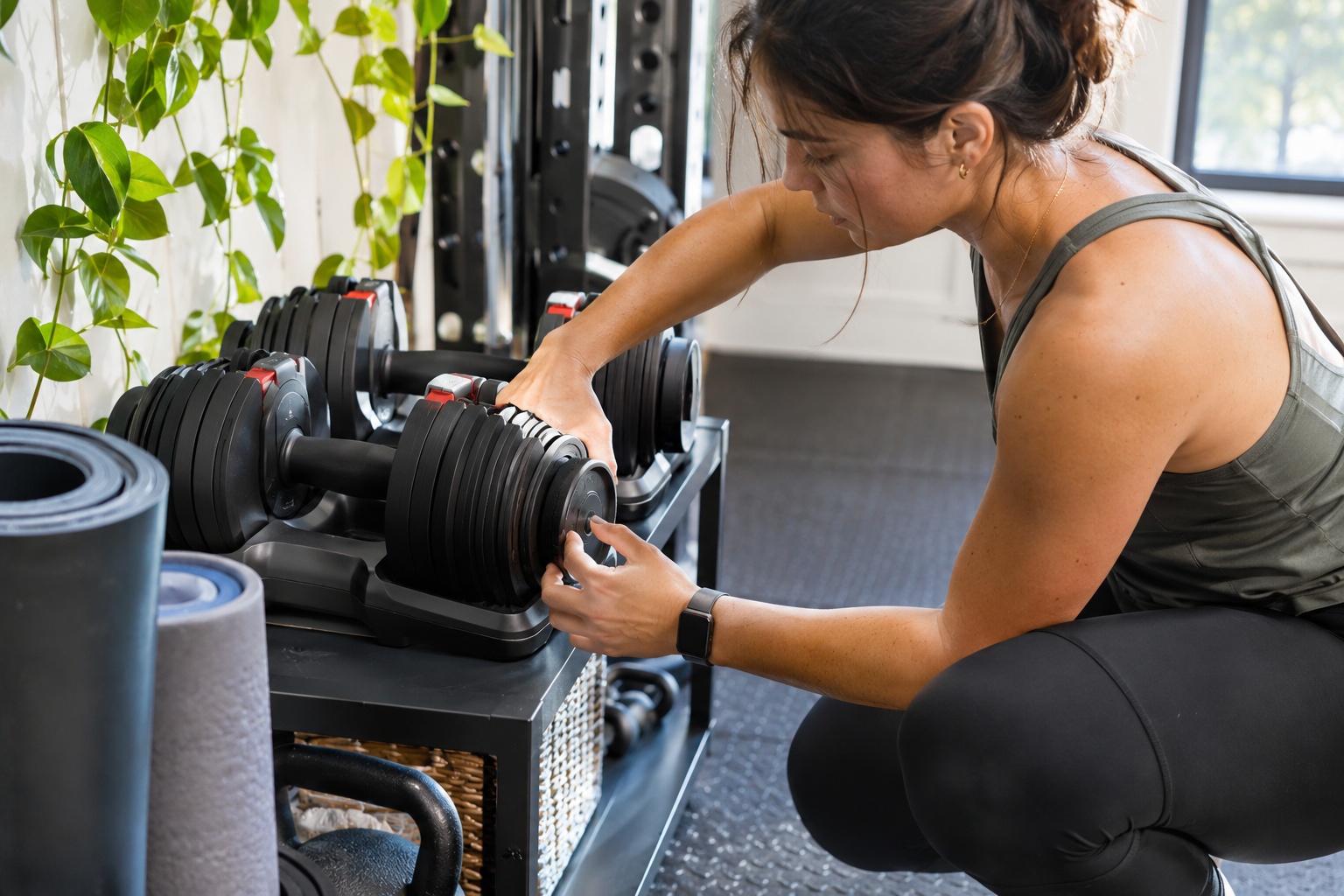
Adjustable dumbbells can represent an interesting solution if you use numerous different loads and have limited space. They allow you to adapt the weight to different exercises without necessarily having to store many separate pairs. Before purchasing, check the adjustment range, available increments, dimensions, and locking system.
Also consider the practicality of changing weights. If your workout involves frequent variations between sets, a quick system can be particularly convenient. If, on the other hand, you predominantly use a few stable loads, completing your current setup with specific weights might be sufficient.
When to invest in plates or barbells
If you already own a barbell compatible with your program but have run out of available load, expanding your set of plates may be the most rational choice. Evaluate the hole diameter, compatibility with sleeves, usable loading space, and the presence of adequate fastening systems.
A new barbell becomes interesting, however, when the existing one presents functional limits compared to the exercises performed, the required characteristics, or the conditions of use. Before replacing it, compare the technical specifications and check whether the problem can be solved with a complementary component. When choosing the barbell equipment available on Donatif, always consider integration with the plates, supports, and workspace already present.
Scenario 2: improving surface area and safety
A second scenario concerns those who possess sufficient equipment to train, but use an unsuitable surface. Delicate floors, slippery coverings, or areas without protection can make certain operations less practical and increase the risk of environmental damage.
In this situation, adding more weights without intervening on the base support might not be the correct priority. A surface designed for sports use can improve space management and help protect the floor underneath, provided it is chosen in relation to the loads, modes of use, and environmental characteristics.
The home gym flooring must be evaluated as part of the equipment and not just as an aesthetic element. Material, thickness, stability, resistance, and ease of maintenance affect its suitability. No covering, however, guarantees complete protection against any impact or dropped weight.
Evaluating the surface based on exercises
For workouts involving bodyweight exercises, mobility, and moderate weights, requirements can be different compared to those of a station dedicated to barbells and heavy loads. Consider the pressure exerted by the equipment, the type of support required, and the possibility of accidental contact with the surface.
It is important to distinguish floor protection from the stability needed to train. Material that is too deformable might not be suitable for certain exercises, while material that is too rigid might offer insufficient protection for the context. The specifications declared by the manufacturer help identify intended applications.
Properly sizing the protected area
Before purchasing tiles or rolls, measure the area actually affected by training. Consider not only the footprint of the equipment, but also the space needed to enter and exit stations, change plates, and move without obstacles.
A modular solution can be interesting when you want to intervene initially on a specific area and expand coverage later. However, check the compatibility between elements, installation methods, and the potential need for additional protections. If you train in an apartment, remember that the reduction of noise and vibrations also depends on the building's structure and not just the chosen covering.
Scenario 3: recovering space and order
The third scenario concerns a home gym that already has adequate equipment, but where every session requires continuous moving around. Plates resting in different spots, dumbbells that are hard to reach, and accessories without a stable placement can make the environment less functional.
In these cases, the problem is not necessarily a lack of equipment. You might need to better organize what you already own. An appropriate storage system can free up usable surface area, make exercise preparation easier, and promote orderly training management.
To improve your home gym, therefore, also consider the layout of elements. A compact but well-organized environment can be more practical than a larger room where equipment continually interferes with your movements.
Choosing supports and storage systems
Plate trees, dumbbell racks, and dedicated supports allow you to assign a stable position to different pieces of equipment. The choice must start from the total weight to be supported, product dimensions, and manufacturer instructions regarding weight capacity and installation methods.
Before purchasing a support, check how much space it occupies and how you will access the equipment during the session. A capacious system placed in an inconvenient position might not solve the initial problem. Shelf height and ease of retrieval also deserve attention.
Organizing the gym into functional zones
Ideally divide the room into zones dedicated to main exercises, load storage, and session preparation. Physical separations are not strictly necessary: it is often enough to arrange elements so that the most frequent operations require minimal movement.
If you use an adjustable bench, for example, make sure you can move and position it without first having to remove plates or accessories. If you alternate exercises with dumbbells and barbells, organize the loads to keep both stations accessible. This approach enhances existing equipment and reduces the need for additional purchases.
Verifying compatibility and technical characteristics
Once you have identified your priority category, you must verify that the desired product is compatible with your home gym. This is a decisive phase because a technically sound tool can turn out to be unsuitable when dimensions, fastening systems, or construction features do not match your existing equipment.
Compatibility concerns several aspects: physical dimensions, load capacity, materials, necessary accessories, and installation conditions. For products intended to support heavy weights, always check manufacturer instructions and avoid relying solely on appearance or commercial photographs.
Technical data sheets are the main reference for comparing different products. When information is unavailable, it is preferable to request it before purchasing rather than assuming two seemingly similar components can be used together.
Checking diameters, weight capacities, and fastening systems
In the case of barbells and plates, check nominal measurements and expected tolerances, as well as sleeve length and locking system. For benches, racks, and supports, consider declared weight capacities, conditions of use, and any limitations indicated by the manufacturer.
Do not use nominal capacity alone as a universal guarantee of suitability. Actual conditions of use, load distribution, and assembly methods can affect safety. Follow the instructions provided for each product and do not improvise structural adaptations.
Checking dimensions and operating space
Dimensions reported in spec sheets generally describe product footprints, but do not always represent the entire space needed to use them. A barbell requires lateral space for loading, while an adjustable bench needs clearance for different configurations.
Also evaluate room access and the path needed to bring the equipment inside. Narrow doors, stairs, and tight hallways can complicate moving bulky products. Checking these aspects before ordering reduces the risk of buying something you cannot install correctly.
How to evaluate offers without impulse buying
Black Friday focuses attention on prices, but an interesting discount is not enough to make a purchase worthwhile. To compare home gym equipment on offer, consider the actual cost, technical features, accessory expenses, and above all the product's ability to solve the identified problem.
A promotion may turn out to be less advantageous if it concerns redundant equipment or requires additional components to be used. Conversely, a product with a more modest discount might represent a better choice when it directly completes your setup and gets used frequently.
To maintain an objective criterion, define a budget range and essential characteristics before promotions begin. This way, you can evaluate available opportunities without constantly changing priorities based on displayed offers.
Comparing price with utility value
A useful criterion consists of estimating how many times you will use the new component over the course of the year. If a 120-euro accessory is used 150 times, the initial cost amounts to 0.80 euros per use in the first year, without considering maintenance and other costs. This is an indicative estimate, not a complete measure of value, but it helps reason beyond the discount.
Also compare the final price including any shipping costs, essential accessories, and installation. Check actually published commercial conditions and do not take for granted that every product is included in seasonal promotions.
Avoiding the novelty effect and price anchoring
A newly discovered product can seem particularly desirable because it introduces a new possibility. However, if it does not address a concrete need, it risks being used rarely. Even a very high crossed-out price can influence the perception of a deal without proving the value of the offer on its own.
Also consider past purchases without feeling obligated to keep every component or build new expenses around previous decisions. If a piece of equipment is no longer consistent with your needs, rationally evaluate how to manage it. The priority remains building a gym functional to your current program, not justifying every investment made in the past.
Building a progressive upgrade plan
When you have identified the main limit, you can organize an improvement path that takes into account present and foreseeable needs. This does not necessarily mean scheduling many purchases, but understanding which interventions are independent and which require a precise sequence.
If you want to increase loads but the surface is unsuitable for intended usage methods, it might be appropriate to address the workstation first. If, on the other hand, you already have a stable and protected area, completing your plate supply might become the immediate priority.
A progressive plan allows you to power up your home gym without needlessly replacing what works. Whenever possible, every intervention should preserve compatibility with existing equipment and leave room for any future needs.
Establishing a single purchase priority
Write a sentence describing the limit to be solved and the expected improvement. For example: I need smaller load increments to better manage progression with dumbbells. Or: I need to protect the workstation surface before using heavier equipment. A concrete formulation makes it easier to evaluate alternatives.
Then compare two or three solutions belonging to the identified category. If none meet technical requirements or fit within budget, postponing the purchase is a sensible choice. It is not necessary to exploit a promotion at all costs.
Measuring utility after the upgrade
After introducing the new component, observe how your routine changes over a few weeks. Verify whether you can execute planned exercises, whether session preparation has become simpler, and whether the initial problem has actually been reduced.
This check helps you distinguish practical benefit from initial enthusiasm. You can note modifications in load management, preparation times, or equipment layout in your training diary. The observations gathered will be useful for deciding on any subsequent improvements.
Turning Black Friday into a targeted investment
The value of a home gym purchase does not depend solely on product quality or discount percentage. It depends above all on the relationship between what you own, the problem you want to solve, and the frequency with which you will use the new equipment. A complementary component can be more useful than a brand-new machine when it eliminates a recurring limit.
Before choosing, return to the three main scenarios. If the problem concerns progression, compare dumbbells, plates, and barbells in relation to available loads. If it concerns the surface, evaluate flooring appropriate for your usage conditions. If it concerns organization, consider supports and storage systems capable of making existing equipment more accessible. Each scenario requires specific checks, and no single product is universally a top priority.
To make a conscious economic decision, consider the overall cost of the intervention and not just the price of the main item. A set of plates might require adequate supports, while a new workstation might involve changes to the room's layout. Including these needs in your budget allows you to compare genuinely usable alternatives.
Donatif proposals dedicated to home training can be evaluated starting from the technical characteristics and needs of your gym, checking the commercial conditions available at the time of purchase. Black Friday thus becomes an opportunity to more carefully select a useful component, without assuming discounts on specific products or buying equipment simply because it is temporarily convenient.
Before confirming your order, make sure you can answer three questions: what concrete limit will this purchase eliminate, how will it integrate with the tools you already own, and how often do you plan to use it? If the answers are clear and supported by technical checks, you will have identified an investment consistent with your training journey and the space you have built over time.


 Budgets
 Dumbers
 Discs
 Benches
 Racks and Rigs
 Weights Holders
 Isotonic machines
 Calisthenics
 Cardio
 Kettlebells
 Flooring
 Gym Set
 Accessories
 Combat
 ARTI MARZIALI
 CONTAINER GYM
 Tug-Of-War
 Used Gym Equipment
 PILATES MACCHINARI
 GINNASTICA ARTISTICA
 CAMPI DA PADEL
 Prodotti in Pronta Consegna
 Informazioni
 IRONMAN
 Gift Card