
Trolley
You have no items in your shopping cart

 Budgets
 Dumbers
 Discs
Discs
 Benches
 Racks and Rigs
 Weights Holders
 Isotonic machines
 Calisthenics
 Cardio
 Kettlebells
 Flooring
 Gym Set
 Accessories
 Combat
 ARTI MARZIALI
 CONTAINER GYM
 Tug-Of-War
 Used Gym Equipment
 PILATES MACCHINARI
 GINNASTICA ARTISTICA
 CAMPI DA PADEL
 Prodotti in Pronta Consegna
 Informazioni
 IRONMAN
 Gift Card
- Donatif
- Sports products
- 0 I like it
- 1604 Views
- 0 comments
- gym flooring, safety flooring, gym safety, shock-absorbing materials
READING TIME: 5 MINUTES ➤➤
The Best Resistance Bands for Home Workouts: A Buying Guide
Resistance bands are among the most versatile tools for training at home. They take up very little space, allow for a wide variety of exercises, and make it easy to adjust workout intensity to different fitness levels. For this reason, the market offers a wide range of options that differ significantly in build quality, included accessories, and long-term durability.
Anyone approaching this type of equipment often faces the same question: what are the best resistance bands for home use, and how can you determine whether a product truly offers good value for money? The answer depends on several factors that help distinguish a reliable, complete kit from one that may prove impractical or short-lived.
How to choose the right resistance bands for your needs
Budget, goals, and training frequency
Choosing a resistance band set should start with understanding how you plan to use it. Someone training two or three times per week to stay fit will have different needs from someone building a complete home gym. Defining your goals helps avoid buying equipment that is either excessive or too limited for long-term use.
A useful criterion is to evaluate the relationship between training frequency and kit completeness. A set offering multiple resistance levels can support your progress over time, increasing the value of the initial investment while reducing the need for additional purchases.
Why price alone does not determine quality
Many people automatically associate a higher price with better quality. In reality, price is only one factor to consider. Some products include useful accessories, more durable materials, or safer anchoring systems, while others simply cost more without providing meaningful benefits.
When comparing products, it is more effective to evaluate the overall package, build quality, and range of resistance levels available. This approach helps identify the most interesting resistance bands with a strong value-for-money ratio without focusing solely on cost.
The main types of resistance bands for home fitness
Closed loop bands
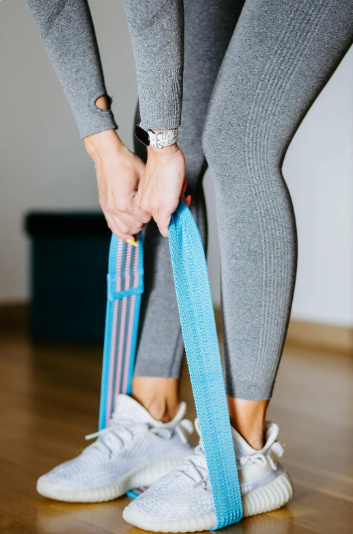
Loop bands are continuous elastic bands particularly appreciated for mobility exercises, muscle activation, and lower-body strengthening. Their simplicity makes them easy to use, even in limited spaces.
Because they are compact and versatile, they are ideal for anyone looking for space-saving yet effective training equipment. They can be easily integrated into workout programs focused on improving strength and stability.
Resistance bands with handles and adjustable resistance
This category is often chosen by users who want to replicate movements commonly performed with cable machines. Handles improve comfort during exercises and provide a more natural grip.
Modular systems with multiple resistance levels also make it possible to increase the load progressively. For many users, they represent one of the most complete solutions for multifunctional home training.
Mini bands for activation and targeted work
Mini bands are primarily designed for muscle activation and focused work on glutes, shoulders, and stabilizing muscles. Despite their simplicity, they can add variety and intensity to many workout programs.
Their usefulness becomes particularly evident during warm-ups and preparation phases before the main workout. A complete kit often includes at least one set of mini bands with different resistance levels.
Which resistance level to choose
Resistance bands for beginners
Beginners should generally choose light to medium resistance levels. This allows them to learn proper exercise technique and gradually develop movement control.
Beginner resistance bands encourage safer progression and help users build confidence with the equipment without excessive difficulty.
Options for intermediate users
Users with some training experience generally benefit from kits that include several resistance levels. This makes it possible to adapt the load to different muscle groups and specific goals.
The availability of different resistance levels increases equipment versatility and allows for more effective medium-term programming.
High resistance for advanced training
Advanced users often look for bands with greater tension and particularly robust construction. In these cases, material quality becomes even more important.
High resistance must always be supported by reliable construction and stability during use. For this reason, it is important to carefully check the product’s technical specifications.
Materials and features that affect durability
Natural latex and synthetic materials
The composition of a resistance band directly affects its elasticity, its ability to maintain tension over time, and its resistance to wear. Higher-quality materials generally provide smoother and more consistent performance during movement.
There is no universally best solution, but it is essential to assess manufacturing quality and resistance consistency throughout the full extension of the band.
Finishes, stitching, and stress points
Areas exposed to the greatest tension deserve particular attention. Hooks, stitching, and connection points are often the most stressed components during training.
A well-made product features quality finishes, solid connections, and construction designed to withstand repeated use. These details contribute to the overall safety of the equipment.
Accessories that make a kit more complete
Door anchors and attachment points
Anchors significantly expand training possibilities. They allow users to perform movements that resemble those carried out with larger equipment typically found in traditional gyms.
For those training at home, they are often among the elements that most increase the kit’s versatility, making it possible to work effectively on several muscle groups.
Handles, carrying cases, and included supports
Handles improve comfort, while carrying cases make it easier to transport and organize the equipment. These elements also contribute to the overall value of the product.
When evaluating a set, it is useful to consider the real usefulness of the included accessories and their impact on everyday use.
How to compare two resistance band sets objectively
Technical features that really matter
An effective comparison should consider the number of resistance levels available, material quality, included accessories, and the possibility of progressing over time. These factors provide more reliable guidance than generic descriptions or marketing claims.
Evaluating concrete parameters helps simplify the decision-making process and identify the product that best matches your needs.
Practical tests to assess quality
The smoothness of extension, the feeling of stability during use, and the perceived quality of the connections are aspects that help reveal a product’s construction level.
Observing these details makes it easier to distinguish a kit designed to last from a solution that may show limitations after prolonged use.
An example of a balanced setup for most users
The ideal composition of a versatile kit
For many users, a set made up of several graduated resistance levels, removable handles, a door anchor, and a carrying case may be sufficient. This configuration allows a wide variety of exercises while taking up very little space.
The presence of different resistance levels also supports gradual progression, making the kit suitable for both beginners and more experienced users.
When it makes sense to invest in a more complete set
Anyone planning to use resistance bands frequently or replace part of their traditional gym equipment may benefit from a richer set. In these cases, kit completeness becomes a strategic factor.
A slightly higher investment can translate into greater versatility, comfort, and long-term durability.
What to check before making a final purchase
A checklist for a safer choice
Before purchasing, it is advisable to check for graduated resistance levels, reliable materials, genuinely useful accessories, and clear usage instructions. These aspects contribute to a more informed choice.
Careful evaluation helps reduce the risk of impulsive purchases and makes it easier to identify a solution that truly suits your training needs.
How to avoid unsatisfactory purchases
Focusing exclusively on price or generic promises can lead to disappointing results. It is better to adopt an approach based on objective and comparable criteria.
By carefully analyzing type, resistance, materials, and kit completeness, it becomes easier to choose the best resistance bands for home workouts and invest in equipment that delivers real value over time.
Comments (0)