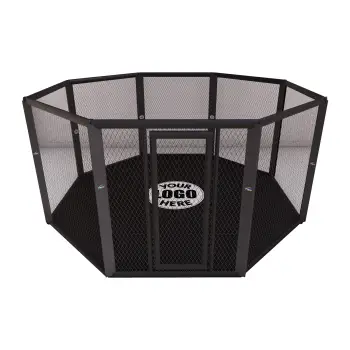
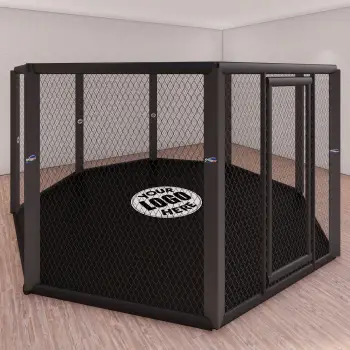
The maintenance of an MMA cage encompasses all the checks necessary to keep the structure efficient, safe, and ready for daily use. A schedule of periodic checks allows you to monitor the mesh, structure, fastening systems, padding, mechanical connections, and training surface, promptly identifying any anomalies before they require more complex interventions.
In a professional gym, maintenance should not be considered an occasional activity but an integral part of facility management. The intensity of use, number of practitioners, and frequency of training sessions directly affect the need to perform regular and documented checks.
Each manufacturer may provide different procedures based on the installed model. For this reason, all operations must be carried out following the technical manual of the structure and using exclusively compatible spare parts and components when necessary.
How to perform maintenance on an MMA cage?
Maintenance of the MMA cage consists of performing periodic checks on the structure, mesh, fasteners, padding, tightness, and flooring, following the manufacturer's instructions. Inspections should be documented, especially in professional facilities, so as to plan interventions and maintain a constant level of equipment efficiency.
A standardized procedure makes checks repeatable and facilitates comparison between inspections carried out over time.
Any anomaly should be resolved before using the structure for training or combat sessions.
Set up a schedule
Establishing daily checks, periodic inspections, and thorough verifications allows you to organize maintenance in an orderly manner.
Log interventions
Recording checks, replacements, and maintenance facilitates the technical management of the structure throughout its lifecycle.
How to organize maintenance correctly?
Preventive maintenance should be planned considering the volume of gym usage and the instructions provided by the manufacturer.
It is useful to distinguish between quick checks performed before daily activities and more thorough inspections carried out according to a pre-established schedule.
To complete a structure dedicated to combat sports, you can consult the range of combat sports equipment.
Daily checks
Before use, it is advisable to visually inspect the structure, mesh, and protections, checking that there are no obvious anomalies.
Scheduled maintenance
Thorough inspections allow you to check less accessible components and plan any necessary interventions.
Which components must be checked?
Inspection should cover all elements subject to wear during normal use of the structure.
Mesh, fastening systems, mechanical connections, structural elements, and protections represent the main areas to monitor.
Even the panels and protective surfaces should be kept in good condition through regular checks.
| Component |
Check |
Objective |
| Structure |
Visual inspection |
Identify anomalies |
| Mesh |
Integrity and tension |
Verify general condition |
| Tightness |
Connection check |
Maintain stability |
| Padding |
Wear and fastening |
Ensure protection |
| Flooring |
Cleaning and conditions |
Promote correct use |
Mesh inspection
The mesh should be intact, correctly fastened, and free of obvious deformations.
Protection inspection
The padding must maintain its position, integrity, and the characteristics provided by the manufacturer.
What practical criteria to follow?
Each check should be performed following the same procedure every time to make results comparable over time.
A checklist helps the assigned personnel verify all elements without forgetting important components.
Check frequencies must be adapted to the intensity of use of the structure.
Use a checklist
A standardized list makes maintenance more organized and easily documentable.
Adapt frequencies
The higher the number of training sessions held, the greater the attention that should be dedicated to scheduled checks.
What errors to avoid?
One of the most common errors is limiting oneself to cleaning alone while neglecting the inspection of structural components.
It is equally important to avoid improvised repairs or the use of components not foreseen by the manufacturer.
Also, postponing interventions after identifying an anomaly can increase the risk of more extensive damage.
Confusing cleaning and maintenance
Cleaning the structure does not replace the technical checks required by the maintenance plan.
Making unauthorized modifications
Any intervention should respect the indications contained in the manufacturer's technical documentation.
How to perform inspections safely?
Before any intervention, it is advisable to make sure the area is clear and that the structure is not being used during control operations.
Operators should follow the procedures provided by the manufacturer and use the tools indicated for the checks.
At the end of maintenance, it is appropriate to perform a final check before putting the equipment back into service.
Before reopening
A concluding check allows you to verify that all components are correctly installed.
Assigned personnel
Entrusting checks to trained personnel helps maintain uniform maintenance procedures.
Manuals and technical documentation
The manufacturer's manual is the main reference for check frequency, inspection methods, and component replacement.
It is advisable to also keep the maintenance log, the list of installed spare parts, and all documentation related to the structure.
When applicable, the manufacturer's instructions and current regulations regarding sports equipment must be respected.
Follow the manual
Each model may require different procedures that must be respected during all maintenance operations.
Keep documentation
Manuals and logs facilitate facility management and the planning of future interventions.
FAQ
Is cleaning sufficient as maintenance?
No. Cleaning represents only a part of maintenance and must be accompanied by technical checks of the structure.
Why use a checklist?
A checklist helps make checks complete, repeatable, and easily documentable.
Is it possible to use any spare part?
It is advisable to use exclusively compatible components and adhere to the manufacturer's instructions.
Why maintenance represents an investment
Scheduled maintenance allows you to constantly monitor the state of the MMA cage, plan interventions before components show significant deterioration, and keep the structure ready for daily use. Basing each check on the manufacturer's instructions, documenting interventions, and using standardized procedures contributes to more efficient long-term equipment management.


 Budgets
 Dumbers
 Discs
 Benches
 Racks and Rigs
 Weights Holders
 Isotonic machines
 Calisthenics
 Cardio
 Kettlebells
 Flooring
 Gym Set
 Accessories
 Combat
 ARTI MARZIALI
 CONTAINER GYM
 Tug-Of-War
 Used Gym Equipment
 PILATES MACCHINARI
 GINNASTICA ARTISTICA
 CAMPI DA PADEL
 Prodotti in Pronta Consegna
 Informazioni
 IRONMAN
 Gift Card