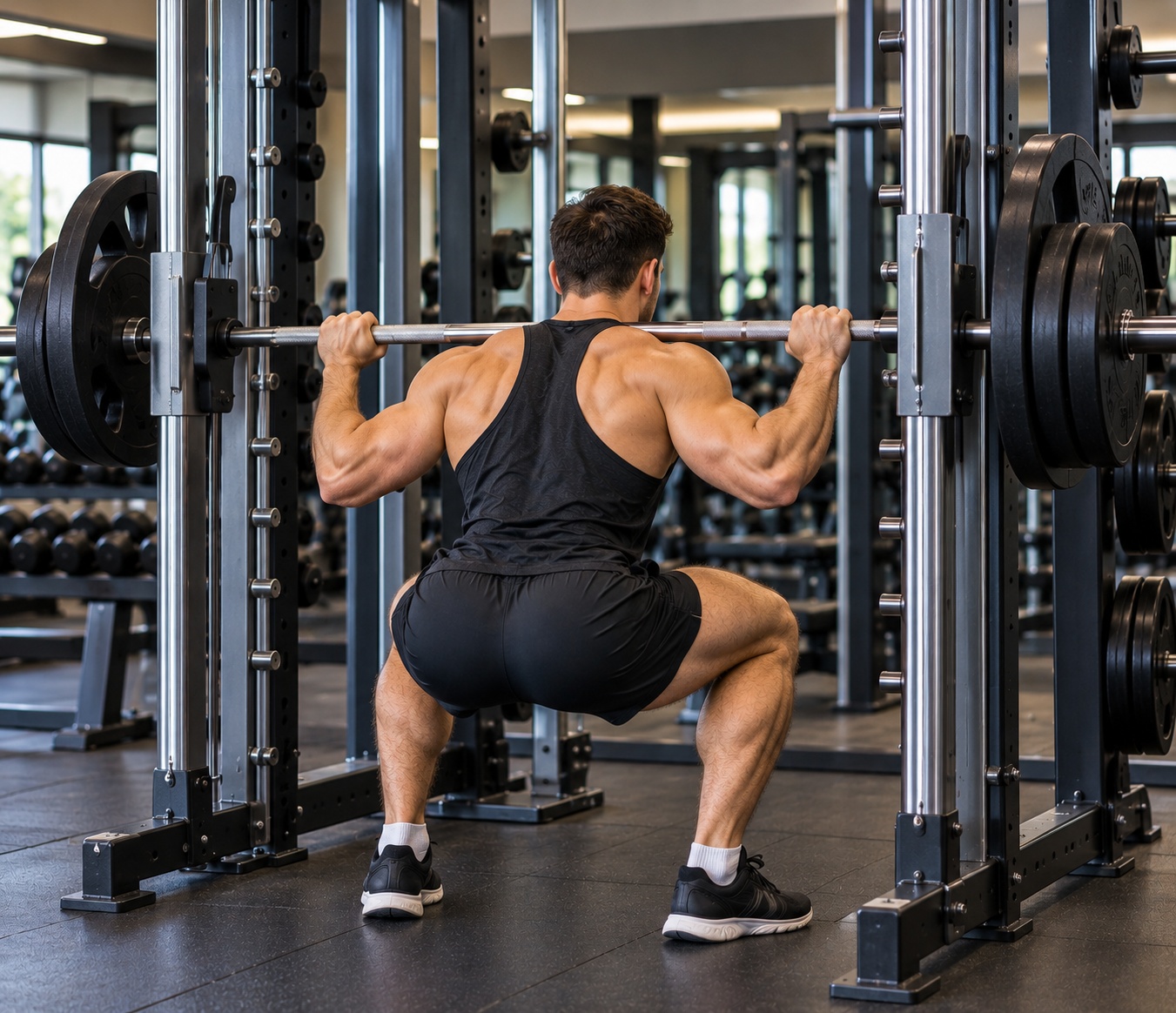
The smith machine is an isotonica machine widely used in bodybuilding thanks to the guided barbell that allows you to perform numerous exercises following a predefined trajectory. To obtain correct usage, it is essential to know how the machine works, check the adjustments before training and choose a model consistent with the expected volume of use.
The operational answer is simple: a smith machine intended for bodybuilding must offer smooth sliding, efficient safety systems, a stable structure and components designed for continuous use. The user must correctly adjust the stoppers and initial position, adapting the technique to the trajectory of the guides.
This guide proposes verifiable criteria to understand when to use the smith machine in bodybuilding, what characteristics to evaluate and what errors to avoid during training without overlapping with the in-depth insights dedicated to the general operation of the machine.
Is the smith machine suitable for bodybuilding?
The smith machine can be used in bodybuilding to perform exercises with a guided trajectory using a barbell that slides along mechanical guides.
The choice depends on the training objectives, the organization of the weight room and the technical characteristics of the available machine.
For correct usage, it is necessary to check the adjustment of the safety devices, the smoothness of the sliding and the position of the body relative to the guides.
What is the main criterion?
Always evaluate whether the guided trajectory is consistent with the programmed exercise and the required technique.
What checks to perform?
Guides, hooking systems, safety stoppers and the stability of the structure must be verified before training.
What is a smith machine used in bodybuilding?
In bodybuilding, the smith machine is used as an isotonic machine to perform exercises with a controlled barbell path.
The movement follows the trajectory imposed by the guides and therefore requires a technique consistent with the construction characteristics of the machine.
This configuration makes correct adjustment of the equipment essential before starting each set.
The role of the guided barbell
The guide system limits the lateral movements of the barbell while maintaining a constant trajectory during execution.
Safety systems
The hooking mechanisms and adjustable stoppers constitute essential elements for the correct usage of the machine.
How to use the smith machine correctly in bodybuilding?
Each exercise must begin with the adjustment of the safety devices and with a check of the barbell sliding.
The initial position of the body must be adapted to the trajectory of the guides, avoiding automatically replicating the technique used with a free barbell.
Throughout the execution, it is important to maintain control of the movement and use loads appropriate to one's level of preparation.
Adjust the machine correctly
Stoppers, bench and any accessories must be set before the start of the set.
Control the movement
The barbell must move uniformly without sticking or abnormal oscillations along the entire stroke.
What requirements must a smith machine for bodybuilding have?
A machine intended for intensive use should feature a rigid structure, precise guides and easily adjustable safety systems.
It is also useful to evaluate the quality of the workmanship, the availability of technical documentation and the simplicity of maintenance operations.
For professional use, the availability of spare parts and technical assistance are also important.
Quality of the guides
The guides must guarantee regular sliding along the entire stroke without abnormal friction.
Ease of maintenance
Accessibility to the main components facilitates control and scheduled maintenance operations.
Which exercises are performed most frequently?
In bodybuilding, the smith machine is used for exercises such as squats, bench press, lunges, military press, calf raises and specific variants adapted to the guided trajectory.
Each exercise requires dedicated adjustments of the machine and an initial position consistent with the path of the barbell.
The choice of exercises depends on the training programming and individual objectives.
Exercises for the lower limbs
Foot position must be defined according to the trajectory imposed by the guides and the selected exercise.
Exercises for the upper body
Bench press and military press require careful adjustment of the bench and safety devices.
What mistakes to avoid during use?
The most common mistake consists of using the smith machine without adapting the technique to the guided path of the barbell.
Another critical issue concerns the failure to adjust the safety stoppers before the start of the set.
It is also advisable to stop using the machine if unusual noises, friction or anomalies in the sliding of the guides are detected.
Inconsistent posture
The initial position must be verified before each exercise to respect the machine's trajectory.
Absence of preliminary checks
Guides, hooking systems, fasteners and safety devices must be inspected before training.
How to choose a smith machine for a bodybuilding-oriented gym?
For a professional facility, it is appropriate to compare construction quality, reliability, availability of spare parts, maintenance and technical documentation provided by the manufacturer.
A machine designed for intensive use facilitates the daily management of the weight room and contributes to operational continuity. To delve deeper into the category of isotonic machines, it is useful to compare the different available configurations and their relative technical characteristics.
Before purchasing, it is also advisable to check the declared load capacity, the space required for installation, compatibility with accessories and the availability of maintenance instructions.
Elements to compare
Structural rigidity, guide precision, simplicity of adjustments and after-sales assistance represent concrete evaluation criteria.
Technical documentation
User manual, maintenance instructions and manufacturer specifications constitute the main reference for installation and use.
FAQ
Is the smith machine used only in bodybuilding?
No. It can also be used in other training contexts as long as it is used according to the manufacturer's instructions.
Is it necessary to adjust the stoppers for each exercise?
Yes. The position of the safety devices must be adapted to the exercise and the expected range of movement.
What checks to perform before training?
Verify the condition of the guides, the correct functioning of the hooking system, the stability of the structure and the adjustment of the safety stoppers.
What sources to consult to use the machine correctly?
The most reliable information is contained in the manufacturer's manual, official technical documentation and any references to applicable standards declared by the manufacturer. The structure of this content follows an answer-first approach with verifiable criteria, consistent with the brief provided.


 Budgets
 Dumbers
 Discs
 Benches
 Racks and Rigs
 Weights Holders
 Isotonic machines
 Calisthenics
 Cardio
 Kettlebells
 Flooring
 Gym Set
 Accessories
 Combat
 ARTI MARZIALI
 CONTAINER GYM
 Tug-Of-War
 Used Gym Equipment
 PILATES MACCHINARI
 GINNASTICA ARTISTICA
 CAMPI DA PADEL
 Prodotti in Pronta Consegna
 Informazioni
 IRONMAN
 Gift Card