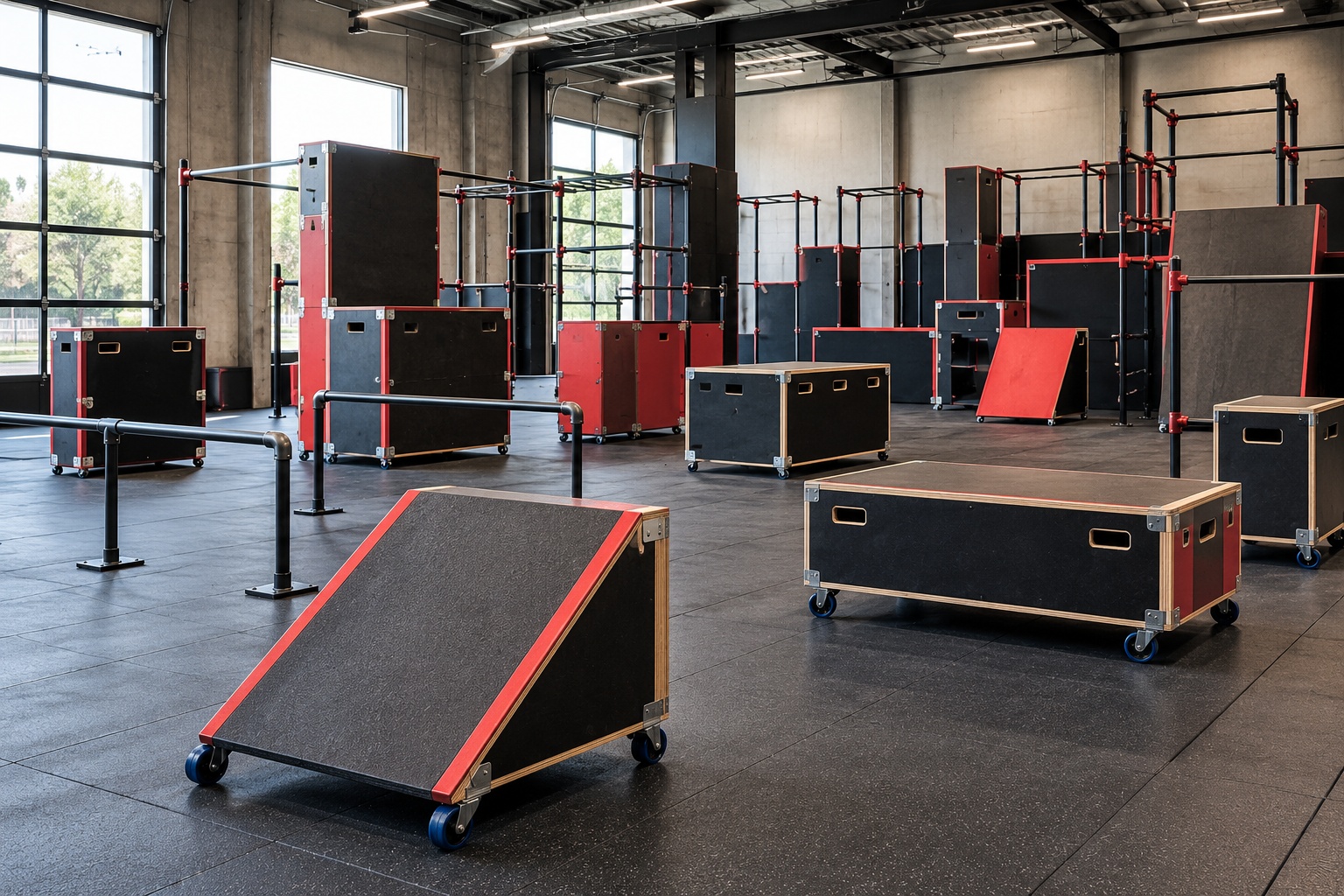
Parkour gym with fixed or mobile modules represents a design choice that impacts flexibility, space management, maintenance and activity organization. The most suitable configuration depends on the facility's goals, user types, route reconfiguration frequency and building characteristics.
Indoor parkour requires environments capable of adapting to technical exercises, progressive training and educational activities. For this reason, the choice between permanent and repositionable modules should be made during the planning phase, evaluating not only the initial configuration but also the gym's future needs.
Sports associations, public entities and facility managers can benefit from modular design that favors space evolution without compromising safety and operational continuity. The best solution comes from analyzing the overall project rather than choosing a single type of equipment.
Better fixed or mobile modules for a parkour gym?
There is no one-size-fits-all solution for every facility. Fixed modules favor layout stability, while mobile modules allow greater flexibility in route configuration. Both solutions require installation, use and maintenance in compliance with the manufacturer's instructions and the intended use of the facility.
The choice should be made considering intended use, available space, organized activities and the possibility of modifying the layout over time.
A well-planned project can integrate both types of modules within the same gym.
Choice objective
Create a functional, safe structure consistent with the planned sports program.
Design approach
The configuration should be evaluated within the context of the entire gym layout.
What differences exist between fixed and mobile modules?
Fixed modules are generally used when you want to maintain a stable route configuration and a constant arrangement of training areas.
Mobile modules instead allow you to modify the layout more easily, creating different configurations based on activities, groups or technical user levels.
Both solutions can be appropriate if included in a project consistent with the facility's goals.
Fixed modules
They favor layout continuity and a configuration easily recognized by users.
Mobile modules
They allow greater adaptability of spaces and training routes.
What criteria to use in the choice?
The first criterion concerns the type of activities carried out in the gym. A facility dedicated primarily to continuous classes may have different needs compared to a facility intended for events, training or multiple uses.
The second criterion concerns available surface area. Spaces should allow module movement, maintenance of fall areas and orderly routes.
The third criterion concerns maintenance and management. Each solution should be compatible with the facility's scheduled check program.
Activity type
Organizational needs directly influence the most suitable configuration.
Flexibility level
Assess how frequently routes will need to be modified.
What safety checks to perform?
Verifications should include modules, fastening systems when present, support surfaces, fall spaces and conditions of the anti-shock flooring.
Mobile modules should also be checked regarding handling procedures and correct positioning before use.
Every check should follow the indications reported in the manufacturer's manuals and the facility's maintenance plan.
Periodic checks
Verifications allow maintaining constant equipment usage conditions.
Scheduled maintenance
Regular scheduling helps reduce operational downtime.
Comparative table
| Element |
Fixed modules |
Mobile modules |
| Configuration |
Stable |
Variable |
| Flexibility |
Limited |
High |
| Reconfiguration |
Less frequent |
Simpler |
| Layout management |
Constant |
Adaptable |
| Checks |
Scheduled |
Scheduled and before repositioning |
| Use |
Permanent routes |
Modifiable routes |
What errors to avoid?
One of the most frequent errors consists of choosing exclusively based on flexibility without considering the gym's sports program.
It is also advisable to avoid configurations that reduce fall spaces or obstruct routes between different areas.
Neglecting maintenance and periodic checks can compromise the facility's functionality and operational continuity.
Unplanned layout
Every configuration should be defined before installing or positioning the modules.
Insufficient checks
Verifications should be documented and scheduled over time.
FAQ
Is it possible to use fixed and mobile modules in the same gym?
Yes. Many projects provide for a mixed configuration to combine stability and reconfiguration possibilities.
What aspects impact the choice most?
Available surface area, planned activities, route modification frequency and facility organization.
How to verify module safety?
By following the gym's maintenance plan, manufacturer instructions and internal control procedures.
How to plan the parkour gym project?
Planning should start from the analysis of available surface area, number of users, planned activities and required flexibility level. Subsequently, it is possible to define layout, module choice, route organization and maintenance program.
To explore dedicated solutions in depth, you can consult gym equipment. When applicable, references include current building regulations, technical standards relating to sports equipment, indications from competent sports organizations and manufacturer manuals regarding installation, use and maintenance. Each configuration should be verified against the facility's intended use and applicable regulatory requirements.
Modular planning allows progressively developing the gym, adapting routes to user needs and maintaining high standards of safety, functionality and operational continuity over time.


 Budgets
 Dumbers
 Discs
 Benches
 Racks and Rigs
 Weights Holders
 Isotonic machines
 Calisthenics
 Cardio
 Kettlebells
 Flooring
 Gym Set
 Accessories
 Combat
 ARTI MARZIALI
 CONTAINER GYM
 Tug-Of-War
 Used Gym Equipment
 PILATES MACCHINARI
 GINNASTICA ARTISTICA
 CAMPI DA PADEL
 Prodotti in Pronta Consegna
 Informazioni
 IRONMAN
 Gift Card


Comments (0)