
Trolley
You have no items in your shopping cart

 Budgets
 Dumbers
 Discs
 Benches
 Racks and Rigs
 Weights Holders
 Isotonic machines
 Calisthenics
 Cardio
 Kettlebells
 Flooring
 Gym Set
 Accessories
 Combat
 ARTI MARZIALI
 CONTAINER GYM
 Tug-Of-War
 Used Gym Equipment
 PILATES MACCHINARI
 GINNASTICA ARTISTICA
 CAMPI DA PADEL
 Prodotti in Pronta Consegna
 Informazioni
 IRONMAN
 Gift Card
- Donatif
- Sports products
- 0 I like it
- 160 Views
- 0 comments
- gym flooring, safety flooring, gym safety, shock-absorbing materials
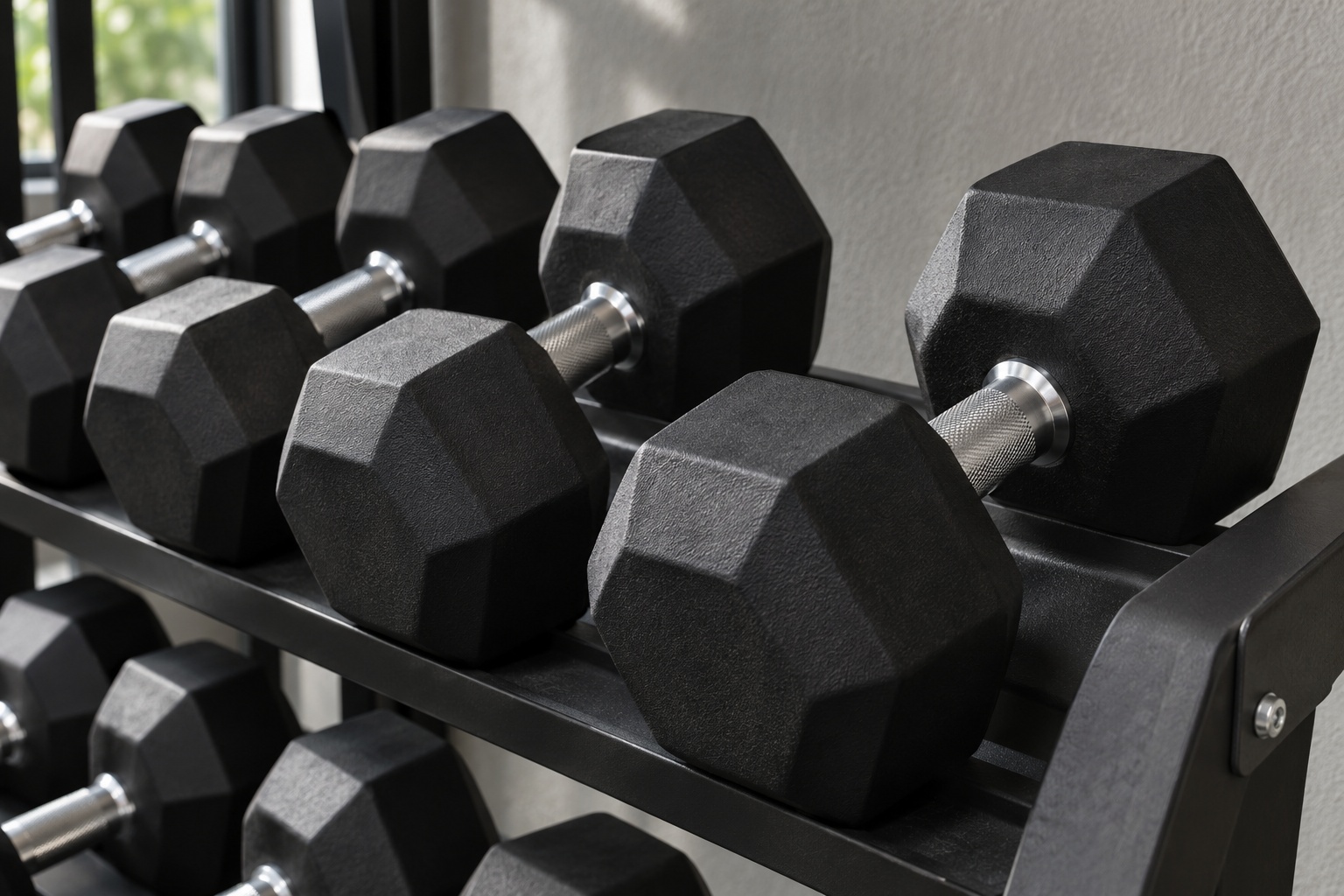
The smells of new dumbbells can become an important evaluation element when purchasing equipment for a professional gym, personal training studio, or hotel fitness room. The perception of an odor after opening the packaging often raises questions about the nature of the coating, storage conditions, and correct usage methods. However, to respond reliably, it is not enough to generically identify the material as rubber or urethane: one must know the characteristics of the specific product and distinguish observations from documented technical information.
A perceptible odor alone does not constitute proof of the quality, durability, or safety of a dumbbell. Likewise, the absence of obvious odors does not automatically imply chemical characteristics or superior performance. Perceived intensity, room ventilation, temperature, quantity of equipment present, and packaging conditions can influence the initial experience. These variables must be considered without turning them into certain explanations when verifiable data is lacking.
For sports facility managers, the issue mainly concerns the ability to formulate precise questions to the supplier, compare alternatives, and organize checks consistent with the intended use. This guide proposes an operational method to evaluate dumbbell coatings, manage user expectations, and document decisions without resorting to unsupported chemical declarations. The objective is not to identify a universally better material, but to build a reproducible comparison for each specific professional context.
- Why new dumbbells may present perceptible odors
- Which coating characteristics to check
- Technical questions to ask the supplier
- How to compare rubber, urethane, and other coatings
- The role of the environment and intensity of use
- How to organize a check before purchase
- How to communicate correctly with users and collaborators
- Maintenance and monitoring after delivery
- How to turn checks into an investment decision
Why new dumbbells may present perceptible odors
When a delivery of dumbbells is made, the first contact with the product often occurs under conditions different from those of normal training. The equipment may have been stored in closed packaging and subsequently concentrated in a room with limited air exchange. These circumstances can influence the initial perception of odors, but do not allow for automatically establishing their origin. Correct evaluation therefore starts from describing the observed conditions and consulting the information available for the purchased model.
It is useful to distinguish three issues that are frequently overlapped: the presence of an odor, its acceptability in the environment of use, and the documented characteristics of the material. The first concerns a sensory observation, the second a management evaluation, and the third requires technical information. Confusing these levels can lead to discarding products without sufficient comparison or accepting commercial explanations lacking evidence.
A manager should record when the odor is perceived, in which area, on how many products, and under what conditions. This simple procedure allows for formulating more detailed requests to the supplier, avoiding generic questions that are difficult to answer with precision.
Why the odor does not automatically identify the material
The commercial definition of a rubber-coated dumbbell does not necessarily describe all the components of the coating or the methods by which it is made. Products belonging to the same category can present different constructions. Without a specific technical datasheet, it is not correct to attribute a certain olfactory perception to a substance, a production process, or a particular formulation.
Separating what is observed from what is hypothesized
A note such as perceptible odor near the rack during unpacking represents a usable observation. A phrase such as coating certainly made with poor materials instead represents an unproven interpretation. Maintaining this distinction helps build a more effective technical dialogue and avoid statements that cannot be supported by documentation.
Which coating characteristics to check
The evaluation of rubber dumbbells and coatings for intensive use must consider the entire product, not just the outer surface. Head geometry, connection with the handle, surface finish, cleaning methods, and expected operating conditions can affect the choice. The coating plays a function within a system that also includes flooring, storage supports, and handling methods.
Before comparing two offers, it is advisable to check whether the available information actually describes equivalent characteristics. A similar commercial designation does not guarantee that thicknesses, composition, construction processes, or maintenance instructions coincide. When data is missing, it is preferable to flag it as information to be requested rather than replacing it with an assumption.
The manager can prepare a comparison sheet containing model identifier, declared material, finish, indicated intended use, cleaning conditions, any operational limitations, and documents provided. This approach allows for evaluating the completeness of information even before expressing a preference.
Declared material and surface finish
The description of the coating should be precise enough to distinguish the different proposed options. It is useful to ask whether the designation reported in the datasheet represents a family of materials or a product technical specification. Any declarations regarding resistance, surface behavior, or compatibility with detergents must refer to the model and test conditions indicated by the manufacturer.
Construction and intended use
A dumbbell intended for frequent use must also be evaluated with respect to expected stresses and the manufacturer's instructions. It is not sufficient to assume that a coating defined as professional is suitable for any training method. It is necessary to check declared limitations, handling instructions, and compatibility with the surfaces on which the equipment is used.
Technical questions to ask the supplier
An effective request does not consist of simply asking whether the dumbbells have an odor. It is preferable to identify the model, describe the installation context, and ask what documented information is available regarding the coating and initial conditions of use. In this way, the supplier can distinguish the declared characteristics of the product from general management indications.
Questions should be formulated in such a way as to obtain verifiable answers. For example, instead of asking whether a dumbbell is completely odorless, it is more useful to ask whether there are manufacturer instructions on olfactory perception after opening the packaging and whether specific procedures are foreseen before commissioning. The possible absence of this information must be recorded without automatically interpreting it as a defect.
It is also important to request the updated version of the instructions relating to the proposed model. Documents referring to similar products, previous generations, or generically equivalent materials might not apply to the supply under consideration.
What documents to request before ordering
The request can include a technical datasheet, instructions for use, cleaning and maintenance instructions, storage conditions, and any documented declarations pertinent to the product. If tests or certifications are mentioned, it is necessary to verify their object, scope of application, reference to the model, and availability of the relative document. The mere presence of a commercial symbol does not replace this verification.
How to evaluate overly generic answers
Expressions such as high-quality material, normal odor, or superior coating do not provide sufficient criteria for a technical decision. The manager should ask what concrete characteristics support such statements and whether there are conditions or limitations to be aware of. An answer that makes explicit what is documented and what is not available is more useful than an absolute promise that is difficult to verify.
How to compare rubber, urethane, and other coatings
In the professional equipment market, there are dumbbells with different coatings, including solutions commercially described as rubberized or urethane. These designations can guide an initial search, but are not sufficient to establish which alternative presents fewer odors, greater durability, or better behavior during use. To support a comparison, specifications referring to concrete products and, when available, tests carried out under comparable conditions are required.
The choice should start from the facility's requirements: frequency of use, type of training, cleaning procedures, flooring characteristics, and space availability. Subsequently, it is possible to compare alternatives against the same parameters. If one manufacturer provides detailed information and another only commercial descriptions, this difference concerns the quality of the available documentation and does not automatically prove material superiority.
A correct comparison also includes uncertainty. When comparable data on odor perception are not available, the relative item should be classified as unverified. It is preferable to keep a question open rather than attribute a result based solely on the coating family.
Comparing specific models and not abstract categories
Two products can have different dimensions, weights, finishes, and operating instructions even when they belong to the same category. For this reason, the evaluation should use article codes, updated documentation, and declared conditions of use. The comparison becomes more reliable when each observation can be traced back to a precise source.
When to consider an alternative solution
If the context presents particular constraints, such as compact environments or specific maintenance needs, it may be useful to examine alternative coatings or different configurations of the weight area. However, the choice must not be based on the idea that a material universally eliminates every criticality. It is necessary to check the product, the context, and the available instructions before formulating a preference.
The role of the environment and intensity of use
A large weight room, a personal training studio, and a hotel gym can use similar dumbbells under very different conditions. The number of equipment present, the frequency of sessions, cleaning methods, and environmental characteristics change. Consequently, an observation made in one facility cannot be automatically transferred to another.
To correctly manage expectations, it is advisable to describe the operational scenario before choosing the coating. Useful information includes the surface area of the weight zone, ventilation conditions, number of stations, frequency of use, and maintenance procedures. This data helps contextualize questions to the supplier, but does not replace any necessary technical verifications.
Another aspect concerns the timing of the evaluation. Conditions immediately following delivery may differ from those observed during the normal operation of the facility. For this reason, it is advisable to separately document the receiving phase, the installation phase, and the ordinary use phase, without assuming that a variation is inevitable or guaranteed.
Personal training studio scenario
In a studio with limited spaces and scheduled appointments, the manager can evaluate a sample under actual installation conditions, noting observations and comparing them with the manufacturer's instructions. User perception can be gathered as management information without turning it into a technical measurement of material composition.
Gym or hotel facility scenario
In a gym with numerous stations or in a hotel fitness room, it is useful to define clear responsibilities for receiving, installing, and checking equipment. The evaluation must also consider the presence of non-specialized personnel in daily management. Understandable instructions and easily consultable documents can facilitate consistent management of any reports.
How to organize a check before purchase
Preliminary verification allows for transforming a generic question about odors into a documentable procedure. The first step consists of identifying the exact model and gathering available technical information. The second consists of defining the conditions under which it will be used. The third concerns comparing declared characteristics with facility requirements.
When it is possible to examine a sample, the evaluation should take place following the supplier's instructions and recording the observed conditions. Sensory control can help describe the initial experience, but does not represent a chemical analysis nor does it allow for certifying the absence of specific substances. Should specialized technical evaluations be necessary, one must turn to competent subjects and use appropriate methods.
The operational checklist can include product identification, declared material, documents received, packaging conditions, preparation for use instructions, cleaning indications, initial observations, and clarifications still needed. Each item should report the source of the information, distinguishing between manufacturer declaration, internal observation, and unavailable data.
Practical checklist example for a supply
A manager who needs to purchase a complete set of dumbbells can prepare a sheet with three columns: requirement, available evidence, and required verification. For the coating, the evidence could be the model datasheet; for maintenance, the manufacturer's manual; for initial odors, any documented instructions and observations made on the sample. Missing information becomes questions to clarify before order confirmation.
Applying criteria to dumbbell selection
The Donatif category dedicated to gym dumbbells can represent a starting point to identify configurations to explore in depth. Before selecting a product, it is still necessary to check the specifications actually available for the considered model, without deducing coating characteristics, olfactory performance, or undocumented compatibility.
How to communicate correctly with users and collaborators
The management of expectations on coatings requires communication proportional to the available information. When new dumbbells are installed, staff should know which characteristics are declared by the manufacturer, which observations were made, and which procedures to follow in case of reports. This prevents individual interpretations from becoming official facility explanations.
Communication must not automatically minimize a report or attribute unproven technical meanings to it. It is more useful to describe the process followed: product identification, documentation consultation, condition recording, and requesting clarification when necessary. If specific doubts about safety or suitability for use emerge, the facility must adhere to relevant indications and request a qualified evaluation, rather than relying on sensory impressions.
A report log can be particularly useful in facilities with multiple operators. Noting the date, area, equipment involved, observed conditions, and interventions carried out allows for identifying any recurrences without automatically attributing a cause. Documentation also favors more precise communication with the supplier.
Preparing operational instructions for staff
Internal indications should explain how to identify the model, where to find the manual, and to whom to forward any observations. It is important to avoid formulas such as completely free of emissions or material certainly harmless when no pertinent evidence exists. Staff must be able to provide correct information without assuming the role of chemical evaluators.
Handling a report without premature conclusions
If a user reports an unusual odor, the manager can gather a detailed description and check the equipment's condition. Any symptoms or health concerns require appropriate management and must not be interpreted through improvised diagnoses. The goal of the internal procedure is to record facts and activate necessary investigations, not to provide absolute reassurances.
Maintenance and monitoring after delivery
Coating evaluation does not end with purchase. During ordinary use, the surface conditions of dumbbells can be influenced by handling, contact with other equipment, detergents, and storage methods. For this reason, it is important to adopt a rubber dumbbell maintenance program consistent with the manufacturer's instructions and the facility's intensity of use.
The choice of cleaning products deserves special attention. Not all coatings must be treated with the same substances or procedures. Before using a detergent, it is advisable to check its declared compatibility, respect application methods, and consider instructions regarding drying and storage. The use of unforeseen products could compromise proper equipment management.
Monitoring should include visual checks of surfaces, handles, and any connection parts, as well as the recording of anomalies compared to initial conditions. It is not possible to establish a universal frequency valid for every model: intervals must be defined considering available instructions and real conditions of use.
What checks to schedule
An internal procedure can provide for verifying the state of the coating, the integrity of the heads, the stability of parts, and the legibility of identifications. Any alterations must be evaluated according to the manufacturer's indications. The presence of new or different odors can be recorded as an additional observation without automatically attributing a specific cause to it.
Traceability and dialogue with support
Keeping purchase documents, product codes, manuals, and intervention records facilitates the management of assistance requests. When an anomaly is reported, precise information on conditions of use and cleaning operations carried out allows the supplier to examine the concrete case. Traceability therefore represents a management tool, not a preventive guarantee of duration or performance.
How to turn checks into an investment decision
The choice of dumbbells for a professional facility should be motivated by documented requirements and not by a single perceived characteristic. Initial price represents only one element of comparison. One must also consider intended use, completeness of instructions, compatibility with maintenance procedures, assistance conditions, and availability of information necessary to manage any criticalities.
A practical method consists of assigning a priority and verification status to each requirement. For example, compatibility with expected training methods can be classified as an indispensable requirement, while a particular aesthetic preference may have secondary priority. Information relating to initial odors must be treated according to their effective documentary availability, avoiding turning incomparable impressions into seemingly objective scores.
Before confirming the investment, the manager should verify that the model has been correctly identified, that the main conditions of use are compatible with the manufacturer's indications, and that any doubts about the coating have received sufficiently specific answers. If decisive information remains absent, it is possible to request further clarification, evaluate a sample, or compare a documented alternative.
For a personal training studio, a high-traffic gym, or a hotel facility, the result of this path may be different because operational requirements change. The most appropriate choice therefore does not stem from a general rule on rubber, urethane, or odor perception, but from verifiable correspondence between product and context. A purchasing process that preserves sources, observations, and motivations also allows for re-examining the decision when conditions of use change or new equipment is introduced.
Comments (0)