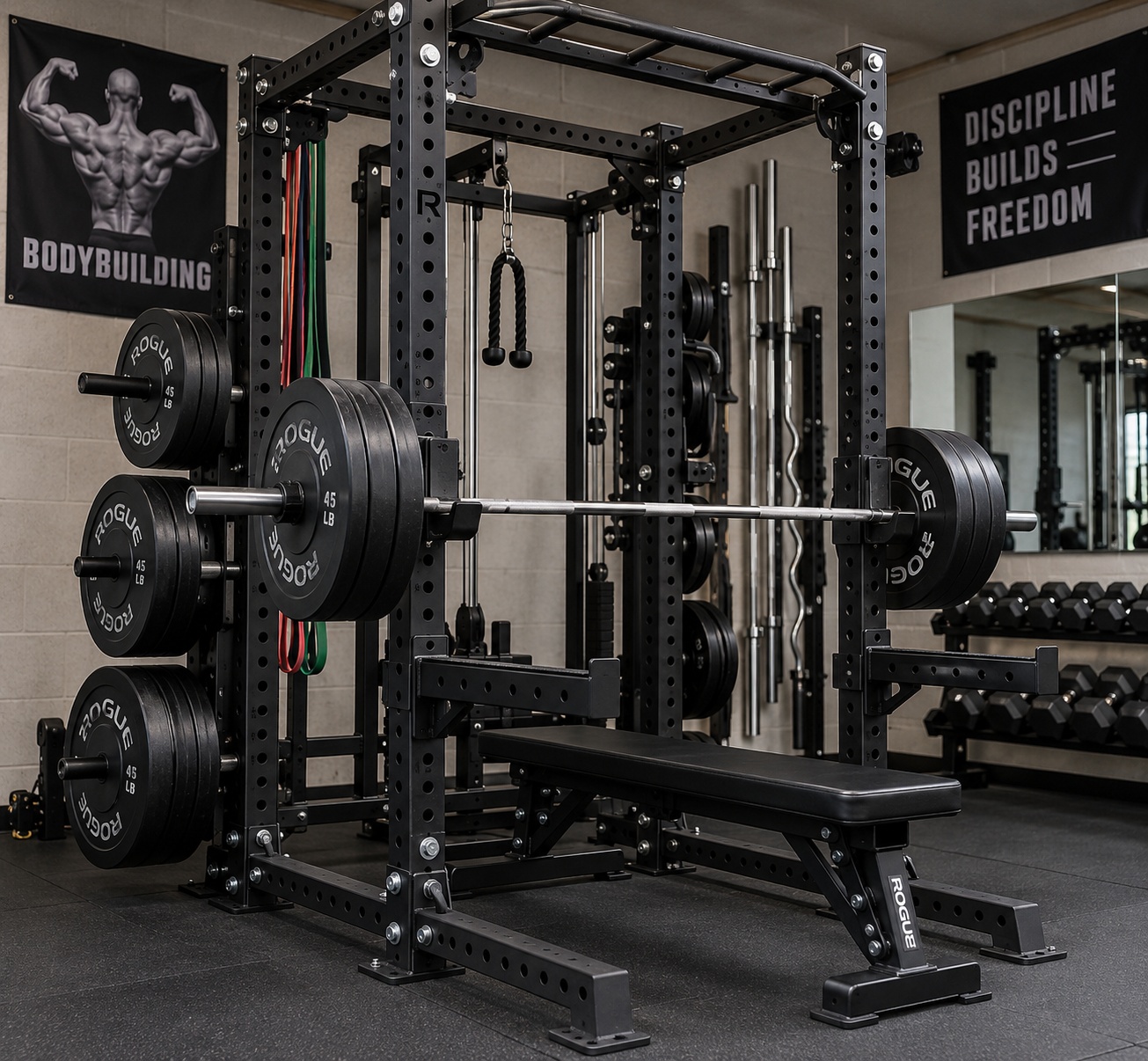
A power rack intended for bodybuilding should be chosen by evaluating build quality, safety systems, accessory compatibility, adjustment options, and suitability for the available space. The choice should not be based solely on the declared weight capacity or price, but on the manufacturer's technical specifications and the type of training planned.
In bodybuilding, the power rack represents an extremely versatile workstation for barbell exercises and compatible accessories. A correct configuration allows you to organize your training efficiently, maintaining high safety standards and adapting to different workout programs.
This guide illustrates the main technical criteria to consider before purchasing, aspects to verify during use, and the most common mistakes to avoid.
What requirements must a bodybuilding power rack have?
A rack intended for frequent use should offer a stable structure, adjustable safety systems, and compatibility with the accessories provided by the manufacturer.
Elements to verify include frame quality, hole configuration, availability of spare parts, ease of maintenance, and completeness of technical documentation.
Careful design facilitates daily use and allows the workstation to be adapted to different training methods.
Why is the structure important?
A structure designed for continuous use helps maintain stability and adjustment precision over time.
How much do safety systems matter?
Support pillars and safety bars must be compatible with the installed model and adjusted according to the manufacturer's instructions.
How to choose the most suitable configuration?
The configuration should be consistent with the type of training, available space, and accessories you plan to use.
It is useful to compare dimensions, capacity, adjustment options, and compatibility with additional components before purchasing.
A modular solution can facilitate future expansions without replacing the entire structure.
Are accessories important?
Yes. The availability of compatible accessories increases the workstation's versatility and allows it to be adapted to different needs.
Why evaluate modularity?
An expandable structure allows you to integrate new components according to the possibilities provided by the manufacturer.
How to use the power rack correctly?
Before each workout, it is advisable to check the correct positioning of supports, safety bars, and installed accessories.
Exercises such as squats and bench presses must be performed in compliance with the adjustments provided by the manufacturer.
Operating procedures may vary from one model to another and must always be confirmed by consulting the manual.
What checks should be performed?
Check the stability of the structure, tightenings, adjustments, supports, and general condition of components before use.
Is the rack suitable for different programs?
Usage possibilities depend on the installed configuration and compatible accessories provided by the manufacturer.
How much does available space matter?
The required space includes both the footprint of the rack and the operating area required during training.
Both the flooring and the height of the room must be compatible with the intended installation procedures.
Proper layout design facilitates movement and improves the organization of the training area.
Why plan the layout?
An orderly arrangement of equipment reduces interference and improves room usability.
Is room height important?
Yes. It must be compatible with the rack and any upper accessories.
What technical specifications should be verified?
Before purchasing, it is advisable to compare dimensions, capacity, safety systems, hole configuration, and accessory availability.
Definitive features must always be confirmed in the manufacturer's official documentation.
To learn more about the various configurations available, you can consult the professional power racks category.
Why consult manuals?
Manuals and technical data sheets outline installation, use, and maintenance requirements.
Does the availability of spare parts matter?
Yes. The availability of components facilitates maintenance and continuity of use.
What mistakes should be avoided?
Evaluating the rack solely based on price, neglecting available space, or ignoring accessory compatibility are frequent mistakes.
It is also important to consider maintenance, technical documentation, and future expansion possibilities.
A choice based on objective criteria facilitates an investment more consistent with your needs.
Why isn't price enough?
The initial cost represents only a part of the total cost of managing the equipment.
What is the main reference?
The manufacturer's official technical documentation is the primary source for verifying features and usage methods.
Comparative table
| Criterion |
Verification |
| Dimensions |
Space compatibility |
| Capacity |
Manufacturer specifications |
| Holes |
Available adjustments |
| Safeties |
Supports and bars |
| Accessories |
Compatibility |
| Manuals |
Installation and maintenance |
This table helps compare different models using verifiable technical criteria.
Which sources to consult?
Installation manuals, technical data sheets, and official manufacturer documentation represent the main reference for comparing features and requirements.
What aspects to compare?
Dimensions, capacity, safety systems, accessory compatibility, maintenance, and technical documentation.
How to choose the power rack best suited for bodybuilding?
Choosing a power rack should stem from a joint evaluation of available space, training goals, technical features, and expansion possibilities. Comparing each model using the same criteria allows you to make a more informed choice consistent with your needs.
FAQ
What is the first criterion to evaluate? Available space and rack compatibility with the usage context.
Are accessories crucial? They can increase the workstation's versatility if compatible with the chosen model.
Does technical documentation matter? Yes. Manuals and technical data sheets represent the primary reference for installation, use, and maintenance.
Is it useful to plan future expansions? A modular structure can facilitate the integration of additional accessories provided by the manufacturer.


 Budgets
 Dumbers
 Discs
 Benches
 Racks and Rigs
 Weights Holders
 Isotonic machines
 Calisthenics
 Cardio
 Kettlebells
 Flooring
 Gym Set
 Accessories
 Combat
 ARTI MARZIALI
 CONTAINER GYM
 Tug-Of-War
 Used Gym Equipment
 PILATES MACCHINARI
 GINNASTICA ARTISTICA
 CAMPI DA PADEL
 Prodotti in Pronta Consegna
 Informazioni
 IRONMAN
 Gift Card