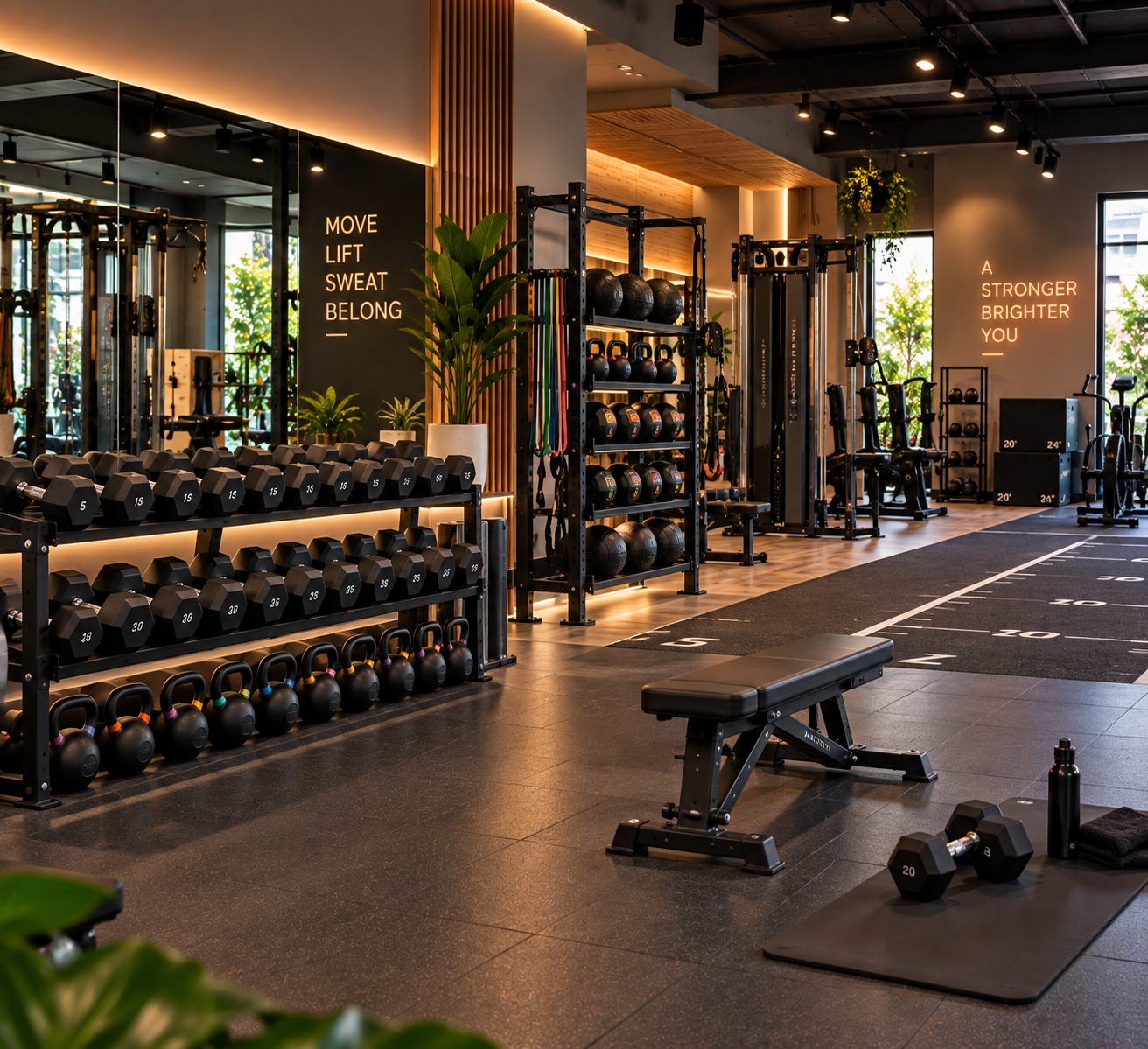
The choice of equipment represents one of the most important aspects in designing a boutique gym. Unlike a traditional gym, this format favors a highly functional setup, capable of supporting numerous types of training without taking up space unnecessarily. Each piece of equipment should contribute to the quality of the proposed experience and integrate with the facility's layout.
Before purchasing any equipment, it is advisable to define the gym's format, the maximum number of simultaneous users, the type of workouts planned, and the environment configuration. Only after this analysis is it possible to identify a setup that is truly consistent with the business project.
A well-designed boutique gym focuses on versatile tools, efficient storage systems, and a rational distribution of space. This approach facilitates daily management, improves the user experience, and makes it easier to expand the facility over time.
How to choose equipment for a boutique gym?
Selection should start from the facility's goals and the activities that will actually be offered. A boutique gym dedicated to functional training will have different needs compared to one specialized in strength training or personal training.
It is useful to evaluate the available surface area, the possibility of quickly reconfiguring spaces, and the compatibility between different tools. Each piece of equipment should have a precise function within the project, avoiding redundant purchases.
Technical specifications from manufacturers, including installation methods, maintenance, and usage requirements, also represent an important reference during the selection phase.
Why start with the target audience?
Knowing your users helps you choose equipment that is truly consistent with the type of training that will be offered.
Why check compatibility?
A setup designed to work in an integrated manner facilitates gym management and makes future expansion easier.
What equipment is essential?
There is no single list valid for every boutique gym, but certain categories are particularly versatile in most projects. These include dumbbells, barbells, benches, kettlebells, suspension systems, multi-function racks, functional training accessories, and mobility equipment.
The quantity of each item should be determined based on room capacity and the maximum number of users expected during sessions. A balanced setup allows each piece of equipment to be used continuously without overloading the environments.
Accessory organization systems also contribute to improving the facility's functionality by keeping the training area tidy.
Why prioritize multi-function tools?
Versatile equipment allows numerous exercises to be performed using the same station while optimizing available space.
How much do accessories matter?
A balanced selection of accessories expands training possibilities without requiring large additional surface areas.
How to organize spaces around the equipment?
Each piece of equipment should be placed according to the room's operational flow. It is important to maintain clear passageways, areas dedicated to dynamic exercises, and easily accessible storage spaces.
An orderly layout facilitates workout supervision, improves the customer experience, and speeds up reorganization operations between sessions.
The design should also provide sufficient margins for any future integrations without compromising the layout's balance.
Why leave open areas?
Well-organized operational spaces favor movement and allow equipment to be used with greater continuity.
Why design storage?
Proper organization of accessories helps keep the gym tidy and speeds up class preparation.
Recommended equipment table
The following table summarizes the main categories of equipment normally found in a boutique gym.
| Category |
Function |
Selection Criterion |
| Dumbbells |
Strength training |
Load progression |
| Barbells |
Multi-joint exercises |
Space compatibility |
| Benches |
Support exercises |
Stability and versatility |
| Kettlebells |
Functional training |
Weight variety |
| Racks |
Complete training |
Modular configuration |
| Accessories |
Exercise integration |
Ease of storage |
The final configuration should be adapted to the facility's characteristics and the planned training program.
Manufacturers' technical specifications represent the main reference for verifying installation, maintenance, and usage requirements.
Why consult technical data sheets?
Manufacturer information allows you to verify compatibility, installation methods, and maintenance requirements.
Why choose a modular configuration?
A modular structure makes it easier to integrate new equipment without completely altering the layout.
Why choose multi-function equipment?
Boutique gyms must make the most of every available square meter. For this reason, tools that can be used in numerous exercises are often more suitable than highly specialized equipment.
A flexible configuration allows the room layout to be quickly modified based on planned activities and facilitates the organization of different classes during the same day.
This approach also helps simplify operational management and the future evolution of the facility.
Why is flexibility important?
Easily reconfigurable spaces allow the gym to be quickly adapted to different training programs.
How to optimize space?
A targeted selection of equipment avoids unnecessary clutter and improves the overall functionality of the room.
How to manage maintenance and organization?
Each piece of equipment should be checked periodically following the instructions in the manufacturers' manuals. Cleaning, visual inspections, and scheduled maintenance help keep the entire facility efficient.
The flooring and storage systems also require regular checks to preserve the order and functionality of the environment.
Organized management facilitates daily activities and makes it easier to plan any replacements or expansions.
What checks should be performed?
It is advisable to periodically check equipment, surfaces, fastening systems, and operational areas according to the manufacturers' instructions.
Why maintain order?
A well-organized gym improves session management and facilitates routine maintenance.
What mistakes to avoid?
One of the most frequent mistakes is purchasing numerous pieces of equipment without having defined the boutique gym format. This approach can reduce space flexibility and increase organizational complexity.
It is also advisable to avoid tools with very limited functions when the available surface area is small. A balanced selection achieves greater versatility while keeping the operational space free.
Neglecting storage planning also makes it more difficult to keep the gym tidy throughout the day.
Do more equipment mean a better project?
No. A setup consistent with the training model is generally more effective than a high number of underutilized tools.
Why plan purchases?
Preventive planning allows investments to be properly distributed and maintains consistency between layout, services, and equipment.
How to plan the investment in equipment?
The choice of equipment should follow a design logic in which each element contributes to the overall functioning of the boutique gym. Analyzing the format, available spaces, and future expansion potential allows you to build an efficient and easily manageable facility.
Carefully evaluating multi-function equipment, layouts for micro gyms, space organization, and compatibility between different stations allows you to develop an environment consistent with the business goals.
To create a versatile setup, it can be useful to integrate a professional dumbbell set compatible with the facility's layout, maintaining order, flexibility, and room for growth over time.


 Budgets
 Dumbers
 Discs
 Benches
 Racks and Rigs
 Weights Holders
 Isotonic machines
 Calisthenics
 Cardio
 Kettlebells
 Flooring
 Gym Set
 Accessories
 Combat
 ARTI MARZIALI
 CONTAINER GYM
 Tug-Of-War
 Used Gym Equipment
 PILATES MACCHINARI
 GINNASTICA ARTISTICA
 CAMPI DA PADEL
 Prodotti in Pronta Consegna
 Informazioni
 IRONMAN
 Gift Card


Comments (0)