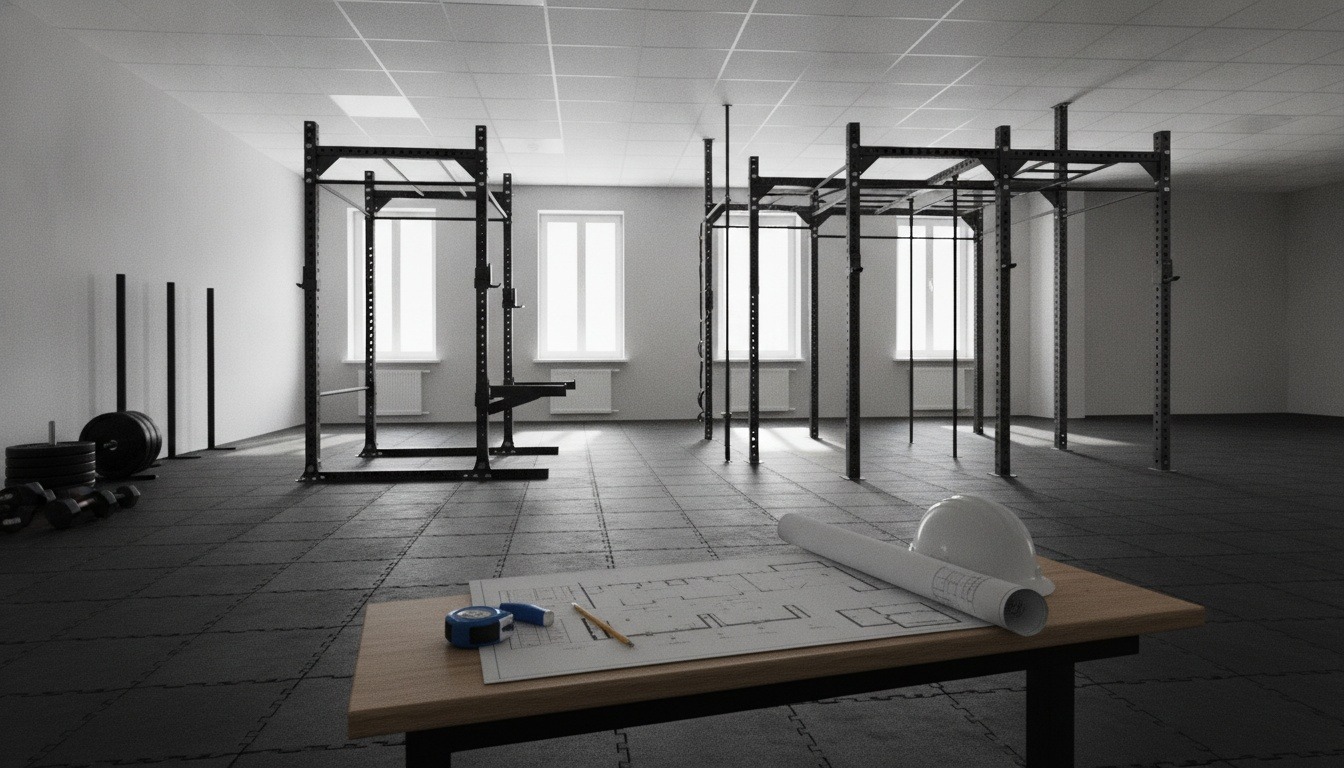
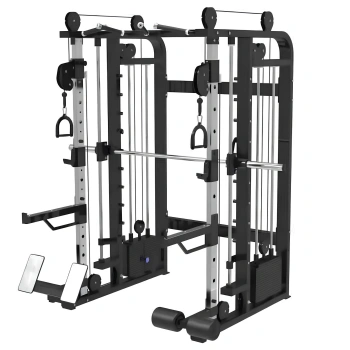
If your opening or renovation date is set for January, the safest choice is to start from your non-negotiable requirements (space, height, loads) and check whether a ready-to-ship gym rack meets them. If it does, it is the most predictable way to hit your date; if it does not, a custom rack is still valid, but it must be planned backwards using the production times listed on the product page.
A custom rack is not automatically the best choice. It is the right one when a specific dimension, height or configuration cannot be compromised. In all other cases, a structure already in stock can get you open on time and leave customization to a second phase.
Here you will find a backwards timeline from your opening date, a checklist of the data to collect, a comparison of the two options and a method for deciding without risky compromises.
In this article
Is a custom rack always the best choice?
No. A custom rack is the right choice when the size of the space, the usable height or the intended use makes a standard model unsuitable. If a standard model meets your requirements, customizing mainly adds a time variable.
There are two opposite risks to avoid: waiting for a dedicated production run and ending up with an empty area during peak season, or rushing into an unsuitable model and having to replace it later. Perfectionism pushes you toward the first, haste toward the second.
A note on method: we tend to underestimate project timelines (the planning fallacy). That is why it is better to build the schedule starting from the end, not the beginning.
How do you plan backwards from your opening date?
Start from the day the area must be usable and work back to today. Every step needs a buffer, because a delay upstream affects everything downstream.
- Opening date: the day clients can use the facility.
- Inspection and testing: check bolts, stability and anchoring before opening to the public, following the manufacturer's instructions.
- Assembly: consider who will do it, the free space available and any flooring already installed.
- Delivery: confirm the date stated in your order confirmation; do not assume it based on generic information.
- Production (custom only): the dedicated lead times are listed on the product page.
- Order confirmation: the deadline by which you must have decided and approved dimensions and configuration.
- Measuring: the task you need to do first, before anything else.
If by step 5 the sum of the lead times exceeds the available schedule, you have your answer: for a January opening you need an option that is already available.
Which requirements are truly non-negotiable?
These are the ones that, if not met, make the structure unusable or unsafe. Collect this data before choosing.
- Room dimensions: width, depth and real footprint, including the movement zones around the structure.
- Usable height: check beams, systems and suspended ceilings, especially for rigs and pull-up structures.
- Anchoring: if the structure must be fixed to the floor or wall, verify the strength of the support and the manufacturer's instructions; for structural assessments, consult a qualified technician.
- Loads and use: who will use it, how often and for which exercises.
- Number of simultaneous users: determines the width and the number of training stations.
- Flooring: the base must support the loads and protect the subfloor; see the flooring category.
Everything else (finishes, colors, accessory configurations) is often negotiable and can be postponed. If your goal is to properly size the entire space, our guide on how to choose space and equipment to open a gym will help.
Ready-to-ship and custom: how do they compare?
Here is a comparison of the criteria that matter when there is a deadline. Actual lead times must always be checked on the product page and in the order confirmation.
| Criterion | Ready-to-ship | Custom |
|---|
| Meeting the deadline | More predictable, if in stock | Depends on the production times on the product page |
| Fit to the space | Limited to standard sizes | Dimensions and configuration defined by you |
| Risk of settling | If you choose only out of haste, an unsuitable model | If you do not plan ahead, an empty area at opening |
| Future flexibility | Can be expanded later | Designed from the start for the intended use |
| When it makes sense | Fixed date and compatible requirements | Space or usage constraints that a standard model cannot solve |
Where to look in the catalog
For a tight deadline, start from the ready-to-ship racks category: for example, the Power Rack with cast iron plates, 200 cm height is listed as available. If you need a wider structure or a modular configuration, explore the racks and rigs categories; for the pull-up area, consider calisthenics structures and the Modular R3 Cage Rig. Always check availability and up-to-date lead times on the product page.
How does the two-phase strategy work?
Often the best solution is not choosing one or the other, but ordering them over time. Open with what is available and already compatible with your minimum requirements; then order the custom structure to complete or replace part of the area.
- Define the essential core of the area (for example, a rack with the basic training stations).
- Choose it from the available solutions that meet your space, height and load requirements.
- Plan the custom build as an expansion, with the order confirmed at a time without pressure.
- Leave room for future integration without blocking walkways.
This way you do not give up the dimensions you need, and you do not wait to open. To choose the right type of structure for your training style, see our guides on CrossFit structures and calisthenics equipment. If the area is for powerlifting, also read how to check bolt tightness and inspect racks and barbells after assembly.
Frequently asked questions
How long does a custom rack take?
It depends on the product: the dedicated production times are listed on the product page and confirmed in the order. Do not rely on generic estimates.
Is a ready-to-ship rack less professional?
No: the difference is availability, not the level of use. Check the features, load capacity and intended use on the product page against your needs.
When should I order to be operational in January?
Build your timeline backwards from the opening date, including testing, assembly and delivery. The order deadline depends on the lead times shown on the product page and in the confirmation.
Can I order a standard structure and customize it later?
It depends on the model. Some structures are modular and can be expanded with accessories; check compatibility on the product page or ask Donatif to confirm.
Conclusion
To open in January without risks: measure the space, set your non-negotiable requirements, rebuild the timeline backwards and choose the option that meets them before the deadline. If a standard model works, start from there; if you need a custom build, plan it as phase two or allow enough lead time.
If you want to compare solutions for your space and your deadline, request a consultation or a quote from Donatif: bring the room measurements and your opening date.


 Budgets
 Dumbers
 Discs
 Benches
 Racks and Rigs
 Weights Holders
 Isotonic machines
 Calisthenics
 Cardio
 Kettlebells
 Flooring
 Gym Set
 Accessories
 Combat
 ARTI MARZIALI
 CONTAINER GYM
 Tug-Of-War
 Used Gym Equipment
 PILATES MACCHINARI
 GINNASTICA ARTISTICA
 CAMPI DA PADEL
 Prodotti in Pronta Consegna
 Informazioni
 IRONMAN
 Gift Card