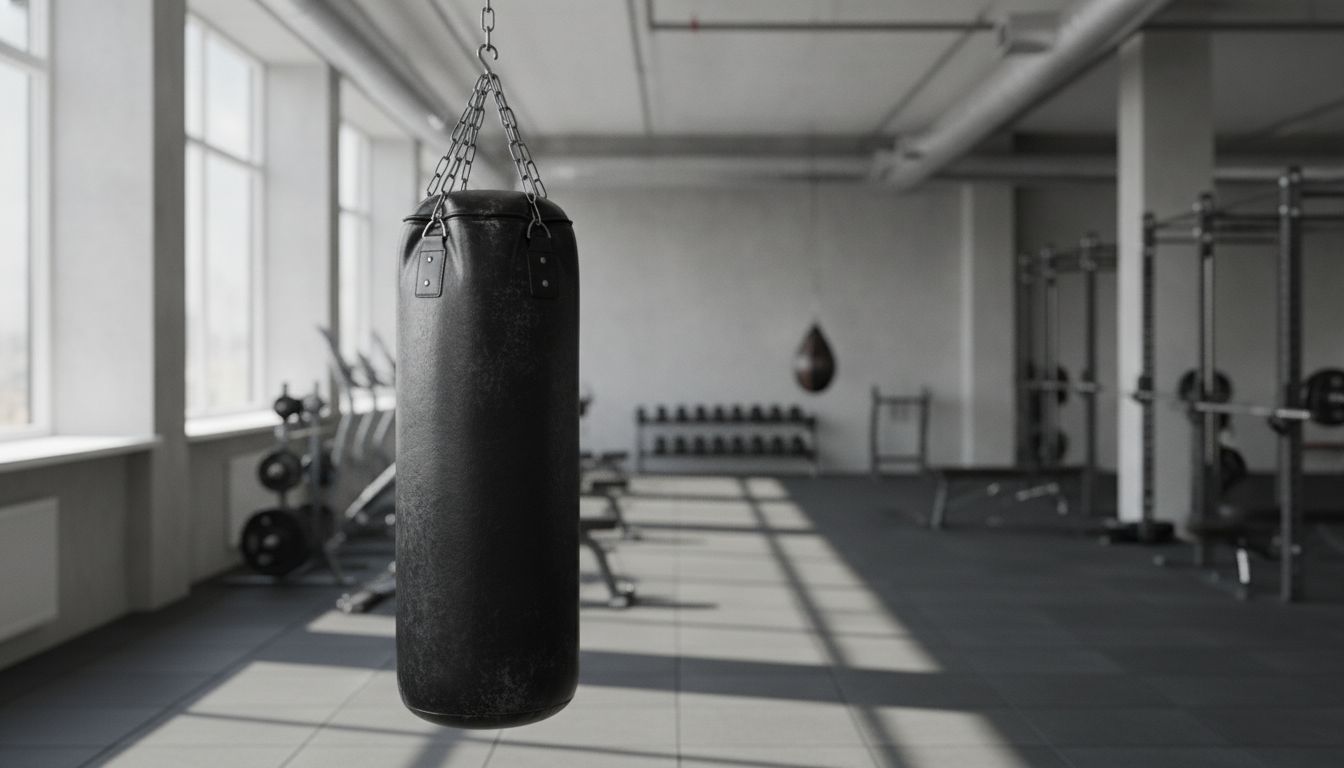
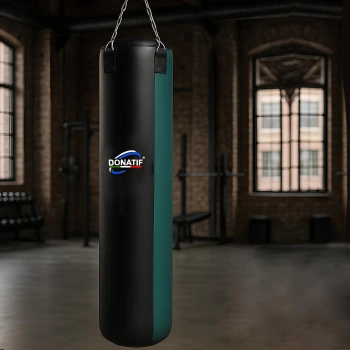
To choose a punching bag, start from a practical rule: the bag's weight should be roughly half your body weight. Go a bit heavier if you hit hard, and lighter if you train mainly for technique and speed. The height is determined by your stature, the type of training and, above all, the ceiling or structure where you will mount it.
The ratio between bag weight and athlete weight is not a standard, but a guideline commonly used in gyms. In this guide we turn it into a concrete choice: which weight, which length, hanging or freestanding, and how much space you really need.
This article does not cover materials or mounting hardware in depth. Dedicated articles address those, and we link to them where relevant. Here we help you narrow your choice down to two or three models.
In this article
What weight should the bag be compared to yours?
The bag should react to a strike without swinging too much and without staying still. If it is too light, it flies off at every punch and forces you to chase it. If it is too heavy, it barely moves, strains your joints and makes it hard to work on footwork and movement.
As a starting point, use this indicative table. These are rough ranges, not certified values:
| Your body weight | Indicative bag weight | Best for |
|---|
| Around 55-65 kg (120-145 lbs) | Around 30 kg (66 lbs) | Technique, fast combinations, beginners |
| Around 70-85 kg (155-185 lbs) | Around 40-50 kg (88-110 lbs) | General fitness, amateur boxing and kickboxing |
| Around 85-100 kg (185-220 lbs) | Around 50-60 kg (110-130 lbs) | Power, hard strikes with gloves |
| Over 100 kg (220 lbs) or very powerful strikes | From 80 kg (175 lbs) upward | Advanced athletes, heavy use in the gym |
Also consider who will use the bag. In a gym with members of different weights, a medium-heavy bag works best, since it suits both hard hitters and lighter training. At home, with just one user, you can be more precise.
Kicks, elbows and knees
If you practise Muay Thai or kickboxing and use mid and low kicks, a heavier and longer bag is more stable. A light bag tends to swing very markedly when kicked.
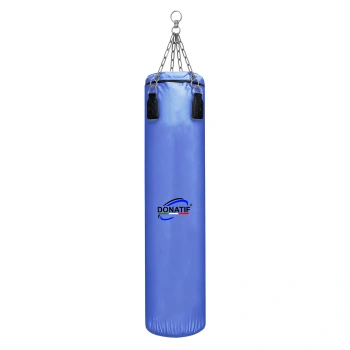
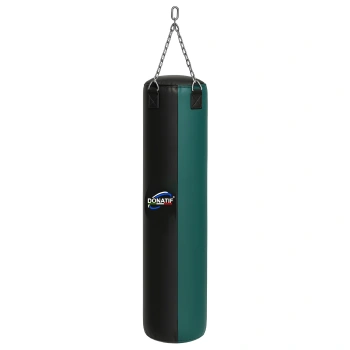
In our catalogue you will find several weights in the punching bags category: for example, the 150 cm, 50 kg bag for general use, and the 180 cm, 80 kg bag for those who want a heavier bag. For choosing between materials and fillings, see our guide to bag weight and material for professional use.
Which height to choose: 120, 150 or 180 cm?
The length of the bag changes what you can train. A 120 cm bag is compact and suits punches and work at head and upper-body height. At 150 cm you get a larger striking surface, suitable for some kicks as well. At 180 cm you can work at every level, including low kicks.
A simple rule: if you practise boxing only, a shorter bag is enough and takes up less space. If you practise combat sports with kicks, choose at least 150 cm, ideally 180 cm.
How high does the ceiling need to be?
Do a simple calculation. Add the length of the bag, the height of the hanging system (chains, carabiner and bracket) and the clearance you want from the floor. For example, a 180 cm bag with about 30 cm of hanging hardware and about 20 cm of floor clearance needs roughly 230 cm of usable height. Always measure using the actual data of the model you choose and check the product sheet.
If the ceiling is low, a shorter bag or a compact model makes more sense than forcing a long bag. If you train in an apartment, you will find other options in our guide to punching bags for home use.
Hanging or freestanding bag?
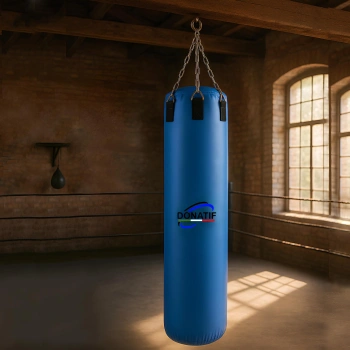
The hanging bag is the classic choice: it swings naturally and forces you to work on footwork. It does, however, require a solid anchor point, and this is often the real limitation.
A freestanding bag, with a base you fill with water or sand, does not require drilling into the ceiling and can be moved easily. On the other hand, the movement is different: it tends to return upright and swings less. For those who cannot drill, it is often the only sensible solution.
| Aspect | Hanging bag | Freestanding bag |
|---|
| Mounting | Ceiling, beam or frame | None, base rests on the floor |
| Movement | Swings, simulates an opponent | Swings less, returns to position |
| Space | Needs height and open area | Needs open area, less height |
| Typical use | Gyms, boxing clubs, serious training | Home, rented spaces, converted areas |
For freestanding bags, browse the freestanding bags category. If you want support for a hanging bag, read our guide to wall, ceiling or freestanding mounts.
How to mount it and what to check first
Mounting is not something to improvise. A bag is heavy, and when struck it swings, putting dynamic loads on the anchor that are much higher than its static weight. A point that looks solid may not be.
- Decide where you want to hang it: concrete ceiling, structural beam, wall bracket or freestanding frame.
- Check the material and condition of the support: a suspended ceiling or a lightweight wall is not suitable.
- Read the manufacturer's instructions for both the bag and the anchor, including the types of fixings specified.
- If in doubt, ask a technician or installer to check the structure.
- After installation, test with light strikes and make sure nothing moves.
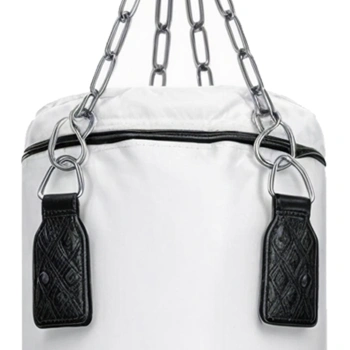
For a heavy bag, weight and length also affect your choice of mount. A bag such as the 100 kg, 180 cm punching bag requires an anchor designed for high loads: always check the product sheet and installation instructions.
How much space you need around the bag
Beyond height, you need to keep an area clear around the bag. When you strike, the bag moves and so do you: you need room for lateral steps and swinging, with no walls, furniture or other people close by.
- Keep a clear circle around the bag, wider if you kick.
- Keep mirrors, glass and protruding equipment away.
- If there are several bags in a gym, space them apart to avoid collisions.
- Consider suitable flooring under the bag to protect the surface and reduce noise.
There is no single measurement that works for everyone: it depends on the model, your technique and how many people use the area. It is best to measure with a tape and compare with the dimensions in the product sheet.
Checklist before buying
- Body weight and level: choose the bag weight using the indicative ratio in the table.
- Discipline: punches only, or kicks too?
- Bag length: 120, 150 or 180 cm based on what you train.
- Usable ceiling height: bag + hanging hardware + floor clearance.
- Anchor point: ceiling, beam, wall, frame, or a freestanding bag.
- Free space around the bag and floor protection.
- Accessories: gloves and hand wraps, as explained in how to use boxing hand wraps.
Frequently asked questions
Is a heavier bag better than a lighter one?
Not necessarily. A bag that is too heavy makes technique harder to develop and can strain wrists and shoulders. The right choice depends on your body weight and type of training.
Can I use a 180 cm bag in a low-ceilinged room?
It depends on usable height: add together the length, the hanging hardware and the floor clearance. If it does not fit, choose a shorter bag or a freestanding one.
Is a freestanding bag less effective?
It is not less effective, just different: it swings less and returns to position more quickly. It is ideal when you cannot hang a bag.
How heavy should the bag be if I train with kicks?
Generally, a longer and heavier bag that stays stable under kicks is the better option. As a reference, start from the ratio to your body weight and consider a heavier model if you hit hard.
How do I learn to use the bag properly?
With the guidance of a qualified instructor. For the basics of the speed bag and technique, you can also read how to use a speed bag correctly.
Next steps
Choose the weight based on your body weight and type of strikes, the height based on your discipline and ceiling, and only then decide whether to hang it or place it on the floor. If you have doubts about mounting, consult a technician before buying.
Browse the punching bags category and compare weights and lengths. If you want advice on the model best suited to your gym or home, request a consultation from Donatif.


 Budgets
 Dumbers
 Discs
 Benches
 Racks and Rigs
 Weights Holders
 Isotonic machines
 Calisthenics
 Cardio
 Kettlebells
 Flooring
 Gym Set
 Accessories
 Combat
 ARTI MARZIALI
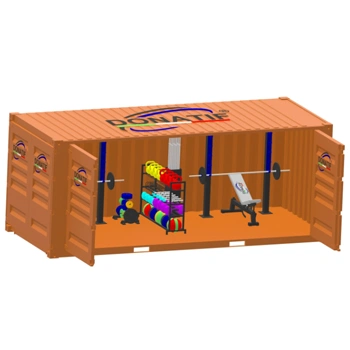 CONTAINER GYM
 Tug-Of-War
 Used Gym Equipment
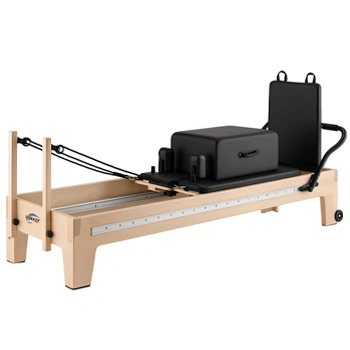 PILATES MACCHINARI
 GINNASTICA ARTISTICA
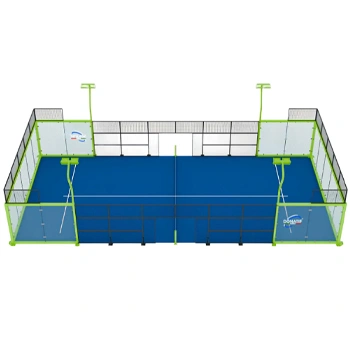 CAMPI DA PADEL
 Prodotti in Pronta Consegna
 Informazioni
 IRONMAN
 Gift Card