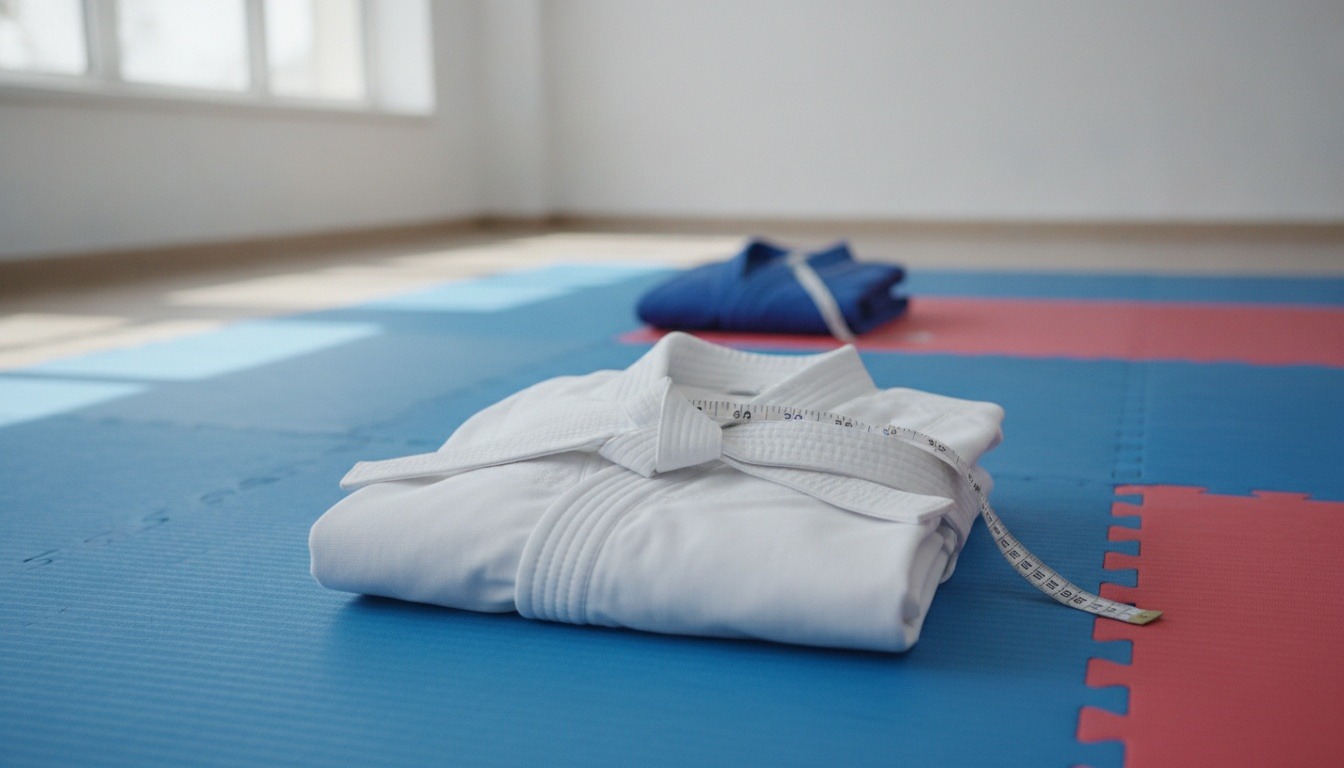
Height alone isn't enough to pick the right judo gi size or BJJ gi size. You need to measure the person (height, weight, arm length) and compare those numbers with the size chart for the specific model you're looking at. Then factor in possible cotton shrinkage. First of all, though, ask the instructor what rules the club follows on colour, style and competitions.
Sizes aren't universal. A 170 from one brand can fit differently from a 170 from another, and Brazilian Jiu-Jitsu size codes (A1, A2, M2...) don't follow the same system as judo. Fabric weight (GSM) also has a big impact on fit, durability and comfort.
This guide covers the differences between a judo gi and a BJJ gi and the questions to ask your club. You'll also see how to take measurements, how to read size codes and fabric weight, how to wash the gi to limit shrinkage, and what to do if you're buying a gift and can't measure the wearer.
In this article
Judo gi vs BJJ gi: what's the difference?
People often say "kimono" for any martial arts uniform. In reality, each discipline uses a garment designed for its own style of fighting. A judo gi and a BJJ gi both consist of a jacket, trousers and a belt, but they aren't interchangeable.
A judo gi usually has a longer, roomier jacket with wide sleeves. It's designed for standing grips and throws, where the opponent needs to be able to grab the fabric. A BJJ gi generally has a closer cut, a shorter jacket and tighter sleeves, suited to ground work. The trousers often have knee reinforcements. Exact features vary from model to model, so always check the product page.
That's why the idea that "any gi will do, just pick the size by height" often leads to mistakes. A karate gi, for example, has a lighter fabric and isn't built to withstand the constant grip fighting of judo and BJJ. Two people of the same height may also need different sizes depending on weight, build and arm length.
What should you ask the club before buying?
The first step isn't the size chart but a quick chat with the instructor. Many clubs have specific requirements, and a gi that fits perfectly but isn't allowed on the mat will just sit in the closet.
- Exact discipline: judo, BJJ or something else (traditional ju-jitsu, gi grappling). The garment changes.
- Allowed colour: many clubs require white, especially for beginners. Others also accept blue or, in BJJ, black.
- Club style or logo: some dojos adopt a common uniform or patches to be sewn on.
- Competitions: if the person competes, ask which rulebook applies. Federations set requirements on colour, cut, sleeve and trouser length, and any approval labels.
- Recommended fabric weight: the instructor knows which weight suits the student's level and age.
- Current rank: needed if you're also thinking of buying a belt.
No gi is "competition-legal" by definition. Compliance depends on the specific competition's rules, and checking is up to the buyer together with the instructor.
If you're an instructor or run a dojo
Questions about sizes and washing come up at the start of every season. A simple handout for families saves time: allowed colour, recommended fabric weight, measurements to take and a link to the model's size chart. If you collect orders for several students, note each one's height, weight and arm length, not just age.
If you're also refurbishing your training area and considering second-hand equipment, first read the checks to make on used gym equipment.
How to measure and read the size chart
All you need is a tape measure, a scale and a few minutes. Measure the person in light clothing and write down the values so you can compare several models.
Measurements to take
- Height: barefoot, back against the wall, heels together.
- Weight: crucial especially for BJJ sizes, which combine height and weight.
- Arm length: from the base of the neck, over the shoulder, down to the wrist, with the arm stretched forward. It tells you whether the sleeves will be short or long.
- Chest circumference: at the widest point, under the armpits.
- Waist and hips: useful for the trousers, especially on drawstring or elasticated models.
- Inseam: from crotch to ankle.
If the product page lists the garment's own measurements (jacket length, sleeve length, trouser length), compare them with the person's. It's the most reliable method.
How to read size codes and numbers
These are the most common sizing systems. Exact equivalents differ between brands, so use the table as a reading guide, not as a universal conversion.
| System | Example size code | What it means | What to watch for |
|---|
| Judo in centimetres | 130, 150, 170, 190 | Approximate reference height | Check the recommended weight and garment measurements on the product page |
| Judo numeric | 0, 1, 2, 3... | Progressive sizes | The centimetre equivalent varies from brand to brand |
| BJJ adult | A0, A1, A2, A3... | Combination of height and weight | If the person is stocky or has long arms, you may need to size up |
| BJJ kids | M0, M1, M2... (or similar codes) | Junior sizes | The letters used differ between brands |
| BJJ women | F1, F2, F3... | Women's cut, different proportions | Not every model offers one |
If the person is between two sizes
Consider build and fabric. With a stocky frame or long arms, the larger size is usually the better choice. The same applies if the gi is non-preshrunk cotton and you expect a few washes. With a slim build and a fabric stated as preshrunk, the smaller size may work.
With kids, there's a temptation to buy two sizes up "so it lasts". A moderate margin makes sense. But sleeves and trousers that are too long restrict movement, get in the way of grips and may not be accepted in competition.
If you're looking for a cotton judo gi for training, you can start with the Judogi JU1: open the product page and compare your measurements with the listed sizes. To see all available models, browse the judo gi category or the BJJ gi category.
Fabric weight: what it means and which to choose
Fabric weight (GSM) indicates the weight of the cloth, usually in grams per square metre (g/m²), and almost always refers to the jacket. In general, the higher it is, the sturdier and harder to grip the fabric is. At the same time, it's hotter, heavier and slower to dry.
The weave matters too. Judo gis often come in single weave, lighter, or double weave, thicker and more grip-resistant. In BJJ gis, the pearl weave is common, a compromise between lightness and durability. Trousers may be cotton or a more technical fabric like ripstop.
| Use | Suggested fabric weight | Why |
|---|
| Beginner child | Light | More comfortable, dries quickly, stands up to frequent washing |
| Adult with first gi | Light or medium | Good balance of comfort and durability while you learn |
| Judo with frequent training or competition | Medium or heavy, often double weave | Better resistance to grips; check the competition rules |
| BJJ with regular training | Medium | Sturdy but not too hot for ground work |
| Hot climate or travel | Light | Less bulky and quicker to dry |
These are general guidelines: the exact weight and fabric type of each model are listed on the product page. A beginner doesn't need the highest fabric weight. A very heavy fabric won't make you better, it will just make you sweat more.
Does a gi shrink after washing?
Yes, it can, especially cotton gis washed at high temperatures or put in the dryer. How much it shrinks depends on the fabric and any preshrinking treatment: if the model is preshrunk, this is usually stated on the product page or label. There's no percentage that applies to everything, so be wary of generic rules.
To limit the problem, follow this routine:
- Read the label before the first wash and follow the stated temperature and programme.
- Wash at low temperature, unless the manufacturer says otherwise.
- Turn the jacket inside out to protect the collar and stitching.
- Avoid the dryer if the label doesn't allow it: it's the most common cause of marked shrinkage.
- Air dry, laid flat or hung, away from direct heat.
- Wash after every session: the gi soaks up sweat and must be kept clean for the hygiene of the wearer and training partners.
If the gi isn't preshrunk and the person is at the upper limit of a size, the next size up leaves a small margin. If in doubt about how a specific model behaves, ask before buying.
How to buy a gift if you can't measure
If you want it to be a surprise, taking measurements gets complicated. There are still some reliable options:
- Measure a gi they already own: lay their current gi flat and note jacket length, sleeve length and trouser length. Then compare those values with the garment measurements on the product page.
- Ask the instructor: they know the student's current size and the club's rules.
- Involve a family member who can get height and weight without giving the surprise away.
- Check the label of the current gi: it gives you at least a starting point, to be verified against the new model's size chart.
If none of these is possible, a Donatif gift card lets the recipient choose model and size. That way you avoid the risk of getting it wrong and still show you care about their training.
What about a belt?
A belt seems like the easiest gift, but there's a firm rule: rank is awarded by the instructor, not bought. A belt of a higher colour isn't encouragement, it's out of place. You can, however, give a new belt of the current rank if the one in use is worn out. Choose the length based on waist size: it should wrap twice around and close with a knot, leaving the ends free. You'll find models in the martial arts belts category.
If you're buying online from a specialist shop for the first time, this guide helps you assess the reliability, range and support of an online fitness equipment store.
FAQ
What judo gi size should I buy for a growing child?
Start from their current measurements and, if they're between two sizes, choose the larger one. Avoid going up two sizes: sleeves and trousers that are too long get in the way of training and may not be allowed in competition.
Can I use a judo gi for BJJ or vice versa?
For the first few classes some clubs tolerate it, but the cuts are different and designed for different movements. If training becomes regular, the specific gi is better. In any case, ask the instructor, and for competitions check the rulebook.
Should a beginner choose a heavy fabric weight?
Not necessarily. A light or medium weight is more comfortable and easier to wash. Heavy ones make sense for intense training or ahead of competitions, if the rules require it.
Is the gi I'm buying valid for competitions?
It depends on the rules of the specific competition or federation, which may set requirements on colour, cut, measurements and labels. Check the product page and compare it with the rulebook together with the instructor.
White or blue?
It depends on the club and any competition. Many clubs use white for training, while some competitions also require blue to tell athletes apart. Ask before ordering.
Summary: how to proceed
To avoid mistakes, always follow the same order. First choose the discipline, then ask about club or competition rules. Next, take the person's measurements and decide on fabric and weight. Finally, read the washing instructions. That way the gi arrives in the right size, is accepted on the mat and is ready to use from the first session.
Once you have the measurements, compare them with the product pages for judo gis and BJJ gis. If you're an instructor who needs to supply several students, or you're setting up your dojo's training area, contact Donatif for advice or a quote.


 Budgets
 Dumbers
 Discs
 Benches
 Racks and Rigs
 Weights Holders
 Isotonic machines
 Calisthenics
 Cardio
 Kettlebells
 Flooring
 Gym Set
 Accessories
 Combat
 ARTI MARZIALI
 CONTAINER GYM
 Tug-Of-War
 Used Gym Equipment
 PILATES MACCHINARI
 GINNASTICA ARTISTICA
 CAMPI DA PADEL
 Prodotti in Pronta Consegna
 Informazioni
 IRONMAN
 Gift Card