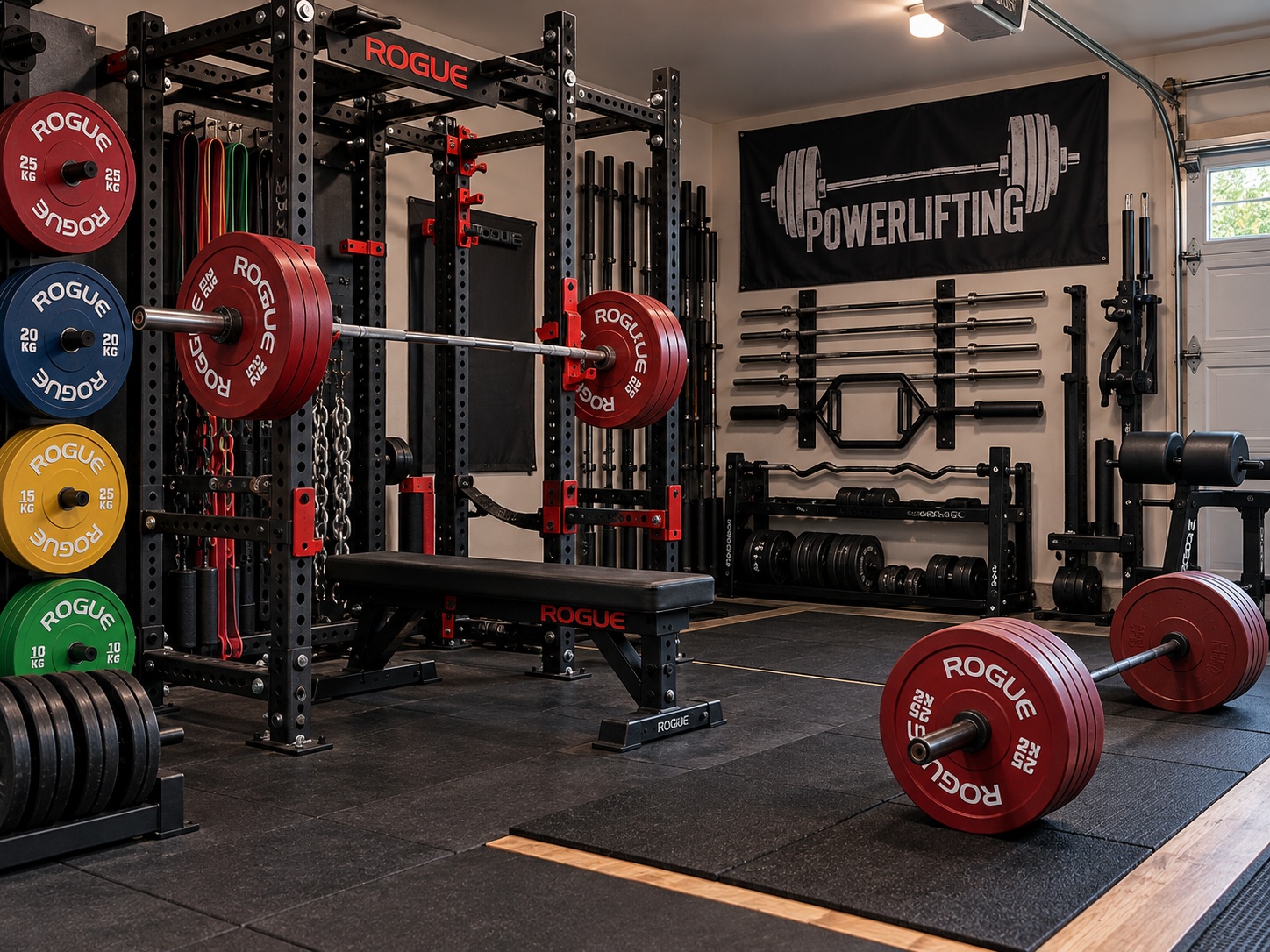
Setting up a home gym dedicated to powerlifting requires careful space planning and equipment selection based on verifiable technical criteria. The goal is to create a setup that allows you to perform squats, bench presses, and deadlifts efficiently while maintaining maximum compatibility among all components.
A well-designed configuration includes a rack, a stable bench, an Olympic barbell, compatible weight plates, a technical platform, and the essential accessories to organize the training area. Before purchasing, it is essential to verify dimensions, load capacities declared by the manufacturer, adjustment possibilities, and the actual available space.
The choice should not be based solely on the number of pieces of equipment purchased, but on their ability to work together coherently. A properly designed home gym can be expanded over time without having to replace the entire system.
What equipment do you really need for a powerlifting home gym?
The priority is to have a structure that allows you to train the three fundamental powerlifting movements. A rack normally represents the starting point because it allows you to perform squats and bench presses in a dedicated station.
Alongside the rack, you need a stable bench, a barbell compatible with the plates used, and a platform designed for overload training. Accessories can be added later based on the user's needs.
The choice should always take into account the available space and the possibility of expanding the setup without completely modifying the layout.
Which rack to choose?
The rack should offer precise adjustments, adequate stability, and a declared load capacity consistent with the type of training planned. A modular structure also allows you to integrate new accessories over time.
How important is the bench?
The bench must guarantee stability during the bench press and be compatible with the chosen rack in terms of both dimensions and available adjustments.
How to choose each component of the setup?
Each element must be evaluated individually but also in relation to the other components of the system. Barbell, plates, and rack must be perfectly compatible to avoid limitations during training.
It is advisable to always check the technical specifications provided by the manufacturer, including dimensions, materials, load capacity, and installation instructions.
Modularity represents an important advantage because it allows you to adapt the home gym to the evolution of your goals without replacing the entire equipment.
How to choose the barbell?
The barbell must be compatible with the plates used and designed for the type of training planned. Technical characteristics must be verified in the manufacturer's documentation.
Which plates to use?
The choice depends on the user's needs and compatibility with the barbell. The space available for storage should also be considered in the design.
Table of essential equipment
The following table summarizes the main components of a home gym dedicated to powerlifting.
| Equipment |
Function |
What to verify |
| Rack |
Squat and bench press |
Load capacity, adjustments, stability |
| Bench |
Bench press |
Rigidity and compatibility |
| Barbell |
Main exercises |
Dimensions and materials |
| Plates |
Load progression |
Compatibility with the barbell |
| Platform |
Protection and stability |
Materials and dimensions |
| Accessories |
Order and practicality |
Compatibility with the rack |
This configuration represents a starting baseline that can be expanded based on available space and future needs.
Before purchasing, it is always advisable to compare the technical specifications of the different components.
Which dimensions to check?
It is important to check height, width, depth, and operating space necessary to use the barbell safely.
Why is compatibility essential?
A setup composed of compatible elements facilitates daily use and makes it easier to add new accessories.
How to organize the home gym space?
Designing the equipment layout is just as important as choosing the individual components. Every exercise must be executable without interference with walls, furniture, or other equipment.
The required space includes not only the footprint of the rack but also that of the barbell during loading and execution of exercises.
An orderly layout also improves daily practicality and makes it easier to keep the area clean.
How to plan the layout?
It is advisable to leave sufficient space around the setup to facilitate movements, adjustments, and plate management.
Where to place accessories?
Plate trees and organization systems help keep the training area orderly and easily accessible.
How to correctly use the setup?
Before each workout, it is advisable to verify that the rack is adjusted correctly for the scheduled exercise and that all components are stable.
Adjustments should be adapted to the user's characteristics, always following the manufacturer's instructions regarding the installation and use of the equipment.
Even a simple visual inspection of the setup helps identify any anomalies before the session begins.
Why check adjustments?
Correct adjustment facilitates the execution of exercises and contributes to consistent equipment use.
What checks to perform before training?
It is advisable to check supports, safety systems, fasteners, and the general conditions of the setup.
How to improve safety in the home gym?
Safety begins with choosing components designed for the intended use and continues with correct installation according to the manufacturer's instructions.
The presence of adjustable safety systems, adequate technical flooring, and sufficient operating space help make the setup more functional.
Periodic maintenance is also an important element to keep the equipment in the conditions foreseen by the manufacturer.
Why use a platform?
The platform protects the floor and provides a dedicated surface for barbell exercises.
How much does maintenance matter?
Regular checks and cleaning of the equipment help preserve its functionality and durability over time.
What errors to avoid during setup?
One of the most frequent errors consists of purchasing equipment without verifying the actually available space. Lack of compatibility between the rack, bench, and accessories can also limit the use of the setup.
It is also advisable to avoid neglecting the technical specifications reported by the manufacturer and choosing products based exclusively on price.
Planning the entire project before purchasing allows you to reduce subsequent modifications and replacements.
Is price the main criterion?
No. Materials, adjustments, load capacity, and expansion possibilities are equally important elements.
Why think about future developments?
A modular structure facilitates the addition of new accessories while keeping the entire setup uniform.
How to plan the investment in the home gym?
A home gym dedicated to powerlifting should be designed considering the user's goals, available space, and the possibility of evolving over time. Initially investing in the fundamental components allows you to build a solid foundation on which to add new equipment when necessary.
Carefully analyzing powerlifting equipment for home gym, compatibility between rack and bench, space organization, and setup safety allows you to make a more informed choice.
To create a versatile configuration, it can be useful to start from a professional home gym rack compatible with the other elements of the system and easily expandable based on future needs.


 Budgets
 Dumbers
 Discs
 Benches
 Racks and Rigs
 Weights Holders
 Isotonic machines
 Calisthenics
 Cardio
 Kettlebells
 Flooring
 Gym Set
 Accessories
 Combat
 ARTI MARZIALI
 CONTAINER GYM
 Tug-Of-War
 Used Gym Equipment
 PILATES MACCHINARI
 GINNASTICA ARTISTICA
 CAMPI DA PADEL
 Prodotti in Pronta Consegna
 Informazioni
 IRONMAN
 Gift Card