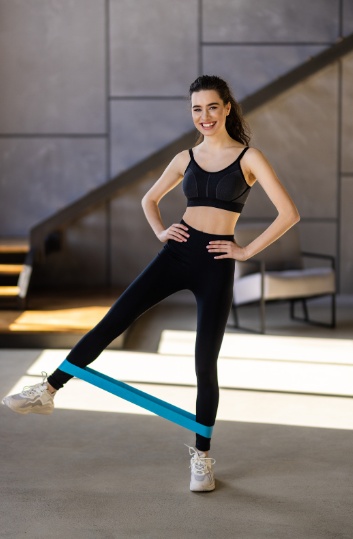
Resistance bands are among the simplest accessories to add to a workout routine, but that very simplicity often raises practical doubts. People who start training at home wonder which resistance level to choose, how to avoid mistakes during exercises, whether a resistance band can really replace part of the work done with weights or machines, and how safe it is to use one without direct supervision.
This guide gathers the most frequently asked questions about resistance bands and offers clear, concise yet complete answers, designed for anyone looking for guidance before buying or starting to use them. The goal is to reduce uncertainty and confusion by explaining when resistance bands are useful, how to choose them, and when they can be integrated into a home gym, a mobility routine or a more structured training plan.
Resistance bands add progressive resistance to body movements. The more the band is stretched, the greater the tension you feel, which allows you to work on strength, control, muscle activation and mobility. They are useful for leg, glute, shoulder, back and arm exercises, and also as support for technical movements such as assisted pull-ups or warm-up work before using free weights.
Their main advantage is versatility. A resistance band can be used at home, in a gym, in a small space or as an accessory combined with racks, benches and functional structures. They don't always replace full equipment, but they can make training more accessible, especially for those who want to start with a manageable load and gradually increase the difficulty.
Are resistance bands suitable for beginners too?
Yes, resistance bands are suitable for beginners, as long as they are chosen with a resistance that matches the starting level. For people who have just started training, a band that is too stiff can lead to compensations, incomplete movements or loss of control. A light or medium resistance, on the other hand, lets you learn the movement, feel the muscle involved and build a safer foundation.
The advantage for a beginner home trainer is the ability to start without clutter and without heavy loads. Resistance bands help you get comfortable with squats, rows, presses, abductions and mobility work while keeping a wide margin for adaptation. The practical rule is simple: the band should make the exercise challenging, but it should not prevent controlled technique.
How to choose resistance bands and sets
Is a single band better, or a set with multiple resistance levels?
A single band may be enough for a very specific use, such as light mobility work, warm-up or a targeted exercise. For more complete training, however, a resistance band set with different levels is often more practical. Each muscle group requires different tension levels: what is appropriate for the shoulders may be too light for legs and glutes, or too intense for rehabilitation exercises.
A set also allows for more orderly progression. When an exercise becomes easy, you can move to a stronger band or combine several bands, if the product allows it. For anyone building a small fitness area at home, this solution offers more continuity and reduces the risk of buying an accessory that becomes limiting after just a few weeks.
How do you know the right resistance?
The right resistance is recognized by the quality of the movement. During the exercise, the band should generate tension without forcing jerky motions, poor posture or overly fast movements. If your technique gets worse right away, the band is probably too strong. If instead the exercise still feels easy after many controlled repetitions, it may be useful to move to a higher resistance.
To guide your purchase, consider your goal. For mobility, warm-up and light physiotherapy, soft bands are more suitable. For general muscle training, a medium resistance may be needed. For strength exercises, assisted pull-ups, or leg and glute work, sturdier bands can be useful. If in doubt, a varied resistance band set lets you cover several uses with a single purchase.
Proper use, safety and maintenance
Can resistance bands break during training?
Resistance bands can break if they are worn, cut, exposed to excessive heat or used improperly. Before training, it's good practice to check the surface of the band, looking for cracks, thinning or damaged spots. Anchoring is also important: attaching a band to sharp edges, abrasive surfaces or unstable supports increases the risk of failure.
Safety also depends on controlling the movement. A band should not be stretched beyond its rated limit, nor allowed to snap back abruptly. During exercises near the face or torso, it is best to always keep a firm grip and a cautious distance. A good-quality product, used correctly and replaced when it shows signs of wear, offers more reliable use.
How do you store them so they last longer?
Resistance bands last longer if they are stored away from direct sunlight, heat sources, humidity and abrasive surfaces. After use, it's helpful to put them away dry and avoid leaving them knotted or stretched for long periods. Small habits, such as avoiding rough floors or contact with sharp objects, help preserve elasticity and material integrity.
Proper maintenance doesn't require complex procedures. Simply check the condition of the band regularly and clean it gently when needed, avoiding harsh detergents. In shared settings, such as personal training studios or gyms, checks should be more frequent because use is more intense. A worn-out band should never be forced: it's better to replace it before it becomes unsafe.
Resistance bands for home, gym and physiotherapy
Can you use them for home workouts?
Yes, resistance bands are particularly well suited to home training because they take up little space, are easy to store and allow for many exercise variations. For those without a dedicated room, they are a compact solution for working on muscle tone, mobility and general conditioning. They can be used alone or together with other equipment such as benches, mats, dumbbells or lightweight frames.
Their main limitation is that they require attention to technique and to choosing the right tension. At home, without supervision, it's best to prioritize controlled, progressive movements and avoid improvised exercises or unstable anchor points. For more organized use, it can be useful to build a small kit made up of bands with different resistance levels, a mat and a few essential functional accessories.
Are resistance bands also good for mobility and recovery?
Resistance bands are often used for mobility, warm-up and light recovery work, because they allow gradual, controlled movements. In these cases you don't need maximum resistance, but tension that supports the movement without causing pain or compensations. They are useful for activation exercises, joint control and muscle preparation before more intense sessions.
When it comes to physiotherapy or recovery after an injury, however, it's important to distinguish general use from therapeutic use. Resistance bands can be valid tools, but the program should be prescribed by a professional when pain, functional limitations or specific medical conditions are present. In these cases, the band is not the solution in itself: it is a tool that must be used correctly.
A simple choice once the answers are clear
When is it worth switching to a more complete set?
It's worth switching to a more complete set when a single band no longer covers different exercises. If the same resistance feels too light for some movements and too intense for others, your training needs more modulation. This often happens when you move from simple exercises to more structured routines for legs, back, shoulders and glutes.
A set with multiple resistance levels helps you build progression, adjust the load and make training more balanced. For those who use resistance bands regularly, choosing a varied resistance band set is more functional than buying single bands at random. This way, each exercise can be adjusted to your actual level, not to whichever resistance happens to be available at the time.
Where can you learn more before buying?
Before buying, it helps to clarify your main goal: home training, warm-up, mobility, support for strength exercises or professional use. This choice determines the format, resistance and accessories to consider. A light band may be adequate for stretching and activation, while a more complete set offers greater freedom for progressive programs.
To get better guidance, you can read our guides on resistance band exercises for beginners and explore the functional accessories section, where you'll find resistance bands and small equipment suited to your training space. When your questions have clear answers, the choice becomes safer and using resistance bands every day feels more natural, effective and sustainable over time.


 Budgets
 Dumbers
 Discs
 Benches
 Racks and Rigs
 Weights Holders
 Isotonic machines
 Calisthenics
 Cardio
 Kettlebells
 Flooring
 Gym Set
 Accessories
 Combat
 ARTI MARZIALI
 CONTAINER GYM
 Tug-Of-War
 Used Gym Equipment
 PILATES MACCHINARI
 GINNASTICA ARTISTICA
 CAMPI DA PADEL
 Prodotti in Pronta Consegna
 Informazioni
 IRONMAN
 Gift Card