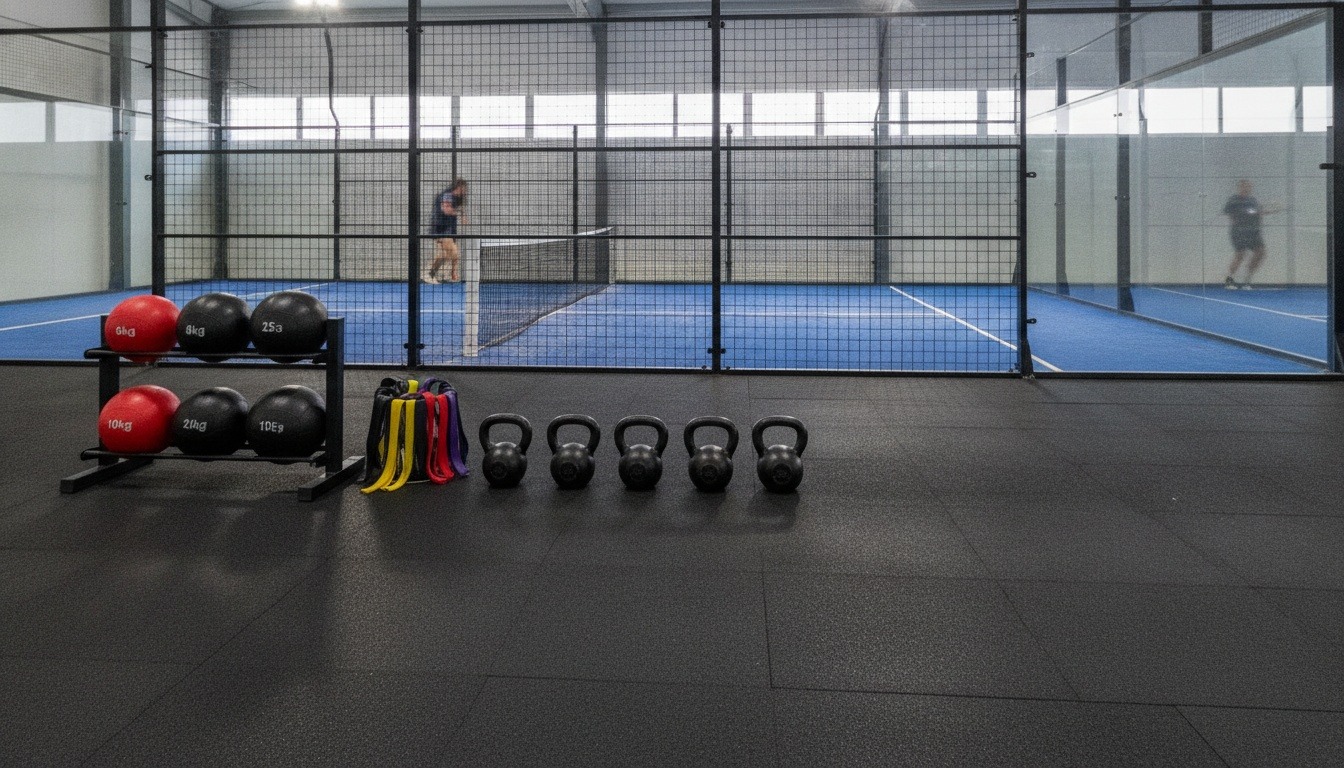
A fitness area in a padel club makes sense when it is driven by the needs of players and the work of coaches, not by the idea of opening a generic gym. It is best to start with a small, well-used space (warm-up and basic preparation) and expand only if members really use it.
The most common objection is fair: people who come to play padel usually don't want to go to the gym. For this reason, the area should be designed as a service for the player, linked to the time before and after the match and to lessons. In this guide you will find how to assess demand, how much space you need and three hypothetical scenarios with the equipment suited to each.
The scenarios are examples of reasoning, not forecasts of revenue or usage: your choices will depend on your club, your members and the space available.
In this article
Does a fitness area make sense in a padel club?
It depends on who uses the club. If you have regular players, competitive groups, coaches who run structured lessons, or members who stay at the club beyond their court time, a space for preparation fits your offer. If the club relies almost entirely on occasional matches, the service risks sitting empty.
Fitness works as a complement to the courts: it gives people more reasons to arrive early, stay after playing and keep visiting the club on rainy days or in winter. It is neither an obligation nor a shortcut to member loyalty: it is a service to test with a lightweight setup.
Before investing, talk to coaches and trainers: they know what players are missing and how they would use the space.
Which uses should you start with?
Start from the uses, and only then choose the equipment. For a padel club, the three most realistic cases are:
- Warm-up and mobility before a match or lesson.
- Small-group functional training led by a coach or trainer.
- Basic strength and conditioning for players who want more consistent preparation.
Each use has different needs in terms of space, supervision and schedules. A warm-up corner is free and quick to use; a functional class requires a dedicated area and an instructor; a full gym requires management, maintenance and a sufficient number of users.
For general design principles, you can consult the guide on how to design an athletic preparation area and the one on choosing equipment for athletic preparation. Here we focus on the specific case of the padel club.
How much space do you need and which flooring should you choose?
There is no single valid floor area for every club: it depends on how many people use the area at the same time and what they do. As a practical rule, consider the footprint of movements (throws, lunges, jumps) as well as the equipment, and always leave clear walkways between stations. For details on safety distances, refer to the manufacturers' instructions and your designer.
Flooring is the most important choice, because in a club the fitness area is often built in rooms designed for other purposes (storage, a room above the changing rooms, a covered terrace). Suitable flooring, such as rubber gym flooring in rolls or tiles, protects the subfloor, reduces the noise of falling equipment and makes the area usable even with heavy loads and slam balls.
Always check thicknesses and features on the product page against the loads and movements you plan.
Three scenarios: from warm-up to full gym
These scenarios are working hypotheses: they help you decide, step by step, what to install, not predict results.
Scenario 1: warm-up corner
This is the minimum level, suited to a small space near the courts or the changing rooms. It prepares players before a match, with light and compact equipment.
- Variable-resistance bands, such as the set of 5 fitness bands.
- Light medicine balls for rotation and wall throws.
- Balls and steps for mobility and coordination exercises.
- A section of rubber flooring, even if limited.
The investment is contained and the area does not require constant supervision. It is the best test to find out whether members actually use it.
Scenario 2: functional area for small groups
Designed for small-group classes led by a coach or trainer, with station-based circuits. It needs a dedicated space, suitable flooring and equipment that is easy to move and store.
To plan your circuits, you can start from the guide on equipment for a bodyweight functional circuit. A tidy equipment rack or storage zone makes a real difference: if preparing a lesson takes ten minutes, the area will not get used.
Scenario 3: full gym
This is the most demanding level and only makes sense if the first two work well. It adds a strength and cardio zone and requires maintenance, access management and, ideally, a staff member on site.
- A rig or frame for multi-station work (pull-ups, suspension training, functional stations).
- Functional cardio for conditioning and active recovery.
- Multi-function machines for basic strength: look at compact solutions in the selectorized machines category.
- An optional separate stretching and mobility area.
To understand how to combine cardio and strength in a single space, see also the guides on cardio equipment for professional centres and on which areas to include in a fitness centre.
How to avoid an underused mini gym
The main risk is buying generic equipment that nobody uses. A few measures help reduce it:
- Involve the coach or trainer in choosing the equipment: they know which movements are needed.
- Start with the minimum scenario and observe for a few months who uses it and when.
- Connect the area to the courts: schedules, lessons and warm-up routines should bring players there naturally.
- Expand in phases, adding equipment only when what you already have is used consistently.
- Plan maintenance: a broken or dirty piece of equipment discourages use more than a small area does.
Beware of the copycat effect: the fact that another club has a gym tells you nothing about the demand at yours. Assess your members, not someone else's.
Frequently asked questions
Does it really need a large room?
No. A well-equipped warm-up corner can be a valid first step. Expand only if usage justifies it.
Who should supervise the area?
It depends on the scenario. A warm-up corner can be open access; lessons and circuits require a qualified coach or trainer. For advice on exercises and safety, always turn to professionals.
Which equipment makes the most sense to start with?
Bands, medicine balls, slam balls, kettlebells and functional accessories: they are versatile, take up little space and suit several levels.
Does a fitness area prevent injuries?
You cannot promise results of this kind. The area can support preparation, but programmes and goals should be defined with trainers and medical professionals.
Can I use second-hand equipment?
It depends on the piece and how it will be used. The catalogue also includes used gym equipment: always check the condition and the product page.
Where to start
Fitness in a padel club works when it starts from the player: clear uses, a realistic space, a light first scenario and gradual expansion. Consult your coaches, choose the right flooring and install equipment based on what will actually be used.
If you want to assess the space and equipment at your club, you can explore the categories of accessories and flooring or request a consultation or a quote from Donatif.


 Budgets
 Dumbers
 Discs
 Benches
 Racks and Rigs
 Weights Holders
 Isotonic machines
 Calisthenics
 Cardio
 Kettlebells
 Flooring
 Gym Set
 Accessories
 Combat
 ARTI MARZIALI
 CONTAINER GYM
 Tug-Of-War
 Used Gym Equipment
 PILATES MACCHINARI
 GINNASTICA ARTISTICA
 CAMPI DA PADEL
 Prodotti in Pronta Consegna
 Informazioni
 IRONMAN
 Gift Card