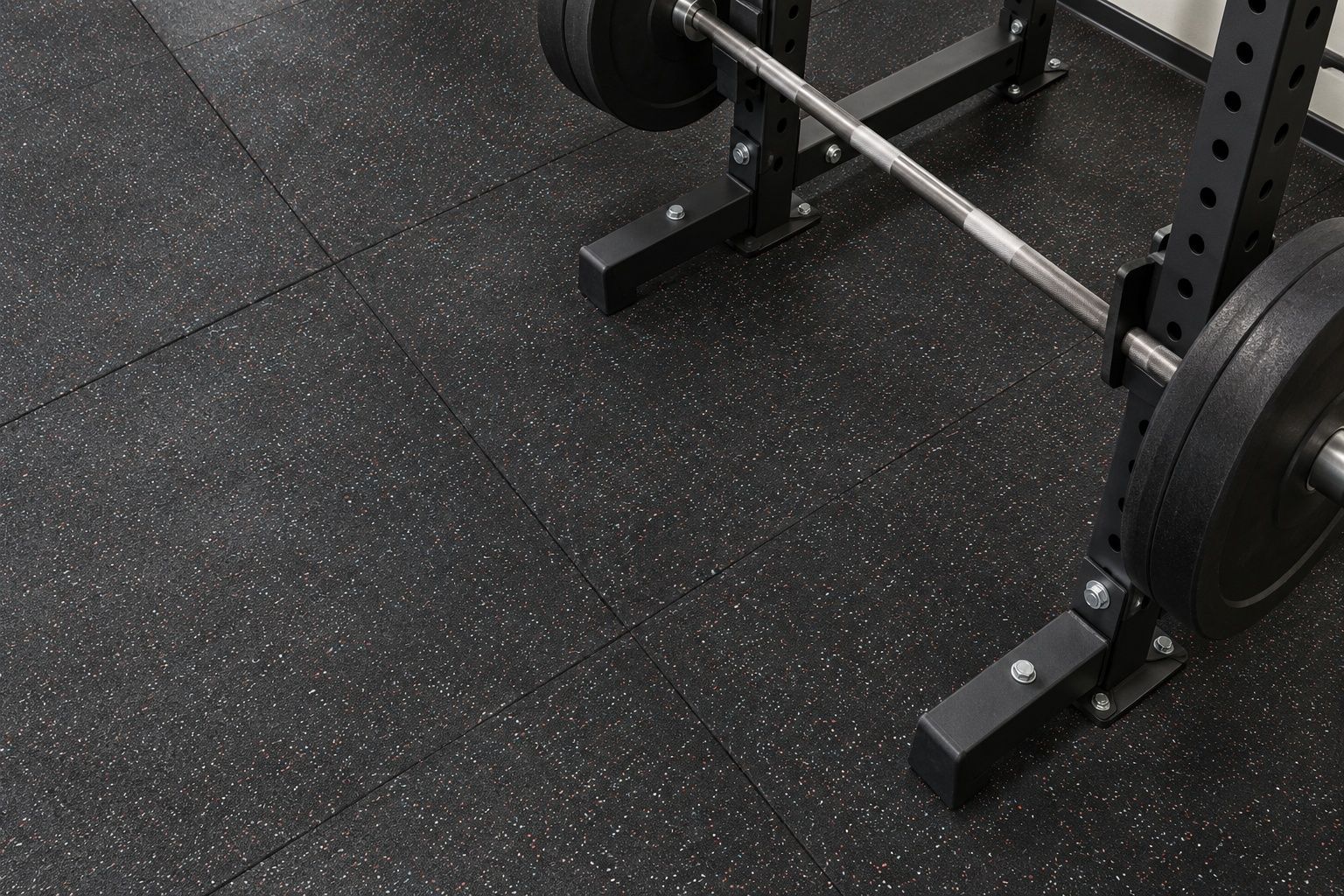
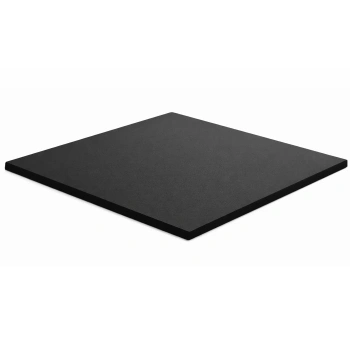
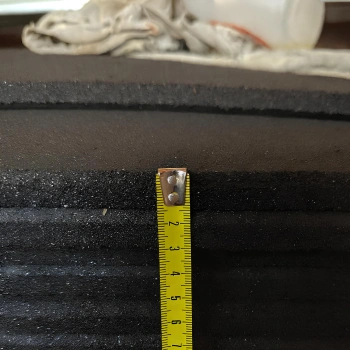
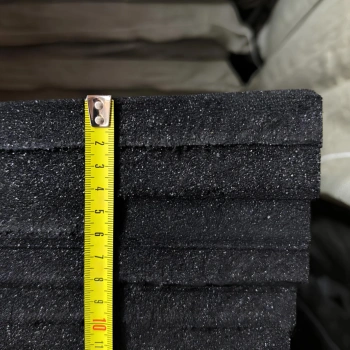
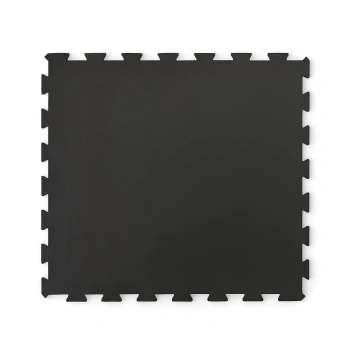
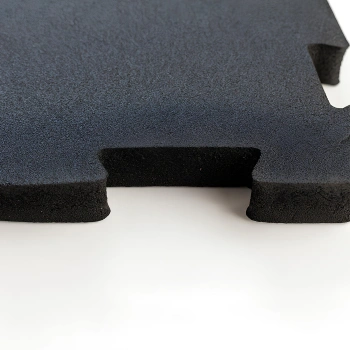
The gym flooring with colored dots is a visually recognizable solution, often chosen to give character to fitness environments and integrate the surface with the facility's aesthetic identity. The presence of colored granules distributed on a generally dark base can enhance weight rooms, functional areas, and spaces dedicated to training. However, for a designer, the visual result represents only one of the elements to consider when selecting flooring.
Two seemingly similar surfaces can exhibit different characteristics in terms of composition, density, finish, installation methods, and behavior during use. The distribution of colored dots does not automatically prove better grip, superior stress resistance, or a particular impact absorption capacity. These properties must be evaluated through technical documentation referring to the specific product and the conditions foreseen by the project.
For those designing a professional gym, the correct question is therefore not whether a speckled surface is better than a uniform one, but which characteristics are actually declared, verifiable, and compatible with the planned activities. This guide proposes a comparison method based on samples, material datasheets, operational requirements, and documentary checks, distinguishing aesthetic preferences from demonstrated performance.
Table of contents
The problem: aesthetics and performance of speckled flooring
Choosing gym flooring involves architectural, functional, and economic requirements. A finish with colored granules can contribute to the visual continuity of environments, make certain areas recognizable, and coordinate with walls, equipment, and furnishings. These advantages mainly concern the perception of space and must be distinguished from the technical characteristics of the surface.
The design risk arises when an easily observable attribute is used as an indicator of non-directly visible properties. A surface that appears compact is not necessarily more resistant. A finish with evident grain does not automatically guarantee greater grip. Even the presence of colored granules does not allow one to deduce the quality of the material or its suitability for specific stresses.
The designer must therefore separate three levels of evaluation: visual appearance, characteristics declared by the manufacturer, and expected behavior under real conditions of use. The first level can be observed through images and samples. The second requires technical documentation. The third requires a comparison between available data, installation methods, and the activities actually planned in the gym.
What colored dots really indicate
In rubber flooring, colored dots can result from the presence of pigmented granules integrated into the surface composition. Their size, distribution, and visible percentage depend on the specific processing. However, it is not possible to establish the complete composition of the product by observing the pattern alone. It is necessary to verify whether the manufacturer declares materials, structure, layer characteristics, and any differences between aesthetic variants of the same range.
Why the finish does not constitute performance proof
Functional properties depend on factors that can include formulation, thickness, structure, surface processing, and installation conditions. A color or texture does not represent a technical measure. When characteristics such as slip resistance or impact behavior are declared, it is necessary to know the test method, the result, the examined product, and the conditions in which the data is applicable.
What data to collect before choosing
Before comparing two speckled floors, it is useful to build a design requirements sheet. The intended use constitutes the starting point: an area dedicated to guided machines presents different operating conditions compared to an area for bodyweight exercises or a room where weights and equipment are frequently moved.
Information gathering should include room dimensions, subfloor type, expected traffic intensity, cleaning methods, presence of fixed equipment, and possible future reconfigurations. It is also important to indicate any constraints related to finished floor levels, connections with other materials, accessibility, and available time for installation.
These data transform a generic request into a verifiable technical question. Rather than simply asking which speckled floor is better, the designer can inquire which solutions are compatible with a given subfloor, specific maintenance operations, and the planned equipment.
Material datasheets and essential information
Documentation to request includes exact product identification, declared composition, nominal thickness, format, available tolerances, installation and maintenance instructions. When relevant, test results, classifications, and relative validity conditions must also be requested. The absence of a piece of data does not automatically prove that the material is unsuitable, but prevents attributing undocumented performance to it.
Defining verifiable requirements for each environment
An effective project sheet distinguishes indispensable requirements, preferential characteristics, and exclusively aesthetic aspects. For example, compatibility with the planned installation system may be indispensable, while a certain color combination may represent a preference. This distinction avoids a visual advantage improperly compensating for a documentary shortcoming related to an essential requirement.
Criterion 1: grain, surface, and planned activities
The finishes of rubber floors can show visible differences in granule size, pattern regularity, and surface appearance. These characteristics influence aesthetic perception and may suggest further practical checks, but they alone do not allow predicting the material's behavior during training.
A seemingly fine grain may be preferred to obtain a uniform visual result, while a more evident color distribution can help characterize a functional zone. Neither configuration should be considered automatically superior. Evaluation depends on activities, usage methods, and available data for each product.
The designer should compare representative samples under the environment's lighting conditions, observing them closely and from the normal distance of use. It is useful to check the visibility of joints, color continuity between elements, and the possible presence of differences between batches, asking the manufacturer what tolerances are expected.
Fine grain and evident grain: differences to verify
The visible size of the granules does not necessarily coincide with the actual roughness of the surface. A pattern with large dots may present a relatively regular finish, while a uniform appearance may hide a different microstructure. To correctly compare alternatives, it is necessary to examine physical samples and request specific information on surface processing, avoiding unproven equivalencies between appearance and performance.
Associating the surface with planned activities
A room intended mainly for bodyweight training requires different evaluations compared to an area with benches, machines, and load movement. In impact-prone areas, the declared performance of the complete system must be verified, including thickness, subfloor, and installation methods. Where frequent movements are present, compatibility with wheels and supports and the manufacturer's instructions regarding localized stresses also become important.
Criterion 2: cleanability, grip, and equipment movement
The cleanability of the flooring is an operational criterion that deserves independent evaluation from aesthetics. A floor destined for a professional gym must be integrated into maintenance procedures compatible with the material, the frequency of use of the environments, and the available cleaning equipment.
The presence of colored dots can alter the visual perception of dust, marks, and residue, but it does not demonstrate greater ease of cleaning. The ability to remove dirt depends on surface characteristics, detergents used, intervention methods, and actual conditions. A sample check can help evaluate the visual result, provided it is performed following the manufacturer's instructions.
A second aspect concerns grip. It is incorrect to deduce slip-resistant performance from the simple speckled appearance. To formulate a technical evaluation, documented data, references to the test method, and indications on the considered conditions are required. The same attention must be applied to the movement of equipment, which can generate stresses different from those produced by normal foot traffic.
Verifying daily cleaning procedures
Before choosing, it is appropriate to ask which detergents are permitted, which products should be avoided, and whether there are limitations on the use of floor scrubber machines. It is also useful to clarify stain removal methods and recommended procedures for periodic maintenance. Instructions must refer to the product actually proposed, not generically to the category of rubber floors.
Documented grip and load handling
The documented grip must be evaluated considering the test method used and the relevance of the conditions to the destination environment. For mobile equipment, it is also necessary to verify any limitations related to wheels, dragging, and concentrated loads. When the manufacturer does not have sufficient indications, the designer should record the informational limit and request technical clarification before approving the solution.
Documentary checks, samples, and installation conditions
Flooring cannot be evaluated exclusively as an isolated material. The behavior of the installed system also depends on the subfloor, surface preparation, fixing method, and environmental conditions during installation. For this reason, a product sheet must be accompanied by application instructions consistent with the construction site.
The designer should verify the required flatness, permitted conditions for the support, any prescriptions related to moisture, and compatibility between flooring and products used for installation. Applicable thresholds must come from the chosen system's documentation or the competent technician's checks, without using generic values as if they were valid for every material.
Physical samples perform a complementary function compared to datasheets. They allow observing the finish, evaluating color combinations, and verifying some practical aspects, but they do not replace performance tests or certifications. A visually convincing sample does not automatically prove that the complete installation will maintain the required characteristics.
How to examine representative samples
It is preferable to request samples identified with the exact product code, thickness, and color variant. Comparison should take place on a surface large enough to show the distribution of colored dots. When possible, it is also useful to examine the combination between adjacent elements to evaluate the visual continuity of joints and identify any issues to clarify before ordering.
Installation conditions and technical responsibilities
Instructions must specify the conditions required for the subfloor, any compatible fixing materials, and installation procedures. It is appropriate to distinguish the responsibilities of the manufacturer, designer, and installer. If the construction site presents conditions not foreseen by the documentation, a specific evaluation must be requested instead of assuming the system can be installed without modifications.
Technical matrix to compare alternatives
To avoid a decision dominated by visual appearance, it is useful to build a matrix that places functional requirements and the quality of available information on the same plane. The matrix must not transform undocumented characteristics into arbitrary scores. Its objective is to distinguish what is verified, what requires clarification, and what is not compatible with the project.
Three hypothetical alternatives can be compared: a speckled surface with visually fine grain, a speckled one with more evident granules, and a chromatically uniform surface. These descriptions identify only aesthetic configurations and not specific commercial products. No alternative possesses, by definition, superior performance to the others.
Evaluation should be completed only after collecting documents referring to each proposal. If an indispensable requirement is not demonstrated, the alternative remains pending even when it fully satisfies aesthetic preferences. This method makes the reasons for the choice explicit and keeps a record of the checks carried out.
Example of comparison matrix
| Criterion |
Fine speckled surface |
Evident speckled surface |
Uniform surface |
| Aesthetic coherence |
Evaluate on sample |
Evaluate on sample |
Evaluate on sample |
| Composition and thickness |
Verify datasheet |
Verify datasheet |
Verify datasheet |
| Cleanability |
Verify instructions |
Verify instructions |
Verify instructions |
| Grip |
Request relevant data |
Request relevant data |
Request relevant data |
| Equipment movement |
Verify compatibility |
Verify compatibility |
Verify compatibility |
| Installation conditions |
Verify system |
Verify system |
Verify system |
How to interpret results without creating false certainties
For each criterion, three states can be used: verified, to be investigated, and not compatible. The verified state requires documentary reference or appropriate technical evaluation. To be investigated indicates that available information does not yet allow a decision. Not compatible instead identifies documented contrast with a project requirement. This approach is more transparent than a ranking based on subjective impressions.
Two design scenarios for the designer
To understand the application of the method, let us consider two hypothetical scenarios. They do not represent comparative tests between products and do not attribute performance to specific flooring. They serve to show how priorities change according to use and how the same aesthetic finish may require different checks.
In the first scenario, a gym includes a functional training area with bodyweight exercises, small equipment, and frequent traffic. In the second, the surface will be installed in a weight area with larger equipment, concentrated supports, and possible space reconfigurations.
In both cases, a speckled finish can be considered, but the decision must start from operational constraints. Color characteristics are evaluated after verifying the material's compatibility with activities and installation conditions. This order reduces the risk of selecting an aesthetically convincing solution that is insufficiently documented.
Scenario A: functional area with frequent traffic
In this environment, the designer should focus on the surface's compatibility with planned exercises, cleaning procedures, and grip information under relevant conditions. The presence of small equipment makes it useful to also check the manufacturer's indications on contact with the material. A speckled finish can be chosen for aesthetic reasons only after confirming indispensable functional requirements.
Scenario B: weight area with movable equipment
Here, localized stresses, compatibility with supports, and planned methods for moving equipment become central. If load drops are possible, relevant data on system behavior under the considered conditions must be requested, without presuming protective capacity based on thickness or finish. Among the categories to be examined is the anti-shock gym flooring, verifying declared characteristics, application limits, and project compatibility for each actually available model.
Checklist, signs of unsuitability, and questions for the supplier
A technical checklist allows standardizing information gathering and comparing offers from different suppliers. To be useful, it must contain precise questions, requested documents, and verification responsibilities. It is not enough to note that a surface is suitable for the gym: it is necessary to specify which activities, conditions, and requirements this statement refers to.
The first check concerns material identification. The second verifies correspondence between documentation and proposed product. The third concerns operating conditions, including installation, maintenance, and equipment. Finally, the designer must record any exclusions, limitations, and checks still necessary before final approval.
A warning sign is the presence of generic commercial descriptions not accompanied by verifiable data. The impossibility of identifying the examined product in a test or the absence of relevant installation instructions also require clarification. These situations do not necessarily demonstrate poor material quality, but prevent considering technical evaluation concluded.
Checks to complete before purchase
- Identify product code, variant, format, and thickness.
- Request technical datasheet and relevant performance documentation.
- Examine a physical sample representative of the finish.
- Verify compatibility with activities, equipment, and cleaning methods.
- Check subfloor requirements and installation instructions.
- Record limitations, exclusions, and aspects still to be verified.
- Confirm technical responsibilities and job acceptance conditions.
Targeted questions to ask the supplier
It is useful to ask whether color variants share the same composition and declared performance, which tests are available for the specific product, and which conditions limit its application. Other questions concern compatible detergents, prescriptions for mobile equipment, dimensional tolerances, and management of any color differences between supplies. Responses should be documented and kept together with project deliverables.
How to justify the decision and protect the investment
Selecting professional flooring impacts the initial cost of setup and subsequent management activities. The price of the material represents only one component of the economic evaluation. Subfloor preparation, installation, maintenance, any corrective interventions, and compatibility with future equipment layout modifications must also be considered.
A reliable economic comparison requires offers built on equivalent conditions. If two proposals include different processes or provide different requirements for the support, the price per square meter alone does not allow a complete comparison. It is appropriate to distinguish documented costs, design estimates, and items yet to be defined, avoiding attributing unproven future savings to a particular finish.
The decision should be formalized through a brief report outlining intended use, examined alternatives, indispensable requirements, consulted documents, and reasons for selection. In this way, the designer can explain to the gym owner why a certain surface was preferred, clarifying which elements derive from tests, which from application evaluations, and which from aesthetic preferences.
When two products satisfy the same documented technical requirements, the distribution of colored dots can become a legitimate criterion for architectural choice. If, instead, information on an essential characteristic is missing, comparison must remain open until verified. Investment protection derives above all from the quality of the decision-making process, the correct assignment of responsibilities, and the availability of documents consistent with the system actually installed.
For a gym in the design or renovation phase, the operational step is therefore to collect candidate product datasheets, request identifiable samples, and submit actual conditions of use to the supplier. Only after this comparison is it possible to transform a preference for speckled flooring into a motivated, verifiable purchase specification compatible with the facility's needs.


 Budgets
 Dumbers
 Discs
 Benches
 Racks and Rigs
 Weights Holders
 Isotonic machines
 Calisthenics
 Cardio
 Kettlebells
 Flooring
 Gym Set
 Accessories
 Combat
 ARTI MARZIALI
 CONTAINER GYM
 Tug-Of-War
 Used Gym Equipment
 PILATES MACCHINARI
 GINNASTICA ARTISTICA
 CAMPI DA PADEL
 Prodotti in Pronta Consegna
 Informazioni
 IRONMAN
 Gift Card