
Trolley
You have no items in your shopping cart

 Budgets
 Dumbers
 Discs
Discs
 Benches
 Racks and Rigs
 Weights Holders
 Isotonic machines
 Calisthenics
 Cardio
 Kettlebells
 Flooring
 Gym Set
 Accessories
 Combat
 ARTI MARZIALI
 CONTAINER GYM
 Tug-Of-War
 Used Gym Equipment
 PILATES MACCHINARI
 GINNASTICA ARTISTICA
 CAMPI DA PADEL
 Prodotti in Pronta Consegna
 Informazioni
 IRONMAN
 Gift Card
- Donatif
- Sports products
- 0 I like it
- 1458 Views
- 0 comments
- stress reduction, improved self-esteem, physical and mental well-being, gym training
READING TIME: 5 MINUTES ➤➤
Puzzle tatami or professional solution: which one really makes sense in a combat studio
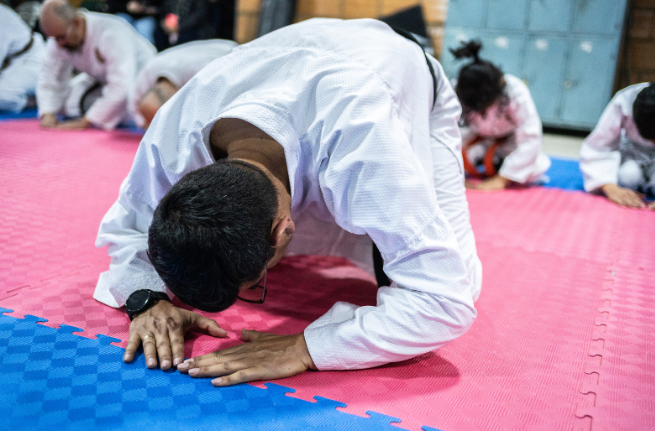
When designing a space dedicated to combat sports, one of the most delicate choices concerns the flooring. The most common dilemma revolves around two options: puzzle tatami or a structured professional surface. This is not just a technical decision, but one that directly impacts safety, customer perception, and the positioning of the studio.
Many operators find themselves stuck between the fear of choosing a low-cost solution that appears unprofessional and the opposite risk of overinvesting in a structure that is excessive for their business model. Understanding when a solution is truly appropriate means finding the right balance between cost, actual use, and professional image.
- Puzzle tatami and professional surfaces
- When to choose puzzle tatami
- When a professional solution is needed
- Practical comparison
- Investment and positioning
Puzzle tatami and professional surfaces: two different approaches to flooring
Puzzle tatami represents a modular solution made of interlocking elements, designed to be installed quickly without structural work. They are especially common in flexible environments where space must adapt to different activities.
Professional surfaces, on the other hand, are more complex systems, often installed in a semi-permanent or permanent way. They use high-density materials and provide a more precise technical response, especially in terms of shock absorption and stability.
How puzzle tatami works
Puzzle tatami is based on independent modules that interlock, creating a continuous surface that can still be easily removed. This feature makes it extremely versatile, especially for those operating in shared or evolving spaces.
From a technical standpoint, they offer a good level of protection, but with limitations related to long-term stability and resistance under heavy loads. Quality can vary significantly depending on the materials used, making careful selection essential.
What sets professional flooring apart
Professional solutions stand out for their performance-oriented design. Each layer of the flooring is engineered to ensure shock absorption, energy return, and stability, all crucial elements in combat sports.
These surfaces also convey a strong sense of solidity and continuity, improving not only safety but also the overall perception of the space by the user.
Real-world use: when puzzle tatami is a sensible choice
Puzzle tatami finds its ideal application in contexts where flexibility is a key requirement. PT studios focused on functional training with a light combat component can benefit from this solution without compromising the experience.
It is particularly suitable when the activity does not involve frequent throws or high-impact movements, and when the space needs to be reconfigured quickly. In these cases, operational advantages outweigh structural limitations.
Low-intensity and multifunctional environments
In a micro gym where multiple disciplines coexist, puzzle tatami allows the space to be transformed dynamically. This adaptability is a real asset for those with space or layout constraints.
It also represents a good starting point for those in the early stages who want to test an offering without tying up capital in more complex infrastructure.
Operational limits to consider
Despite its advantages, puzzle tatami can show weaknesses over time. Stability may decrease with intensive use, and the surface can become less uniform under high stress.
Visual perception can also be a limitation: in more structured environments, clients may interpret it as a temporary or less professional solution.
When a structured professional solution is needed
Professional flooring becomes essential when combat activity is central to the business model. In these cases, the surface is not just an accessory but a critical part of the experience.
Investing in a structured solution means ensuring operational continuity, advanced safety, and consistency with a premium positioning.
High-intensity and impact environments
If the studio includes sparring, throws, or high-intensity training, puzzle tatami may not be sufficient. The surface response must be predictable and consistent.
A professional flooring system ensures stable performance over time, reducing injury risk and improving training quality.
Stability, safety, and surface continuity
One of the main advantages is the complete absence of discontinuities. This is crucial for disciplines where contact with the ground is frequent and dynamic.
The perception of safety increases, along with the client's trust in the space and the service offered.
Direct comparison: installation, maintenance, and visual impact
From a practical standpoint, puzzle tatami is unbeatable in terms of ease of installation. It requires no technical work and can be managed independently, making it ideal for those seeking speed and simplicity.
Professional surfaces, on the other hand, require more careful planning and specialized installation, but offer superior performance in every structural aspect.
Ease of installation and management
Puzzle tatami can be assembled and disassembled quickly, also simplifying routine maintenance. However, this flexibility can translate into lower long-term stability.
Professional solutions require fewer corrective interventions over time, making them more efficient in high-usage environments.
Aesthetic impact and customer perception
Visual impact is one of the most underestimated elements. A professional surface immediately communicates quality, order, and specialization.
Puzzle tatami, while functional, may convey a more amateur impression if not properly integrated into the studio context.
Investment and positioning: avoiding strategic mistakes
The choice between puzzle tatami and a professional solution should not be driven solely by budget, but by the positioning you want to build. Every structural decision contributes to shaping brand perception.
An investment that is too low can undermine credibility, while an excessive one can reduce the economic sustainability of the project.
Budget vs perceived value
It is essential to consider return on investment not only in economic terms, but also in terms of attractiveness and customer retention. Flooring is one of the most visible and perceived elements.
A consistent choice strengthens trust and improves the overall experience, directly influencing retention.
How to choose based on your studio model
There is no universally better solution. The right choice depends on usage intensity, target audience, and growth objectives.
Carefully evaluating your context allows you to avoid positioning mistakes and build a space that is coherent, functional, and credible over time.
Comments (0)