
Trolley
You have no items in your shopping cart

 Budgets
 Dumbers
 Discs
Discs
 Benches
 Racks and Rigs
 Weights Holders
 Isotonic machines
 Calisthenics
 Cardio
 Kettlebells
 Flooring
 Gym Set
 Accessories
 Combat
 ARTI MARZIALI
 CONTAINER GYM
 Tug-Of-War
 Used Gym Equipment
 PILATES MACCHINARI
 GINNASTICA ARTISTICA
 CAMPI DA PADEL
 Prodotti in Pronta Consegna
 Informazioni
 Gift Card
- Donatif
- Training and exercises
- 0 I like it
- 2 Views
- 0 comments
- gym flooring, safety flooring, gym safety, shock-absorbing materials
READING TIME: 5 MINUTES ➤➤
30-Minute Full Body Resistance Band Workout
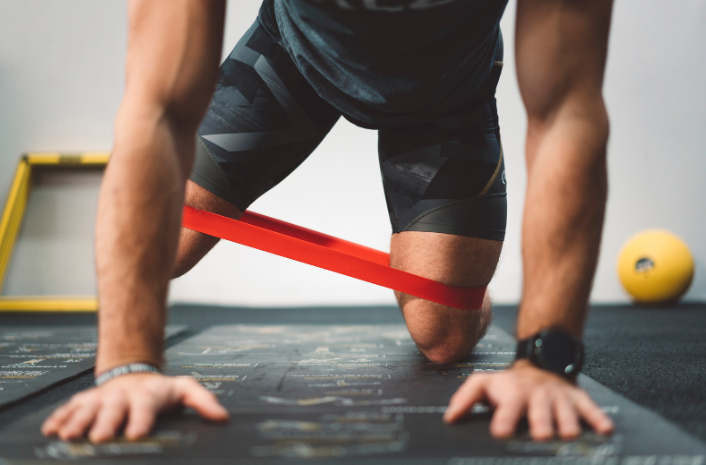
A full body resistance band workout can be a practical solution when time is limited, space is restricted, and going to the gym does not always fit into your daily schedule. Resistance bands do not replace every gym machine or free weight, but they allow you to build an organized, progressive, and effective routine for maintaining consistency without overcomplicating your training.
The goal is not to do everything in half an hour, but to make those 30 minutes count. A short program works when it follows a clear structure, controlled rest periods, and movements that involve legs, back, chest, shoulders, arms, and core. For beginners or frequent travelers, a resistance band circuit workout can become a reliable foundation: easy to repeat, simple to modify, and minimally disruptive to everyday routines.
Why a short circuit can work even without a gym
The advantage of resistance bands when time is limited
Resistance bands offer a practical advantage: they reduce the time wasted on setup, commuting, and changing equipment. Whether you are in a room, a hotel, or a small corner of your home, they allow you to move quickly from squats to rows, from pushing exercises to core movements. This makes a 30-minute resistance band workout ideal for people who are not looking for long sessions but want a sustainable routine. Resistance changes according to band tension, so movements remain adaptable even without traditional weights.
How to approach the 30 minutes: density, control, and consistency
Half an hour should not be viewed as a shortcut, but as a well-structured training window. Workout density depends on the relationship between exercises, rest periods, and technical quality. Rest periods that are too long reduce the effectiveness of the circuit, while pauses that are too short can negatively affect execution. For this reason, using a simple timer is recommended: 40 seconds of work followed by 20 seconds of rest, transitioning smoothly between exercises. The result is a compact session designed for those who want to stay active without relying on random or difficult-to-maintain programs.
The full body resistance band workout with timer
Active warm-up and first lower body block
Before starting the main circuit, dedicate 4 minutes to mobility and activation exercises: shoulder circles, bodyweight squats, chest-opening movements with a light band, and marching in place. Then begin the first block with band squats, alternating lunges, and glute bridges with the band positioned above the knees. Each exercise lasts 40 seconds, followed by 20 seconds of rest. Repeat the block twice. This opening phase prepares the legs and hips, gradually raises the workout intensity, and creates a solid base for the rest of the full body resistance band program.
Pushing, pulling, and core work
The second block focuses on the upper body. Include resistance band rows, chest presses with the band fixed behind your back or attached to a stable anchor point, shoulder presses, and controlled curls. Again, maintain 40 seconds of work and 20 seconds of rest for two complete rounds. Finish with shoulder-tap planks, dead bugs using a light resistance band, and controlled torso rotations. The sequence alternates pulling, pushing, and stabilization exercises, preventing excessive fatigue on a single muscle group. This structure keeps the resistance band circuit organized and easier to complete.
Practical variations to adapt the circuit to your level
How to simplify the exercises if you are a beginner
Beginners can reduce band tension, shorten work intervals to 30 seconds, or increase rest periods to 30 seconds. Lunges can become assisted squats, planks can be performed with knees on the floor, and shoulder presses can be replaced with front raises using a lighter band. The priority is feeling the movement without losing posture, breathing control, or coordination. A short workout should create a sense of control rather than confusion, and this feeling makes it easier to maintain consistency over time.
How to increase intensity without losing technique
When the circuit becomes too easy, there is no need to completely change the routine. You can use a stronger resistance band, increase the work interval to 45 seconds, reduce recovery time, or add a third round only to the blocks you handle more comfortably. Slowing down the return phase of the movement also increases muscular tension without making the exercise chaotic. The best progression is measurable: same timer, same exercises, and small changes in perceived resistance. This allows the resistance band workout to maintain structure instead of turning into a random sequence of exercises.
Setup, recommended equipment, and routine consistency
Complete resistance band set and door anchor
To make the program more versatile, a complete resistance band set with multiple resistance levels is more useful than a single generic band. A lighter resistance works well for mobility, shoulders, and activation; a medium band covers many full body exercises; a stronger band supports rows, squats, and more demanding movements. A door anchor, when correctly used on a secure and properly closed door, expands your exercise options for rows, chest presses, face pulls, and torso rotations. The quality of your setup directly affects the smoothness and practicality of the session.
How to make the workout repeatable week after week
Consistency begins with a routine that is easy to start. Keeping your resistance bands, timer, and mat in the same place reduces friction, especially on busy days. A good starting frequency is three sessions per week, alternating the full circuit with walking or mobility-focused days. After two or three weeks, you can evaluate whether to increase resistance, add another round, or improve movement precision. For those looking to organize their training space more effectively, resistance bands can complement other compact home gym equipment available in the Donatif catalog while maintaining a gradual and sustainable training approach.
Comments (0)