
Trolley
You have no items in your shopping cart

 Budgets
 Dumbers
 Discs
Discs
 Benches
 Racks and Rigs
 Weights Holders
 Isotonic machines
 Calisthenics
 Cardio
 Kettlebells
 Flooring
 Gym Set
 Accessories
 Combat
 ARTI MARZIALI
 CONTAINER GYM
 Tug-Of-War
 Used Gym Equipment
 PILATES MACCHINARI
 GINNASTICA ARTISTICA
 CAMPI DA PADEL
 Prodotti in Pronta Consegna
 Informazioni
 IRONMAN
 Gift Card
- Donatif
- Training and exercises
- 0 I like it
- 4735 Views
- 0 comments
READING TIME: 3 MINUTES ➤➤
Feet are one of the most neglected areas of the body, especially for those who lead a sedentary lifestyle. Yet they play a fundamental role in balance, posture, and our connection with the ground. When we remain seated for hours, our body awareness gradually fades, often resulting in that annoying sensation of “sleeping” or numb feet. But is it possible to reactivate this part of the body with a simple daily routine lasting just 30 seconds? Let’s find out.
- Why Feet “Fall Asleep” with a Sedentary Lifestyle
- The Role of Mobility in Foot Awareness
- Simple Exercises to Reactivate Your Feet in 30 Seconds
- Benefits of a Daily Mobility Routine
Why Feet “Fall Asleep” with a Sedentary Lifestyle
The sensation of numbness or tingling in the feet is often the result of reduced circulation and poor neuromuscular activation. When we sit for extended periods, the muscles of the feet remain inactive, while constant pressure can limit blood flow. This decreases sensitivity and reduces the efficiency of neuromuscular responses.
A sedentary lifestyle not only weakens the muscles but also causes a gradual loss of awareness of the lower body. The brain literally begins to “forget” how to use certain areas if they are not regularly stimulated, which is why we often become aware of our feet only when they start causing discomfort. Poor joint mobility and tendon stiffness are inevitable consequences of this chronic inactivity.
The Role of Mobility in Foot Awareness
The foot is, in every sense, a sensory organ. It contains nerve receptors that constantly send information to the brain about position, weight distribution, balance, and the surrounding environment. When these signals are interrupted or slowed down, we lose our sense of connection with the ground. This is why foot mobility is essential for maintaining proper body awareness.
Training mobility does not simply mean making the foot more flexible; it also means reactivating the neuromuscular connections that allow us to perceive every stimulus from the ground more clearly. A mobile foot is also a more responsive and stable foot, capable of preventing postural imbalances that, over time, can lead to joint pain in areas far from the feet, such as the knees, hips, or lower back.
Simple Exercises to Reactivate Your Feet in 30 Seconds
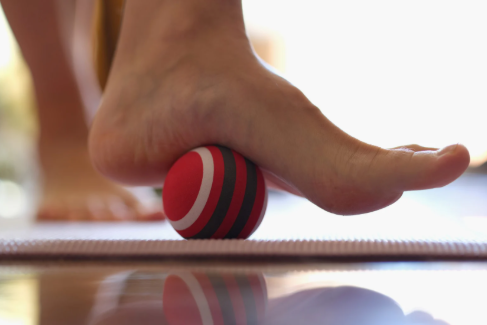
You do not need special equipment or long workout sessions to improve the health of your feet. Just 30 seconds a day, perhaps immediately after getting out of bed or following a long period of sedentary work, can produce remarkable results. One of the simplest exercises is lifting your toes individually, starting from the big toe and moving toward the little toe, then lowering them slowly in sequence. This seemingly simple movement deeply stimulates the intrinsic muscles of the foot and improves fine motor coordination.
Another effective movement is performing controlled ankle rotations while alternating between maximum dorsiflexion and plantar flexion. These exercises can be done while seated, barefoot, on a stable surface. The secret lies in consistency and awareness: the more focused you are during the movement, the more the neural signals are reinforced and reactivated. You can also try walking slowly on your tiptoes or heels for a few seconds, awakening areas of the foot that are often underused during everyday walking.
Benefits of a Daily Mobility Routine
Introducing a brief foot activation routine into your day provides benefits that go far beyond a simple feeling of lightness. Within just a few days, you may notice improved stability, reduced stiffness, and greater confidence in your movements. Over the long term, this habit can help prevent injuries and falls while also improving overall posture.
A “living,” responsive foot promotes better weight distribution throughout the body, protects the joints above it, and enhances overall body awareness. This type of practice fits perfectly into a philosophy of sustainable wellness that is accessible to everyone, especially those who often feel “stuck” due to a sedentary lifestyle. Sometimes, just 30 seconds of mindful movement are enough to reconnect with the lowest part of your body—often forgotten, yet essential for every step you take in life.
Comments (0)