
Trolley
You have no items in your shopping cart

 Budgets
 Dumbers
 Discs
Discs
 Benches
 Racks and Rigs
 Weights Holders
 Isotonic machines
 Calisthenics
 Cardio
 Kettlebells
 Flooring
 Gym Set
 Accessories
 Combat
 ARTI MARZIALI
 CONTAINER GYM
 Tug-Of-War
 Used Gym Equipment
 PILATES MACCHINARI
 GINNASTICA ARTISTICA
 CAMPI DA PADEL
 Prodotti in Pronta Consegna
 Informazioni
 IRONMAN
 Gift Card
- Donatif
- Training and exercises
- 0 I like it
- 1996 Views
- 0 comments
- gym flooring, safety flooring, gym safety, shock-absorbing materials
READING TIME: 5 MINUTES ➤➤
Advanced Hip Thrust Variations and Explosive Progressions to Increase Strength and Power
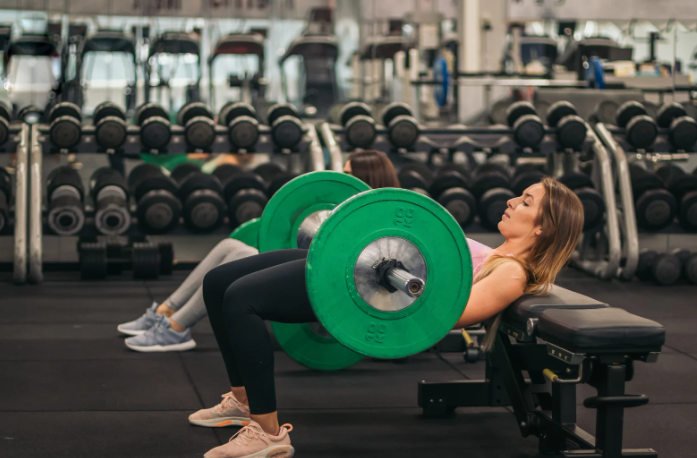
The hip thrust has become a staple exercise in both strength training and glute development programs, whether in bodybuilding or athletic performance settings. After an initial phase focused on technique and motor pattern development, many athletes begin to notice a reduction in training stimulus. At this stage, advanced variations become particularly valuable, especially those that modify the resistance profile through bands, cables, or explosive execution styles.
Athletes already training with heavy loads often do not need to simply “do more,” but rather introduce different types of tension and more specific progressions. The goal is not only glute aesthetics, but also the ability to generate force quickly, control the lockout phase, and maintain technical quality under fatigue. Advanced hip thrust variations are designed precisely for this purpose: increasing intensity and variety without turning the movement into a random or poorly controlled exercise.
Read also:
When the Traditional Hip Thrust Is No Longer Enough
Signs of Adaptation and Stagnation in Glute Training
One of the most common mistakes among advanced athletes is increasing the load without modifying other training variables. When the body adapts to the same execution pattern, even progressive weight increases may produce limited results. In many cases, the issue is not a lack of intensity, but rather the predictability of the stimulus. Experienced athletes tend to adapt quickly to constant movement paths, tempos, and resistance profiles.
Advanced explosive hip thrust variations are specifically designed to interrupt this adaptation process. The use of heavy bands, accommodating resistance, or dynamic execution changes how the load behaves throughout the movement. This creates a higher neuromuscular demand and increases involvement during the final lockout phase. The perceived effort changes significantly, especially during peak contraction.
Why Advanced Athletes Look for More Technical Variations
A well-trained athlete often develops greater technical awareness. The goal is not simply “fatigue,” but a stimulus that aligns with performance objectives. Advanced variations make it possible to work on acceleration, eccentric control, and the ability to maintain stability even with variable resistance. This is particularly relevant for powerlifters, athletes, and coaches who use the hip thrust as a complementary exercise for sprinting, jumping, or posterior chain development.
The psychological component also plays an important role. Many experienced athletes fear stagnation and perceive repeating the same training structure as a limitation to progress. Controlled technical progressions help maintain motivation without resorting to random strategies. When training is structured progressively, variety enhances overload potential without compromising movement quality.
Hip Thrust with Bands and Cable Machines to Increase Tension
How Resistance Changes with Bands
Adding resistance bands dramatically changes the exercise’s tension curve. At the beginning of the movement, the perceived load remains relatively manageable, while resistance increases rapidly during the final phase. This makes the lockout considerably more demanding and forces the athlete to produce force until the very end of the thrust. The result is greater glute activation in the fully extended hip position.
However, an advanced banded hip thrust requires careful setup management. Bands that are too light may become irrelevant, while excessively rigid bands can alter the barbell path or shift the focus toward lumbar stabilization. For this reason, gradual progression is essential, increasing tension only when the movement remains stable and repeatable.
Cable Machines for More Consistent Tension
Using cable machines introduces a more linear resistance profile compared to bands. Cables maintain continuous tension throughout the entire range of motion and can be particularly useful for athletes who tend to “unload” the weight at the bottom phase of the exercise. In professional environments, this solution is often used to improve control and mechanical quality without excessively increasing absolute load.
Many coaches combine barbells and cable machines to create a dual stimulus: the main load manages maximal strength, while the cable maintains constant muscular demand. This strategy is especially effective for experienced athletes seeking a stronger glute contraction without constantly chasing maximal loads. Technical precision therefore remains central even during high-intensity overload phases.
Explosive Progressions and Power-Oriented Training
Why Execution Speed Changes the Training Stimulus
In explosive training, the goal is not simply to move weight, but to generate force rapidly. This changes how the nervous system recruits muscle fibers and makes the hip thrust valuable even for sports requiring acceleration or sprint capacity. Dynamic repetitions with moderate loads can be extremely effective when combined with short rest periods and high technical control.
A properly executed explosive hip thrust maintains a stable movement path and controlled pelvic position even during high-speed accelerations. The most common mistake is turning the exercise into an uncontrolled bounce. In reality, the quality of the eccentric phase largely determines the effectiveness of the following concentric drive. Advanced athletes and coaches therefore place significant emphasis on “loading” tension before the explosive phase.
Progression Strategies for Experienced Athletes
Advanced progressions work best when introduced gradually within structured programming. One effective approach alternates strength-focused weeks with blocks dedicated to execution speed. This alternation prevents excessive neural fatigue accumulation while maintaining high technical quality.
Many athletes use cluster sets, isometric pauses, or contrast training to increase neuromuscular demand. For example, a heavy traditional hip thrust set may be followed by an explosive variation using light bands. This contrast between heavy load and acceleration creates an effective stimulus both from a performance perspective and in terms of perceived intensity. Maintaining adequate technical margin is essential to avoid loss of control.
Managing High Intensity Without Compromising Technique
Overconfidence and Setup Control
Among advanced athletes, perceived confidence can sometimes become a limitation. Familiarity with the exercise may lead to underestimating details such as band anchoring, bench positioning, or floor stability. When introducing very heavy bands or cable systems, setup quality becomes a fundamental part of execution safety.
A stable environment and reliable equipment reduce the risk of compensation patterns. In particular, solid racks, compact flooring, and secure anchor points allow athletes to work with high tension while maintaining controlled movement paths. This aspect is important both in advanced home gyms and in professional training facilities focused on strength and conditioning.
Intelligent Scaling to Maintain Quality and Consistency
Scaling is not only relevant for beginners or post-injury recovery. Advanced athletes also benefit from intelligent intensity management. Temporarily reducing load or band tension can improve execution speed, technical precision, and contraction quality. In many cases, progress comes from the ability to modulate training rather than constantly accumulating intensity.
The most effective progressions are often those that remain sustainable over time. Introducing advanced variations without a clear structure can increase joint stress and systemic fatigue. When training follows a logical progression, the hip thrust becomes an extremely versatile tool for developing strength, control, and specific power while maintaining high technical quality even during the most demanding phases of the season.
Frequently Asked Questions
Are bands useful even for already very strong athletes?
Yes, especially because they modify tension during the final phase of the movement. For many advanced athletes, this allows higher intensity without excessively increasing absolute barbell load.
Does the explosive hip thrust replace traditional heavy training?
No. Explosive variations work best as a complement to strength-oriented sessions. Alternating heavy loading with execution speed generally produces a more complete training stimulus.
When should cable machines be preferred over bands?
Cable machines are useful when consistent tension throughout the entire range of motion is desired. Bands, on the other hand, primarily increase difficulty during the final lockout phase.
Who should avoid advanced variations?
Athletes with unstable technique or poor lumbar control should first master the traditional hip thrust. Advanced variations require solid load management and technical stability.
Developing Power and Control Through Advanced Progressions
The evolution of the hip thrust does not depend solely on increasing loads. Bands, cables, and explosive progressions make it possible to target different aspects of performance, from force production to lockout quality. For advanced athletes and coaches, these variations provide a practical way to maintain a high training stimulus without sacrificing technical precision.
Progression choices should always consider experience level, objectives, and recovery capacity. A structured approach to advanced variations allows athletes to increase intensity and variety sustainably, enhancing both home gym training and professional athletic performance environments.
Comments (0)