
Trolley
You have no items in your shopping cart

 Budgets
 Dumbers
 Discs
Discs
 Benches
 Racks and Rigs
 Weights Holders
 Isotonic machines
 Calisthenics
 Cardio
 Kettlebells
 Flooring
 Gym Set
 Accessories
 Combat
 ARTI MARZIALI
 CONTAINER GYM
 Tug-Of-War
 Used Gym Equipment
 PILATES MACCHINARI
 GINNASTICA ARTISTICA
 CAMPI DA PADEL
 Prodotti in Pronta Consegna
 Informazioni
 Gift Card
- Donatif
- Training and exercises
- 0 I like it
- 3 Views
- 0 comments
- gym flooring, safety flooring, gym safety, shock-absorbing materials
READING TIME: 5 MINUTES ➤➤
How to Combine Resistance Bands and Weights: When to Use Them Together
Combining resistance bands and weights does not mean making every exercise more complicated. Instead, it means choosing the most suitable form of resistance for a specific goal. Free weights provide a stable, measurable load that is easy to program, while resistance bands change tension throughout the movement and require greater control during the final phase of an exercise. For people training at home, runners, or anyone looking to improve strength without constantly increasing weight, this combination can be a practical solution when applied correctly.
The key point is not deciding whether weights or bands are better, but understanding when it makes sense to combine weights and resistance bands, when to keep them separate, and when to use a band simply as a technical aid. The right approach helps develop strength, stability, coordination, and movement awareness while reducing the risk of turning every workout into an overly complicated session. The most effective method is progressive: first build a solid foundation with controlled movements, then add elastic resistance where it provides a genuine benefit.
Why Combine Resistance Bands and Weights in the Same Workout
The main difference between free weights and resistance bands lies in how resistance is perceived. A dumbbell, barbell, or weight plate provides a constant load, even though the difficulty changes depending on joint leverage. A resistance band, on the other hand, increases tension as it stretches. This makes certain exercises more demanding at the end range of motion, where greater stability is often required. For this reason, combined exercises can be valuable when the goal is not only to lift more weight but also to improve movement control, posture, and acceleration.
In strength training, bands can add an element of control without requiring an immediate increase in external load. In a home gym, for example, they can be a smart solution when available weights are limited or when you want to make a familiar exercise more challenging. For runners and athletes, the combination can help build more stable and transferable strength, especially in the glutes, hips, back, and shoulders. The important thing is not to use bands as a decorative accessory; they must serve a clear purpose.
When to Use Resistance Bands and Weights Together
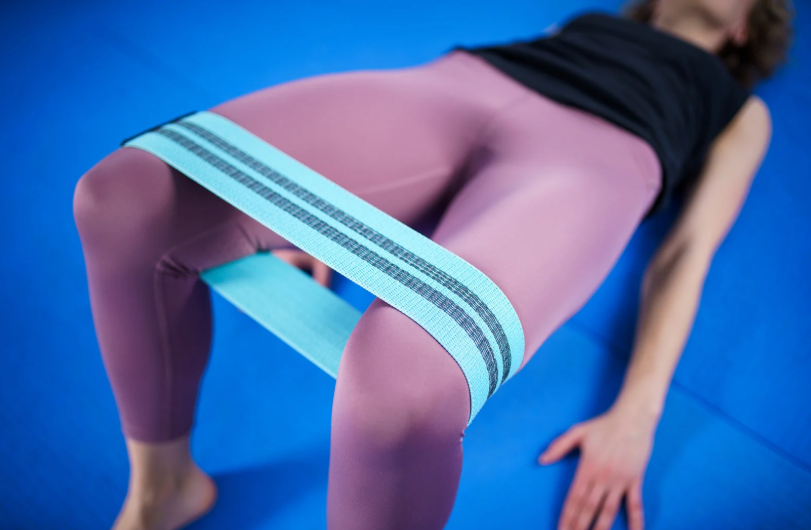
This combination is most appropriate when movement technique is already well established and the athlete wants to increase the training stimulus without sacrificing quality. A simple example is the dumbbell squat with a mini band placed above the knees: the weight develops overall strength, while the band helps keep the glutes and hip abductors engaged, reducing the tendency of the knees to collapse inward. In this case, the band does not replace the load but adds a useful technical constraint.
Another effective application involves presses, rows, and hip thrusts. During pressing movements, a light band can increase stability demands at the end of the range of motion. In rows, it can improve awareness of scapular retraction, while in hip thrusts it can enhance glute activation. For beginners, however, the rule remains simple: first learn the movement with a manageable load, then gradually introduce elastic resistance.
When It Is Not Worth Combining Them
Using resistance bands and weights together is not always the most efficient choice. If execution is unstable, if the load is already close to your limit, or if the goal of the session is to learn a new exercise, adding a band may create unnecessary complexity. In these situations, it is better to separate the stimuli: first technique work with bodyweight or light loads, then strength training, and finally band exercises for activation and control. Progression should remain clear and measurable; otherwise, it becomes difficult to understand what is actually improving.
The combination is also not recommended when it creates obvious compensations. If a band alters foot positioning during a squat, causes excessive shoulder tension during a press, or compromises trunk control during a row, the issue is not the equipment itself but how the stimulus is being managed. Effective training does not add difficulty simply to appear advanced; it adds difficulty only when it improves results. This principle also helps reduce concerns about overtraining because it distinguishes productive work from unnecessary volume.
Practical Combination Examples by Level
For beginner home trainees, a sensible approach may include simple exercises such as goblet squats with a mini band, glute bridges with a weight plate and band, dumbbell rows paired with a light resistance band, and overhead presses with light dumbbells and a band only when scapular control is adequate. The goal is not to reach maximum fatigue immediately but to develop a more accurate perception of movement. At this stage, loop bands or a set of varying resistance levels can help adjust training intensity without constantly changing equipment.
For more advanced users, the combination can become part of a structured program. An athlete may use weights and bands together in a primary exercise for several weeks and then return to free weights to evaluate improvements in control and movement speed. A simple progression model may involve three stages: a light band for learning, a medium band for control under fatigue, and a stronger band only for movements that are already technically solid. The operational rule is straightforward: if technique deteriorates, reduce band resistance before reducing the weight.
How to Manage Progression, Fatigue, and Recovery
Progression with bands and weights should remain measurable, even when training without machines or professional-grade equipment. You can increase the weight, switch to a stronger band, add a set, slow down the eccentric phase, or improve control in the final position. However, changing too many variables at once makes it difficult to evaluate results. For this reason, it is best to modify only one element at a time while keeping track of training data, especially when the goal is to improve strength and functionality.
A practical sign of effective programming is the quality of the final set. If movement remains stable, breathing is controlled, and no major compensations appear, the combination is working as intended. If the exercise becomes disorganized, the band pulls the body out of alignment, or the load significantly reduces the range of motion, simplifying the exercise is the better choice. Successfully integrating resistance bands and weights means giving each tool a specific role: weights build strength, while bands refine control, stability, and progression.
Comments (0)