
Trolley
You have no items in your shopping cart

 Budgets
 Dumbers
 Discs
Discs
 Benches
 Racks and Rigs
 Weights Holders
 Isotonic machines
 Calisthenics
 Cardio
 Kettlebells
 Flooring
 Gym Set
 Accessories
 Combat
 ARTI MARZIALI
 CONTAINER GYM
 Tug-Of-War
 Used Gym Equipment
 PILATES MACCHINARI
 GINNASTICA ARTISTICA
 CAMPI DA PADEL
 Prodotti in Pronta Consegna
 Informazioni
 Gift Card
- Donatif
- Training and exercises
- 0 I like it
- 5 Views
- 0 comments
- gym flooring, safety flooring, gym safety, shock-absorbing materials
READING TIME: 5 MINUTES ➤➤
Mini Bands for Glutes: 7 Effective Exercises Explained
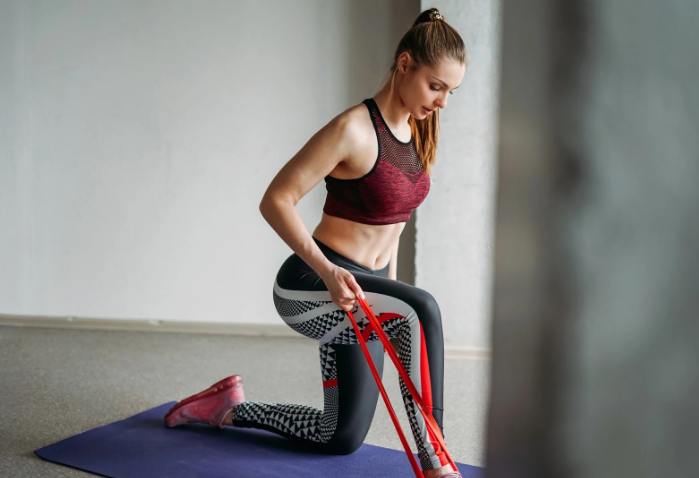
Mini bands for glutes are among the simplest accessories to use when you want to make your workout more targeted, controlled, and accessible. They do not require machines, large spaces, or heavy weights, yet they create constant resistance throughout the movement. For beginners, this is a real advantage: the band helps you better feel the glutes working and understand whether the movement is performed with control or if the body is compensating with other muscle groups.
When it comes to mini band glute exercises, the choice of exercises matters just as much as execution quality. A mini band does not automatically make a movement effective: it must be positioned correctly, paired with the right resistance, and used with consistent technique from start to finish. This guide explains seven practical exercises with simple, progressive instructions designed for women and men who want to improve muscle tone, stability, and control without making training unnecessarily complicated.
Why mini bands are useful for glute training
Muscle activation and movement control
The mini band creates lateral tension that forces the body to better control the knees, hips, and pelvis. This is especially useful in glute exercises because it helps engage not only the gluteus maximus but also the hip stabilizer muscles. In movements such as squats, lateral walks, and bridges, the band provides immediate feedback: if the knees collapse inward or the pelvis loses stability, the tension changes and the mistake becomes easier to notice.
For beginners, this feedback is often more useful than heavy loads. Training with a mini loop band allows you to focus on movement quality before increasing intensity or volume. The result should not be interpreted as an instant aesthetic transformation, but rather as a gradual improvement in muscle connection, exercise posture, and the ability to perform cleaner movements even in other workouts.
When to use them at home or in the gym
Mini bands can be used both during activation phases and as part of the main workout. Before squats, lunges, or hip thrusts, some band exercises help prepare the glutes for the work ahead. At home, they can become the main training tool, especially when dumbbells, barbells, or dedicated machines are not available.
In the gym, mini bands do not always replace weights, but they complement them. They can improve knee control during squats, increase tension during glute bridges, or make warm-up phases more precise. For runners and athletes, band exercises are also useful from a functional perspective because they work on lateral stability, hip control, and movement quality.
How to choose the right mini band resistance
Light, medium, and heavy bands: practical differences
The resistance of the mini band should allow you to complete the movement without losing posture. A light band is suitable for learning technique, activation exercises, or movements with a larger range of motion. A medium resistance can be useful when the movement is already controlled and you want to increase difficulty without making the exercise too rigid. Heavy bands, on the other hand, require more experience because they can lead to compensation through the back, knees, or unwanted muscle groups.
A set of light and medium resistance bands is often the most practical choice for beginners because it allows you to adapt resistance to different exercises. For example, a light band may work well for standing abductions, while a medium one may be better for glute bridges. The rule is simple: the band should make the exercise more challenging without preventing smooth and controlled movement.
How to increase difficulty without losing technique
Progression does not depend only on band resistance. You can increase difficulty by slowing down the return phase, holding a pause at peak contraction, or adding repetitions only when technique remains stable. This approach is safer than immediately switching to a very strong band, especially for those still learning how to properly feel the glutes working.
Another effective method is changing the position of the mini band. Above the knees, the band is generally easier to manage and more suitable for basic exercises. Around the ankles or feet, leverage increases and the movement becomes more demanding. The best progression is the one that allows you to maintain muscle control, steady breathing, and stable posture throughout the entire set.
Seven mini band exercises for glutes
Squat with mini band
To perform the squat with a mini band, place the band just above the knees and position your feet hip-width apart or slightly wider. During the descent, keep the knees aligned with the toes and avoid letting them collapse inward. The mini band acts as a reminder to gently push outward, keeping the glutes and hip stabilizers active.
The movement should remain controlled, without bouncing at the bottom or excessively tucking the pelvis. Descend only as far as you can maintain good posture, then push through the feet to rise back up. This exercise is useful for incorporating mini band glute exercises into a simple routine because it combines leg work, core control, and lateral hip activation.
Glute bridge with mini band
For the glute bridge, position the mini band above the knees. Lie on the floor with your knees bent, feet firmly planted, and pelvis in a neutral position. Lift the hips by squeezing the glutes while avoiding excessive arching in the lower back. At the top, maintain a slight outward push of the knees without forcing the movement.
This exercise is especially useful for learning to distinguish glute work from lower back involvement. If you mainly feel the lower back, reduce the range of motion and focus on pelvic tilt before lifting. The mini band glute bridge can be used both as an activation drill and as a primary exercise, gradually increasing repetitions, time under tension, or band resistance.
Lateral walk with mini band
The lateral walk is performed with the band above the knees or, in a more advanced version, around the ankles. Start with your feet hip-width apart, knees slightly bent, and torso stable. Take small side steps while maintaining constant tension in the band, avoiding bringing the feet completely together between steps.
The key point is avoiding excessive torso sway or dragging the feet. Each step should be controlled, with stable hips and aligned knees. This exercise strongly targets the side glutes and is also useful for runners because it improves hip stability and movement control.
Clamshell with mini band
The clamshell is performed lying on one side with the mini band above the knees and the legs bent. Keep the feet together and lift the top knee upward without rotating the pelvis backward. The movement should be small but precise because the goal is not opening as wide as possible, but rather feeling the side glute working.
Although it looks simple, this exercise is extremely useful for people who struggle to activate the glutes properly. If the pelvis moves too much, tension disperses and effectiveness decreases. For this reason, it is best to use a light or medium band and focus on slow, controlled, and balanced repetitions on both sides.
Kickback with mini band
The mini band kickback can be performed standing or on all fours. In the quadruped version, position the band securely and push one leg backward while keeping the pelvis stable. The movement should originate from the glutes, not the lower back, and the leg should not rise beyond the point where lumbar control is lost.
This exercise is effective for training hip extension, one of the main functions of the gluteus maximus. To maximize effectiveness, avoid fast swings and focus on a clear contraction at the end of the movement. A band that is too strong may reduce range of motion and worsen technique, so it is better to start with manageable resistance.
Standing abductions with mini band
Standing abductions are performed by moving one leg laterally against the resistance of the band. The torso should remain upright, the supporting foot stable, and the pelvis steady. The working leg moves outward without excessively rotating the foot, maintaining a clean and controlled movement.
This exercise is practical because it requires little space and can easily be included in a home workout routine. It helps improve awareness of the side glutes and overall balance control. Beginners may find it useful to hold onto a wall or stable support to better focus on the movement without compensating through the torso.
Monster walk with mini band
The monster walk combines diagonal forward or backward steps with constant mini band tension. Start with slightly bent knees, active feet, and a stable pelvis. Take controlled diagonal steps while maintaining tension in the band and preventing the knees from collapsing inward.
This exercise is more dynamic than the lateral walk and requires good posture control. It works well at the end of an activation sequence or as a complementary movement in a short circuit. To keep it effective, choose shorter distances and precise technique rather than increasing speed or step count too quickly.
Mistakes to avoid during glute exercises
Compensating with the back, knees, or quadriceps
One of the most common mistakes is trying to make the exercise harder by increasing resistance while losing movement control. When this happens, the body finds shortcuts: the lower back arches, the knees collapse inward, or the quadriceps take over. The result is a more tiring exercise, but not necessarily a more effective one for the glutes.
To avoid compensation, it is important to observe movement quality. The band should remain under tension, but the movement must feel natural. If you experience joint discomfort or lose stability during an exercise, reduce the resistance, slow the pace, and return to a simpler variation. Proper technique is the first real sign of progression.
Using too much resistance too soon
A very strong mini band may seem more effective, but that is not always the case. If it excessively limits movement, forces incomplete repetitions, or creates rigid contractions, it may reduce overall training quality. For glutes, moderate resistance performed with good control often works better than heavy resistance paired with obvious compensation patterns.
The most practical way to evaluate resistance is checking whether you can complete all repetitions while maintaining posture, control, and consistent muscle engagement. When these elements are present, you can gradually increase difficulty. Otherwise, the band may not yet be suitable for that movement or training level.
How to build a simple mini band routine
Beginner sequence
A basic routine can start with clamshells, glute bridges, and lateral walks. These exercises help develop activation, hip extension, and lateral stability without requiring excessive coordination. For each exercise, perform short and controlled sets, focusing more on movement quality than on total repetitions.
After this phase, you can add squats with mini bands and standing abductions while keeping resistance manageable. The initial goal is not muscle exhaustion, but building confidence in technique. This type of routine is ideal for people training at home, returning after a break, or looking to integrate targeted glute work before more complex exercises.
Progression over time
As the exercises become more familiar, you can gradually increase volume, slow down specific movement phases, or use a slightly stronger mini band. Effective progression should not involve changing everything at once. It is better to adjust one variable at a time to understand how the body responds and whether technique remains consistent.
Over time, glute band exercises can become part of a broader routine including squats, lunges, hip thrusts, or functional training. Mini bands remain a simple but effective tool when used correctly. The real difference is not made by the elastic itself, but by the ability to maintain control, consistency, and attention to movement during every repetition.
Comments (0)