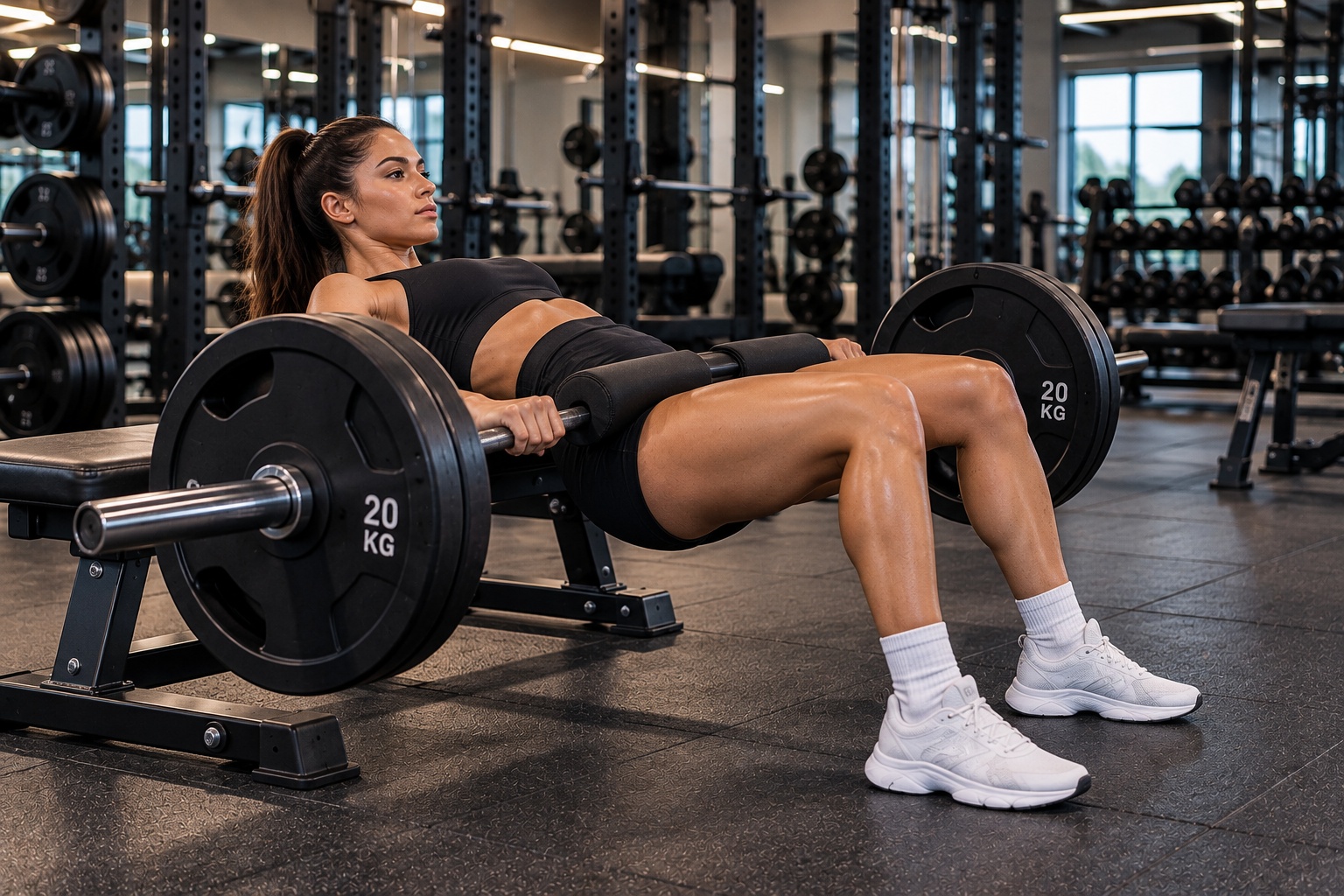
The hip thrust is a hip extension-based exercise that requires proper station setup, controlled execution, and appropriate load management. Accurate technique allows you to maintain continuity in movement and use equipment more effectively, whereas setup errors can compromise the quality of the exercise and make the entire execution less stable.
Before focusing on increasing the weight, it is useful to check the positioning of the bench, barbell or chosen equipment, foot placement, and the availability of the space needed to complete the movement without obstacles. A methodical approach facilitates exercise repeatability and makes it simpler to correct any technical errors.
This guide describes the hip thrust technique, preliminary checks, and the most frequent mistakes without delving into differences from the glute bridge or variants with specific equipment, which are addressed in dedicated content.
How to properly perform the hip thrust?
To execute a hip thrust, you need to set up a stable station, correctly position your back and feet, control the movement throughout the entire hip extension, and avoid compensations that alter the technique. Load progression should only happen when the movement is stable and repeatable.
Careful preparation of the station represents the first step toward correct execution.
Each repetition should maintain the same technical quality from start to finish.
What is the fundamental principle?
Maintain movement continuity, postural control, and a stable setup of the station throughout the entire set.
Why prepare the station?
A correct setup facilitates maintaining technique and reduces the need for corrections during execution.
What is the hip thrust?
The hip thrust is a hip extension exercise generally performed with the upper back supported against a bench.
It can be performed using body weight or with different types of external load.
The station setup varies depending on the equipment used.
What equipment can be used?
The exercise can be performed with a barbell, dumbbells, resistance bands, dedicated machines, or exclusively with body weight, according to training goals.
Why is the station important?
Bench stability, load arrangement, and available space directly influence execution quality.
How to execute the correct technique?
Each phase of the exercise requires attention and control.
Always following the same sequence facilitates movement repeatability.
Adjustments should be completed before the start of the set.
Prepare the starting position
Position the upper back on the bench, place the feet stably on the floor, and verify that the load is correctly positioned before starting the movement.
Control the entire execution
Perform hip extension with smooth movement, maintaining continuity during the ascent and descent phases without sudden accelerations.
What practical criteria help improve technique?
An effective technique stems from small checks repeated consistently.
Execution quality is generally more important than the amount of load used.
Every detail of the preparation contributes to the final result.
Manage the load
The weight should allow you to maintain the same technical quality for all planned repetitions without losing control of the movement.
Maintain a stable setup
Verify that the bench, feet, and equipment remain stable throughout the entire set. To set up the station with free weight, you can use an olympic barbell compatible with the weight room.
What are the most common mistakes?
Many mistakes depend on insufficient station preparation.
Correcting them promptly facilitates training continuity.
Preventive checking reduces the likelihood of repeating them in subsequent sets.
Roughly prepare the station
An unstable bench, incorrectly positioned load, or insufficient space can make it harder to maintain regular technique.
Lose control of the movement
Excessively accelerating the execution phase or altering posture during the repetition can compromise the technical quality of the exercise.
What checks to perform before training?
A brief checklist allows you to standardize station preparation.
The checks take just a few minutes and can be repeated in every session.
Equipment maintenance helps keep station reliability high.
Check the bench
Check that the bench is stable, correctly supported, and free of wobbling during a brief preliminary test.
Check the load
Make sure that the barbell, plates, collars, and other accessories are correctly mounted and that the surrounding area is free of obstacles.
FAQ
What is the most frequent mistake in the hip thrust?
Among the most common mistakes are inaccurate station preparation and loss of control during movement execution.
When to increase the load?
It is advisable to increase the weight only when the technique remains stable and repeatable for all planned repetitions.
Is it useful to check the station before each set?
Yes. A quick check of the bench, barbell, and available space helps keep exercise quality constant.
Why refine the hip thrust technique?
Taking care of the hip thrust technique makes the exercise smoother, improves station organization, and reduces errors that can compromise training quality.
Systematic preparation of the bench, equipment, and workspace fosters greater continuity during sets and facilitates training progression over time.
Applying practical and verifiable criteria to each session represents an effective method to build stable, repeatable execution consistent with your programming goals.


 Budgets
 Dumbers
 Discs
 Benches
 Racks and Rigs
 Weights Holders
 Isotonic machines
 Calisthenics
 Cardio
 Kettlebells
 Flooring
 Gym Set
 Accessories
 Combat
 ARTI MARZIALI
 CONTAINER GYM
 Tug-Of-War
 Used Gym Equipment
 PILATES MACCHINARI
 GINNASTICA ARTISTICA
 CAMPI DA PADEL
 Prodotti in Pronta Consegna
 Informazioni
 IRONMAN
 Gift Card