
Trolley
You have no items in your shopping cart

 Budgets
 Dumbers
 Discs
Discs
 Benches
 Racks and Rigs
 Weights Holders
 Isotonic machines
 Calisthenics
 Cardio
 Kettlebells
 Flooring
 Gym Set
 Accessories
 Combat
 ARTI MARZIALI
 CONTAINER GYM
 Tug-Of-War
 Used Gym Equipment
 PILATES MACCHINARI
 GINNASTICA ARTISTICA
 CAMPI DA PADEL
 Prodotti in Pronta Consegna
 Informazioni
 IRONMAN
 Gift Card
- Donatif
- General information
- 0 I like it
- 319 Views
- 0 comments
- gym flooring, safety flooring, gym safety, shock-absorbing materials
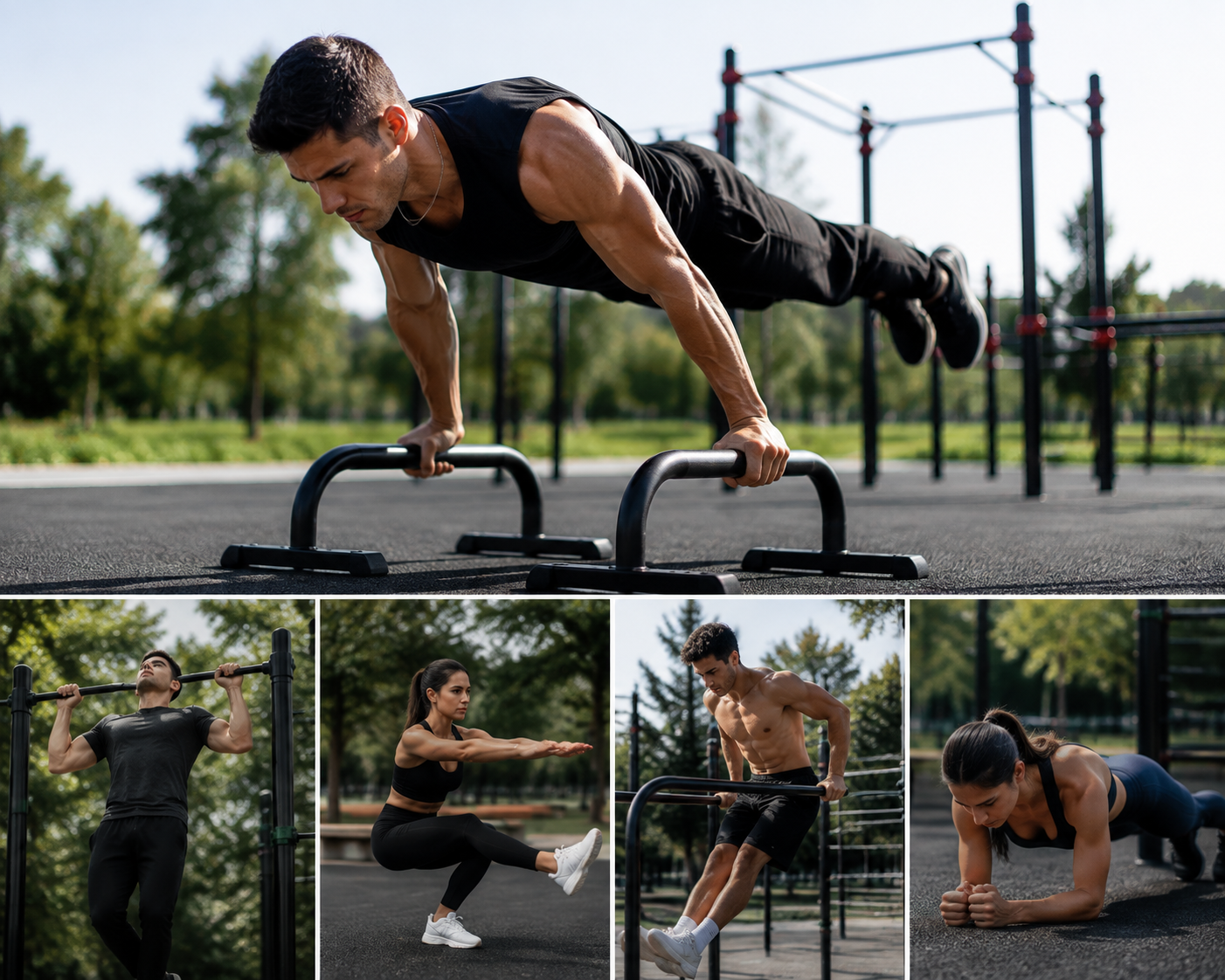
Calisthenics for Mass: Is It Possible to Get Big with Bodyweight Training?
When it comes to calisthenics muscle mass, one of the most frequent questions is whether it is truly possible to build a muscular physique by training primarily with bodyweight. For many years, traditional bodybuilding monopolized the concept of hypertrophy, leading people to believe that barbells, isotonic machines, and dumbbells were the only truly effective tools for increasing muscle mass. Today, thanks to the evolution of calisthenics and the introduction of progressive overload work, this belief has been largely downsized.
Muscle growth does not actually depend on the type of equipment used, but on the mechanical and metabolic stimuli that the muscle receives over time. If these stimuli are programmed correctly, the body responds by increasing strength and muscle volume regardless of whether the load comes from a barbell, a bar, or one's own body weight integrated with weights.
In this guide, we will analyze in depth how to achieve hypertrophy through calisthenics, what the limits of bodyweight-only training are, when it becomes necessary to introduce progressive overload, and why Weighted Calisthenics represents one of the most effective methodologies today for those who wish to develop a strong, athletic, and aesthetically muscular physique.
- How muscle hypertrophy works
- Is bodyweight really enough?
- Weighted Calisthenics
- How to program for mass
- The best exercises
- Equipment for overloading
- Most common mistakes
- Why invest in Weighted Calisthenics
How muscle hypertrophy works
The increase in muscle mass derives primarily from the combination of mechanical tension, training volume, and adequate recovery. Muscle grows when it is subjected to a stimulus that is progressively greater than the usual one.
In calisthenics, this principle remains identical. The difference concerns exclusively the way in which the load is applied. Initially, body weight represents a sufficient stimulus, but as strength increases, it becomes necessary to increase the difficulty.
Effective programming therefore allows for excellent results even without resorting to traditional machines, provided that the principle of progressive overload is respected.
Mechanical tension
Continuous tension during movement represents the main factor responsible for hypertrophy. Controlled executions and full ranges of motion increase the effectiveness of the training.
Volume and recovery
Sets, repetitions, and rest periods must be programmed in a way that is consistent with the goal of muscle growth, avoiding both under-training and excessive fatigue.
Is bodyweight really enough?
For a beginner, body weight alone can produce significant increases in muscle mass during the first few months of training. Push-ups, dips, pull-ups, and squats are extremely effective exercises.
As time goes on, however, the body adapts to the stimulus. Performing fifty consecutive push-ups primarily develops muscle endurance and no longer represents the ideal method for increasing hypertrophy.
To continue growing, it is therefore necessary to increase the load through technical progressions or through the use of dedicated weights.
Initial results
Those who start training obtain rapid improvements thanks to neuromuscular adaptation and high sensitivity to stimuli.
Overcoming the plateau
When progress slows down, it is necessary to introduce new training variables to continue building muscle efficiently.
Weighted Calisthenics
Weighted calisthenics consists of adding an external load to fundamental exercises such as pull-ups, dips, push-ups, and squats. In this way, it becomes possible to apply the same principle of progressive overload used in bodybuilding.
Thanks to weights, it is possible to maintain ideal repetition ranges for hypertrophy, generally between six and twelve repetitions, favoring constant muscle growth.
This approach also allows you to retain all the functional advantages of calisthenics, simultaneously developing relative strength, coordination, and body control.
Why it works
The progressive increase of the load makes every exercise stimulating again even for advanced athletes, allowing for continued improvement over the long term.
Multi-diameter compatibility
A weight belt compatible with different disc diameters offers greater flexibility and allows you to increase the load without having to replace equipment over time.
How to program for mass
To build muscle, it is essential to progressively monitor loads, volume, and intensity. Randomly increasing the number of exercises rarely produces optimal results.
Programming oriented toward hypertrophy should include compound exercises, load progressions, and adequate recovery between sessions.
Bodyweight hypertrophy also requires nutrition consistent with the goal, characterized by sufficient protein intake and a slight caloric surplus.
Repetition ranges
Working between six and twelve repetitions with high intensity generally represents one of the most effective strategies for maximizing muscle growth.
Load progression
Every week should include small increases in load or technical difficulty, always maintaining correct execution.
The best exercises for increasing mass
Weighted pull-ups, dips, push-ups, and squats represent the foundation of any hypertrophy-oriented program in calisthenics.
These movements involve large muscle groups and allow for easy management of progressive overload.
Variations such as Australian pull-ups, pike push-ups, and Bulgarian squats can also effectively supplement the program.
Upper body
Weighted pull-ups and dips develop the lats, pectorals, shoulders, and triceps while maintaining a high functional component.
Lower body
For the legs, squats, pistol squats, lunges, and variations with progressive overload can be used.
Equipment for progressive overload
Good equipment allows you to increase the load safely and progressively. The weight belt is one of the most important tools for those who wish to increase muscle mass through calisthenics.
A stable professional dip station also allows you to train with heavy loads while maintaining safety and comfort during the most demanding sets.
For those who wish to build a complete home gym, a weight belt, 50 mm Olympic discs, and sturdy structures represent an investment destined to last for years.
Olympic discs
50mm discs allow for gradual load increases and are compatible with most professional belts.
Professional Dip Station
A stable structure allows you to train with heavy loads, reducing oscillations and improving the quality of execution.
Most common mistakes
Many athletes believe that simply increasing the number of repetitions is enough to build muscle mass. In reality, beyond a certain threshold, the stimulus becomes primarily metabolic and less effective for hypertrophy.
Another mistake is neglecting recovery. Muscles, tendons, and the nervous system need adequate time to adapt to new loads.
Constantly changing the program also prevents you from evaluating real progress and slows down the application of progressive overload.
Only high repetitions
Training exclusively with very long sets limits the possibility of progressively increasing the load and therefore muscle growth.
Consistency wins
Following a consistent program for several months allows you to obtain results far superior to continuous changes in method.
Why invest in Weighted Calisthenics
Calisthenics and bodybuilding should not be considered opposing disciplines. Both share the same physiological principles of hypertrophy, differing mainly in the tools used to generate the training stimulus.
For those who wish to build a muscular, athletic, and functional physique, Weighted Calisthenics represents an extremely effective solution because it combines the advantages of bodyweight work with the possibility of applying a precise and measurable progressive overload.
Investing in a quality weight belt, a professional dip station, and compatible discs allows you to continue progressing for many years, transforming a simple home gym into an environment capable of supporting advanced muscle mass development programs without sacrificing the functionality typical of calisthenics.
Comments (0)