
Trolley
You have no items in your shopping cart

 Budgets
 Dumbers
 Discs
Discs
 Benches
 Racks and Rigs
 Weights Holders
 Isotonic machines
 Calisthenics
 Cardio
 Kettlebells
 Flooring
 Gym Set
 Accessories
 Combat
 ARTI MARZIALI
 CONTAINER GYM
 Tug-Of-War
 Used Gym Equipment
 PILATES MACCHINARI
 GINNASTICA ARTISTICA
 CAMPI DA PADEL
 Prodotti in Pronta Consegna
 Informazioni
 IRONMAN
 Gift Card
- Donatif
- General information
- 0 I like it
- 603 Views
- 0 comments
- gym flooring, safety flooring, gym safety, shock-absorbing materials
Beginner Calisthenics Exercises: The 5 Pillars of Strength
Starting a journey in beginner calisthenics exercises means building solid foundations before chasing more spectacular skills. Many new practitioners are attracted to muscle-ups, planches, or front levers, but these advanced movements are the result of years of work on the fundamentals. The real difference between those who progress consistently and those who get stuck after a few months is the quality of the technique developed from the very first workouts.
Calisthenics is based on controlling your own body. Each exercise teaches you to manage strength, balance, coordination, and stability through natural movements that involve numerous muscle groups simultaneously. For this reason, it is essential to dedicate time to learning the five exercises that form the heart of any program: Push-ups, Pull-ups, Dips, Squats, and Planks.
In this guide, we will analyze in detail how to perform each movement correctly, what the most frequent mistakes are, how to progress safely, and why impeccable technique represents the best investment for achieving lasting results while avoiding discomfort and injuries.
- Why start with the fundamentals
- Push-ups: the pillar of pushing strength
- Pull-ups: building pulling strength
- Dips: developing upper body strength
- Squats: the base of leg strength
- Planks: core control
- The most common beginner mistakes
- Why building solid foundations always pays off
Why start with the fundamentals of calisthenics
Every experienced athlete started with the same basic movements. Fundamental exercises allow you to develop the strength necessary to tackle increasingly complex progressions without compromising the quality of execution.
Focusing on the fundamentals means training strength, coordination, balance, and motor control simultaneously. These skills will be indispensable when the time comes to learn more advanced exercises.
Furthermore, paying attention to technique from the first few weeks significantly reduces the risk of joint overload and allows for faster results in the long run.
Technique above all
Every repetition should be performed with complete control, prioritizing the quality of the movement over the number of repetitions.
Progressing without haste
Building a solid base requires patience, but it allows you to face any future progression with greater confidence.
Push-ups: the pillar of pushing strength
The push-up is one of the most complete exercises in calisthenics. It involves the chest, shoulders, triceps, and core, teaching you to keep the body stable throughout the movement.
Proper push-up technique involves hands positioned slightly wider than the shoulders, body aligned from head to heels, and the abdomen always active. During the descent, the chest approaches the floor without losing the neutral position of the spine.
Many beginners make the mistake of lowering the pelvis or flaring their elbows too much. Correcting these details immediately improves the effectiveness and safety of the exercise.
How to perform it correctly
Keep your body rigid as a board, inhale during the descent, and exhale during the pushing phase.
Recommended progressions
If the classic push-up is too difficult, you can start with incline push-ups on a bench or a raised bar to reduce the load.
Pull-ups: learning pulling strength
The pull-up is one of the most coveted goals for those starting calisthenics. In addition to developing back musculature, it improves grip, scapular control, and relative strength.
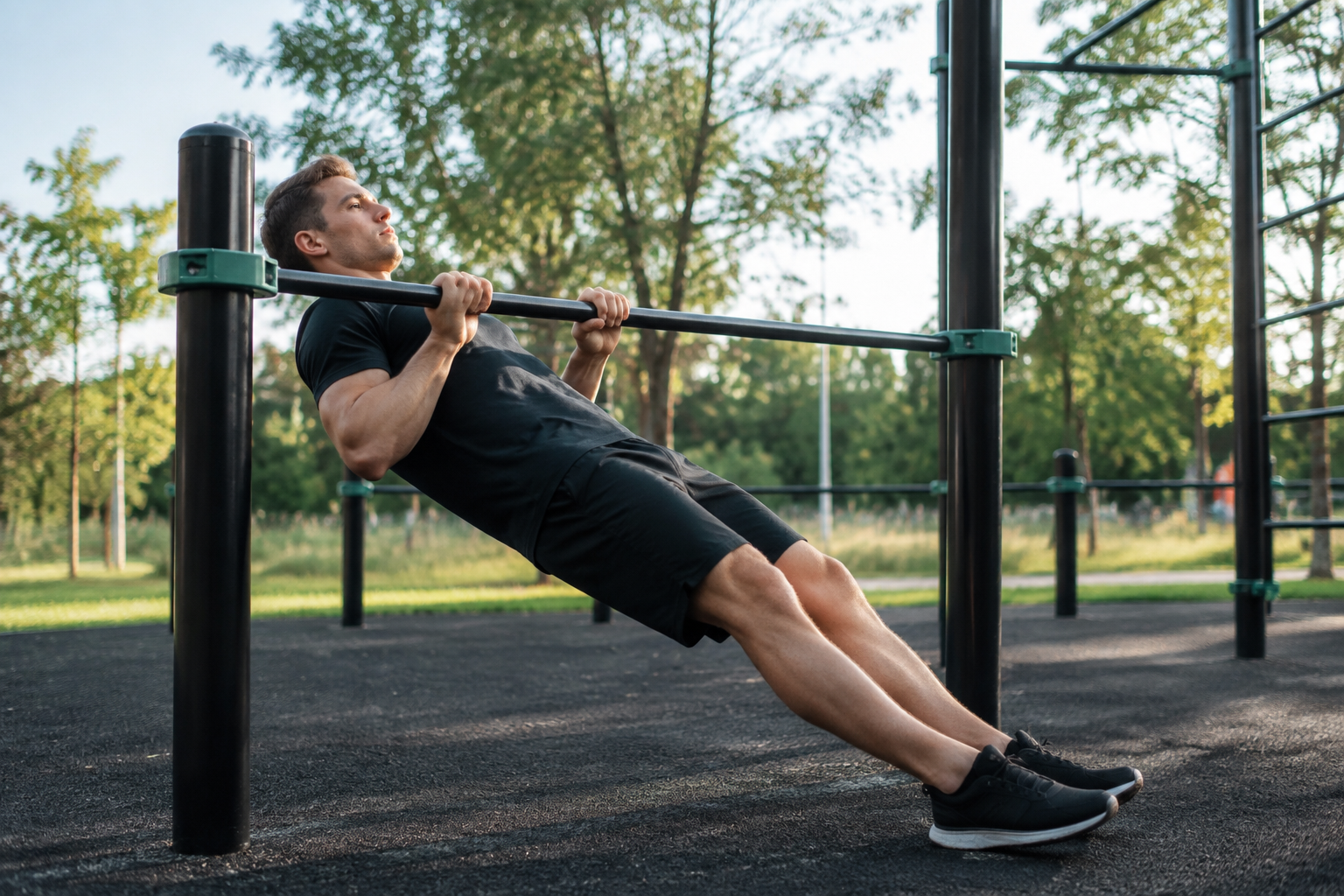
Those who cannot yet complete a repetition can use various pull-up progressions, such as Australian pull-ups, negative pull-ups, and assistance with resistance bands. These exercises progressively build the necessary strength without compromising technique.
It is important to avoid swinging and uncontrolled movements. Every pull-up should start with active scapulae and end by bringing the chin over the bar while maintaining body control.
Negative pull-ups
Slowly controlling the descent is one of the most effective methods for developing strength in beginners.
Learning scapular control
Correctly activating the scapulae improves movement efficiency and protects the shoulders during workouts.
Dips: strength and stability in the upper body
Dips intensely train the chest, triceps, and anterior deltoids. This exercise requires good shoulder mobility and stable torso control.
Going down beyond your available range of motion can unnecessarily increase stress on the shoulders. It is preferable to gradually increase the movement as mobility and strength improve.
Focus on posture
Depressed shoulders, controlled elbows, and a stable torso allow for proper load distribution.
When to increase difficulty
Only after completing several sets with impeccable technique is it advisable to move on to more demanding variations.
Squats: the base of leg strength
Often, those who start calisthenics focus all their attention on the upper body, neglecting the lower limbs. In reality, the squat is one of the most important movements for building functional strength.
A well-executed squat involves the quadriceps, glutes, hamstrings, and core, while also improving balance and hip and ankle mobility.
Keeping the weight distributed across the entire sole of the foot and the back neutral allows you to perform the movement safely and prepare for more advanced variations like the pistol squat.
Correct technique
Descend while maintaining control of the movement and rise by pushing through your feet without losing knee alignment.
The importance of mobility
Good hip and ankle mobility improves the depth and quality of execution.
Plank: the foundation of core control
The plank is much more than just an abdominal exercise. It represents the basis of the body control required by all major calisthenics skills.
During execution, the body must remain perfectly aligned, avoiding the pelvis dropping or rising excessively. The work involves the abdomen, lower back, glutes, and shoulder stabilizing muscles.
A strong core improves the efficiency of push-ups, pull-ups, dips, and practically every bodyweight exercise.
How to maintain the position
Contract your abdomen and glutes while maintaining regular breathing throughout the duration of the exercise.
Gradually increase difficulty
Before increasing the hold time, it is essential to always maintain correct posture.
The most common beginner mistakes
One of the most frequent mistakes is trying to quickly increase the number of repetitions by sacrificing technique. Five movements performed perfectly produce much better results than twenty repetitions done with compensations.
Many beginners also neglect warm-ups, mobility, and recovery. Preparing joints and muscles before training reduces the risk of discomfort and improves performance quality.
Also, constantly comparing yourself to more experienced athletes can be demotivating. Every journey is different, and the most significant progress comes through consistency and personal improvement.
Leave haste aside
Building solid foundations takes time, but it allows you to face increasingly advanced progressions without obstacles.
Train with regularity
Small, constant improvements produce much better results than periods of intense training followed by long breaks.
Why building solid foundations always pays off
The five fundamental exercises represent the language of calisthenics. Mastering them means developing strength, control, coordination, and mobility that will accompany every phase of athletic growth. Every advanced skill is born from the quality with which these basic movements are performed.
Training with correct technique reduces the risk of injury, improves workout efficiency, and allows for more stable results over time. To learn more about programs, progressions, and equipment dedicated to bodyweight training, you can consult calisthenics fundamentals and the resources available on the Donatif website.
Before chasing spectacular exercises, dedicate time to the pillars of the discipline. A carefully built foundation will make every future progression simpler, safer, and more satisfying, confirming that in calisthenics, the quality of movement is always worth more than the quantity of repetitions.
Comments (0)