
Trolley
You have no items in your shopping cart

 Budgets
 Dumbers
 Discs
Discs
 Benches
 Racks and Rigs
 Weights Holders
 Isotonic machines
 Calisthenics
 Cardio
 Kettlebells
 Flooring
 Gym Set
 Accessories
 Combat
 ARTI MARZIALI
 CONTAINER GYM
 Tug-Of-War
 Used Gym Equipment
 PILATES MACCHINARI
 GINNASTICA ARTISTICA
 CAMPI DA PADEL
 Prodotti in Pronta Consegna
 Informazioni
 IRONMAN
 Gift Card
- Donatif
- General information
- 0 I like it
- 604 Views
- 0 comments
- gym flooring, safety flooring, gym safety, shock-absorbing materials
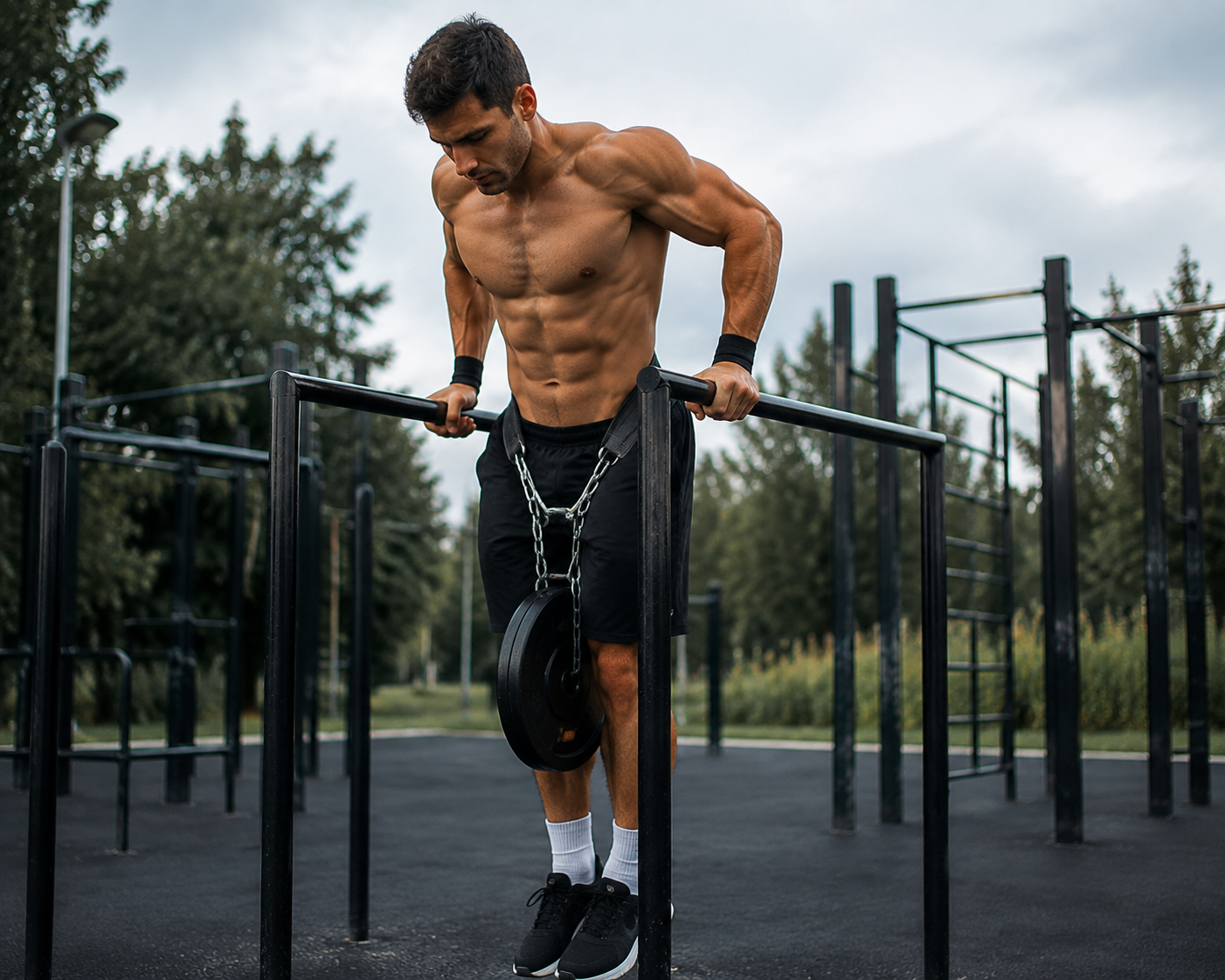
Weighted Calisthenics: When and How to Start
Weighted calisthenics represents the natural evolution of bodyweight training for those who have already developed a good mastery of fundamental exercises. When pull-ups, dips, and push-ups become relatively simple and the number of repetitions continues to increase without a real increase in maximal strength, adding an external load allows for the creation of new stimuli, favoring both the development of explosive strength and muscle hypertrophy.
Many practitioners believe that weighted calisthenics simply consists of wearing a weighted vest or hanging a plate from a belt. In reality, the introduction of weights requires precise programming, impeccable technique, and gradual progression. Increasing the load too quickly can compromise the execution of exercises and increase the risk of injury, while a correct approach allows for constant performance improvement while maintaining high movement quality.
In this guide, we will analyze when to start weighted calisthenics, what equipment to use, how to build an effective routine, and what errors to avoid to get the maximum benefit from overload training.
- What is weighted calisthenics
- When to introduce weights
- The best equipment
- How to build an effective routine
- How to increase the load
- Errors to avoid
- Recovery and programming
- Why invest in the right equipment
What is weighted calisthenics
Weighted calisthenics consists of adding an external load to traditional bodyweight exercises. The goal is not simply to increase difficulty, but to create a sufficient stimulus to continue developing strength, power, and muscle mass when body weight alone no longer represents an adequate challenge.
Weighted pull-ups, dips with additional weight, and push-ups with a vest are among the most common exercises. Thanks to the progressive increase of the load, it is possible to apply the principle of progressive overload, which is fundamental in any strength-oriented training program.
This approach also allows for keeping the number of repetitions relatively low, improving technical quality and reducing the risk of developing exclusively muscle endurance.
The main benefits
Training with overload improves relative strength, body control, and the ability to express power during the main calisthenics skills.
Who it is for
Weighted calisthenics is designed for athletes who have already consolidated the fundamental exercises and wish to continue progressing.
When is the time to add weights
There is no universal number of repetitions that establishes when to start, but a widely used reference is being able to perform at least ten or twelve pull-ups and fifteen or twenty dips with impeccable technique.
Before increasing the load, it is essential to possess full control of the movement, good joint mobility, and the ability to maintain correct posture throughout the execution.
Inserting weights too early often leads to technical compensations and limits the development of the foundations necessary to tackle more demanding progressions.
Signs that indicate the right moment
If the last repetitions are still controlled and recovery is adequate, it might be time to introduce a light overload.
Technique comes before weight
Every increase in load should keep the quality of movement unchanged without momentum or compensations.
Which equipment to choose
The choice of equipment influences comfort, safety, and the possibility of progression. There are various solutions designed to meet different needs.
The weighted calisthenics vest distributes weight evenly on the torso, making it ideal for push-ups, squats, lunges, and numerous dynamic exercises. The load distribution allows for maintaining good freedom of movement and high stability.
For pull-ups and dips, however, many athletes prefer to use a weighted dip belt with a chain and plates, which leaves the torso completely free and allows for easily increasing the weight used based on progress.
When to choose a weighted vest
It is particularly indicated for functional training, circuits, and metabolic work where the load must remain stable during all exercises.
When to use a belt
The belt allows for extremely precise load management and is the preferred solution in weighted calisthenics competitions.
How to build a weighted calisthenics routine
Effective programming should include two or three sessions dedicated to strength, maintaining a lower overall volume compared to traditional bodyweight training. The goal is to work with high loads and contained repetitions, always prioritizing the quality of execution.
A session can start with weighted pull-ups for three to five sets of three to six repetitions, followed by weighted dips, rows, core exercises, and complementary work for shoulders and forearms. On subsequent days, it is possible to insert technical exercises without load to keep the quality of the movement high.
Recovery between sets should be long enough to allow for the complete restoration of strength capacity, generally between two and four minutes depending on the intensity used.
Sessions dedicated to strength
Focusing on a few fundamental exercises allows for precise monitoring of progress and increasing the load in a controlled manner.
Balancing intensity and volume
Too much volume with high loads increases the risk of fatigue and slows down recovery.
How to increase the load over time
Progression should be gradual. Increases of one or two kilograms are generally sufficient to continue improving without compromising technique.
An effective method consists of increasing the weight only after having completed all planned sets with impeccable execution. This approach reduces the risk of plateaus and favors better neuromuscular adaptation.
Monitoring every workout through a logbook allows you to evaluate progress, plan increases, and identify any signs of overload before they become problematic.
Using micro-loads
Small increases allow for constant growth while keeping training quality high.
Recording every session
Noting down weight, repetitions, and sensations facilitates the planning of subsequent weeks.
The most common errors
The most frequent error consists of increasing the load while sacrificing technique. An incomplete pull-up or a dip performed with compensations does not produce the same benefits as a controlled movement.
Another error concerns the choice of cheap equipment not designed for intensive use. Unsturdy belts, low-quality carabiners, or unstable vests can compromise safety and comfort.
Finally, many athletes neglect mobility and prevention work, increasing the risk of inflammation in the shoulders, wrists, and elbows when loads become significant.
Leave the ego aside
Progressing slowly allows you to build more solid results and reduce the risk of injury.
Continue working on mobility
Prepared joints withstand high loads better and improve the quality of execution.
Recovery and periodization
Overload sessions require longer recovery times compared to traditional training. Muscles, tendons, and the central nervous system need time to adapt to the stimuli received.
Inserting deload weeks every six to eight weeks allows you to consolidate progress and prepare the body for new training cycles.
Nutrition, sleep, and stress management also play a fundamental role in strength development and injury prevention.
The importance of deload weeks
Temporarily reducing volume and intensity favors complete recovery and improves future performance.
Supporting growth with nutrition
A correct intake of protein and energy supports muscle recovery and facilitates training adaptations.
Why invest in the right equipment
In weighted calisthenics, equipment is not a simple accessory, but a tool that directly affects the quality of training. Products designed with resistant materials, reinforced stitching, careful ergonomics, and reliable adjustment systems guarantee greater comfort, safety, and durability even during intensive use.
Choosing professional solutions also allows you to tackle increasingly demanding progressions without limitations, maintaining stability and precision during every exercise. To learn more about equipment dedicated to bodyweight training, you can consult calisthenics strength training and the professional solutions available in the Donatif catalog.
Weights represent one of the most effective tools to continue improving when body weight alone is no longer enough. With intelligent programming, careful technique, and adequate equipment, it is possible to increase strength, muscle mass, and performance, facing every new challenge with safety and consistency.
Comments (0)