
Trolley
You have no items in your shopping cart

 Budgets
 Dumbers
 Discs
Discs
 Benches
 Racks and Rigs
 Weights Holders
 Isotonic machines
 Calisthenics
 Cardio
 Kettlebells
 Flooring
 Gym Set
 Accessories
 Combat
 ARTI MARZIALI
 CONTAINER GYM
 Tug-Of-War
 Used Gym Equipment
 PILATES MACCHINARI
 GINNASTICA ARTISTICA
 CAMPI DA PADEL
 Prodotti in Pronta Consegna
 Informazioni
 IRONMAN
 Gift Card
- Donatif
- General information
- 0 I like it
- 542 Views
- 0 comments
- gym flooring, safety flooring, gym safety, shock-absorbing materials
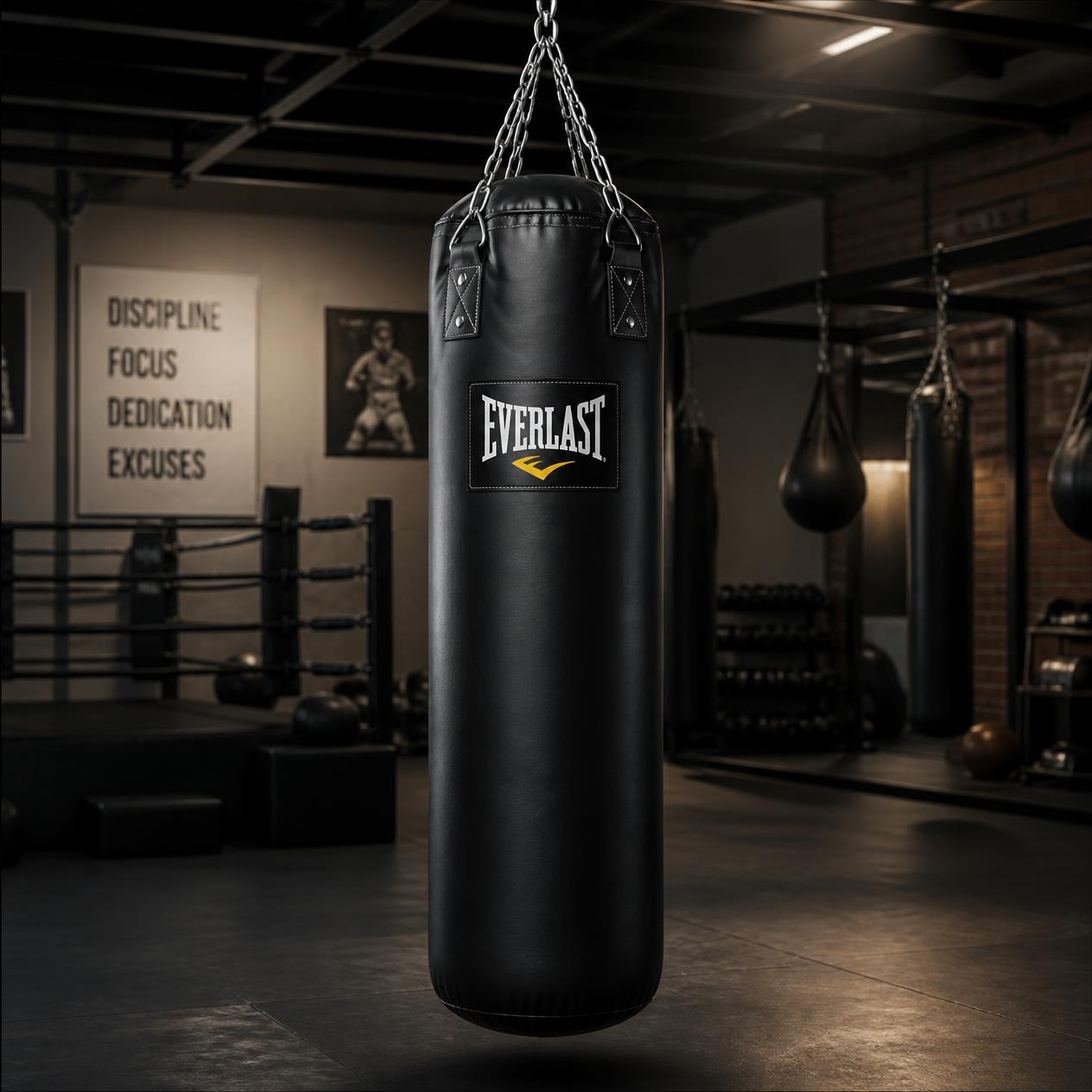
Professional Punching Bag: Which Weight and Material to Choose? Complete Guide
Buying a punching bag is one of the most important investments for those who want to train seriously in combat sports. Whether you practice boxing, kickboxing, Muay Thai, or MMA, the bag represents the main training partner for developing technique, power, endurance, and coordination. However, not all models are the same, and choosing the wrong one can compromise the quality of your training, slow down progress, and increase the risk of injury.
Many beginners tend to focus exclusively on the price or the size of the product, neglecting fundamental characteristics such as weight, covering material, type of padding, and installation method. In reality, these elements directly influence the bag's response to impacts, its durability over time, and comfort during every session.
In this guide, we will analyze in detail how to choose the professional punching bag best suited to your needs, comparing weight, materials, padding, and available configurations. The goal is to help you make an informed purchase that improves the quality of your training and protects your joints in the long term.
- Why choosing the right bag is fundamental
- How to choose the bag weight
- Leather or synthetic material?
- Filled or empty bag
- Dimensions and types
- The best bag for home
- Durability and maintenance
- How to make a smart purchase
Why choosing the right bag is fundamental
A punching bag is not just for hitting with force. It is a tool designed to develop technique, precision, timing, and physical conditioning. The quality of the bag directly affects the biomechanics of your strikes and the ability to correctly absorb impacts.
A model that is too light swings excessively, making it difficult to work on precision and inducing bad technical habits. Conversely, an excessively heavy bag may be unsuitable for beginners and increase stress on hands, wrists, elbows, and shoulders.
The choice must therefore consider experience, body weight, discipline practiced, and the type of training planned, avoiding basing it solely on the price or the aesthetics of the product.
Influence on technique
Training with an adequate bag allows you to develop correct movements and better distance management, favoring the learning of combinations and the correct transfer of weight.
A quality tool provides realistic sensations and contributes to improving every aspect of training.
Protection of joints
A properly designed bag absorbs part of the impact energy and reduces the risk of overloading the joints.
This feature becomes even more important during frequent and high-intensity training.
How to choose the bag weight
Weight represents one of the most important factors in the choice. In general, a bag should weigh about half of the user's body weight, but this rule must be adapted based on experience and goals.
A 50 kg punching bag represents one of the most common solutions in professional gyms because it offers an excellent balance between stability and the ability to absorb powerful strikes. It is suitable for many intermediate and expert practitioners and allows for executing combinations without excessive swinging.
Beginners, on the other hand, can opt for slightly lighter models, favoring a gradual progression in the force of the strikes and in execution technique.
Weight for beginners
A moderately heavy bag allows you to learn technique without subjecting hands and wrists to excessive loads.
The priority should always be the quality of execution rather than the power of the strike.
Weight for expert athletes
Those who possess good technique can use heavier bags to develop explosive strength and muscular endurance.
Greater stability also allows you to work effectively on long combinations.
Leather or synthetic material?
The covering determines a good part of the bag's durability and the sensation perceived during training. The two main categories available are natural leather and high-quality synthetic materials.
The leather vs. synthetic punching bag comparison does not have a universal answer, as both solutions have specific advantages. Leather offers superior durability, better wear resistance, and a premium look, while modern synthetic materials guarantee excellent performance at a generally lower cost.
For intensive use in commercial gyms, leather is often the preferred choice, while for many home gyms, high-end synthetics constitute an excellent compromise between quality and price.
Why choose leather
Natural leather resists repeated impacts better and maintains its aesthetic and functional characteristics even after years of use.
However, it requires slightly more careful maintenance.
The advantages of synthetic materials
Modern technical coverings offer high resistance, are easy to clean, and represent a very competitive solution in terms of cost.
Quality varies significantly between different manufacturers, making it important to choose reliable brands.
Filled or empty bag
Another often underestimated aspect concerns the padding. Models already filled and bags supplied empty are available on the market, to be customized according to your needs.
The filled or empty punching bag choice depends mainly on the level of customization desired and the practicality of use. Filled models are ready for use and guarantee a distribution of padding designed by the manufacturer.
Empty bags, on the other hand, allow you to choose materials and final weight, proving particularly interesting for more expert users or for specific uses.
When to choose a filled bag
It is the ideal solution for those who want to start training immediately without worrying about filling.
It also guarantees a uniform distribution of the internal material.
When it is worth buying it empty
Those looking for a customized configuration can adapt the weight and consistency of the padding to their needs.
However, this solution requires more experience and time for proper filling.
Dimensions and types of bag
In addition to weight, it is important to consider the length and shape of the bag. Longer models also allow you to train kicks and knee strikes, making them ideal for kickboxing and Muay Thai.
Shorter bags are instead particularly suitable for traditional boxing and specific work on punches.
There are also shaped, teardrop, angled, and specific models for certain techniques, designed to satisfy different training needs.
Boxing training
For those who practice only boxing, a traditional cylindrical bag of adequate weight is generally sufficient.
This configuration allows you to develop precision, speed, and power.
Sports with kicks
Disciplines that involve the use of the lower limbs require longer and more stable bags.
A larger surface area allows you to effectively train all combat techniques.
The best bag for home
Those setting up a home gym must also evaluate available space, mounting system, and noise generated during training.
The best punching bag for home is one that manages to combine adequate dimensions, stability, and compatibility with the structure of the home, without compromising comfort and safety.
It is also essential to choose a sturdy support capable of sustaining the dynamic loads produced by repeated impacts.
Space management
Before purchasing, it is advisable to check not only the available height but also the area necessary to allow the bag to swing freely.
Correct positioning improves the effectiveness of the training.
Importance of mounting
The anchoring system must be sized considering the weight of the bag and the expected intensity of the training.
Inadequate mounting can compromise the safety and durability of the entire setup.
Durability and maintenance
Proper maintenance helps keep the bag's performance high over the years. Regular cleaning, checking the seams, and verifying the suspension systems allow you to prevent premature wear and damage.
It is also advisable to periodically rotate the bag during use, distributing impacts uniformly and preserving the integrity of the padding.
Investing in products made with quality materials significantly reduces the need for frequent replacements.
Periodic checks
Checking seams, straps, chains, and mounting points ensures safe use at all times.
Acting promptly on small signs of wear avoids more serious problems.
Cleaning the covering
Keeping the covering clean helps preserve the material and improves the hygiene of the equipment.
It is advisable to use products compatible with the type of covering chosen.
How to make a smart purchase
Choosing a professional punching bag means carefully evaluating weight, material, padding, dimensions, and build quality. Each element contributes to determining the safety, comfort, and durability of the equipment, directly influencing the quality of the training.
A well-designed product allows you to improve technique, reduce the risk of injury, and face increasingly intense sessions with greater safety. For this reason, it is preferable to invest in a reliable solution from the start rather than frequently replacing low-performing, cheap models.
To discover a complete selection of equipment dedicated to combat sports, you can visit professional punching bag, where models designed for home gyms, gyms, and intensive use are available, made with quality materials and designed to guarantee high performance over time.
Comments (0)