
Trolley
You have no items in your shopping cart

 Budgets
 Dumbers
 Discs
Discs
 Benches
 Racks and Rigs
 Weights Holders
 Isotonic machines
 Calisthenics
 Cardio
 Kettlebells
 Flooring
 Gym Set
 Accessories
 Combat
 ARTI MARZIALI
 CONTAINER GYM
 Tug-Of-War
 Used Gym Equipment
 PILATES MACCHINARI
 GINNASTICA ARTISTICA
 CAMPI DA PADEL
 Prodotti in Pronta Consegna
 Informazioni
 IRONMAN
 Gift Card
- Donatif
- General information
- 0 I like it
- 490 Views
- 0 comments
- gym flooring, safety flooring, gym safety, shock-absorbing materials
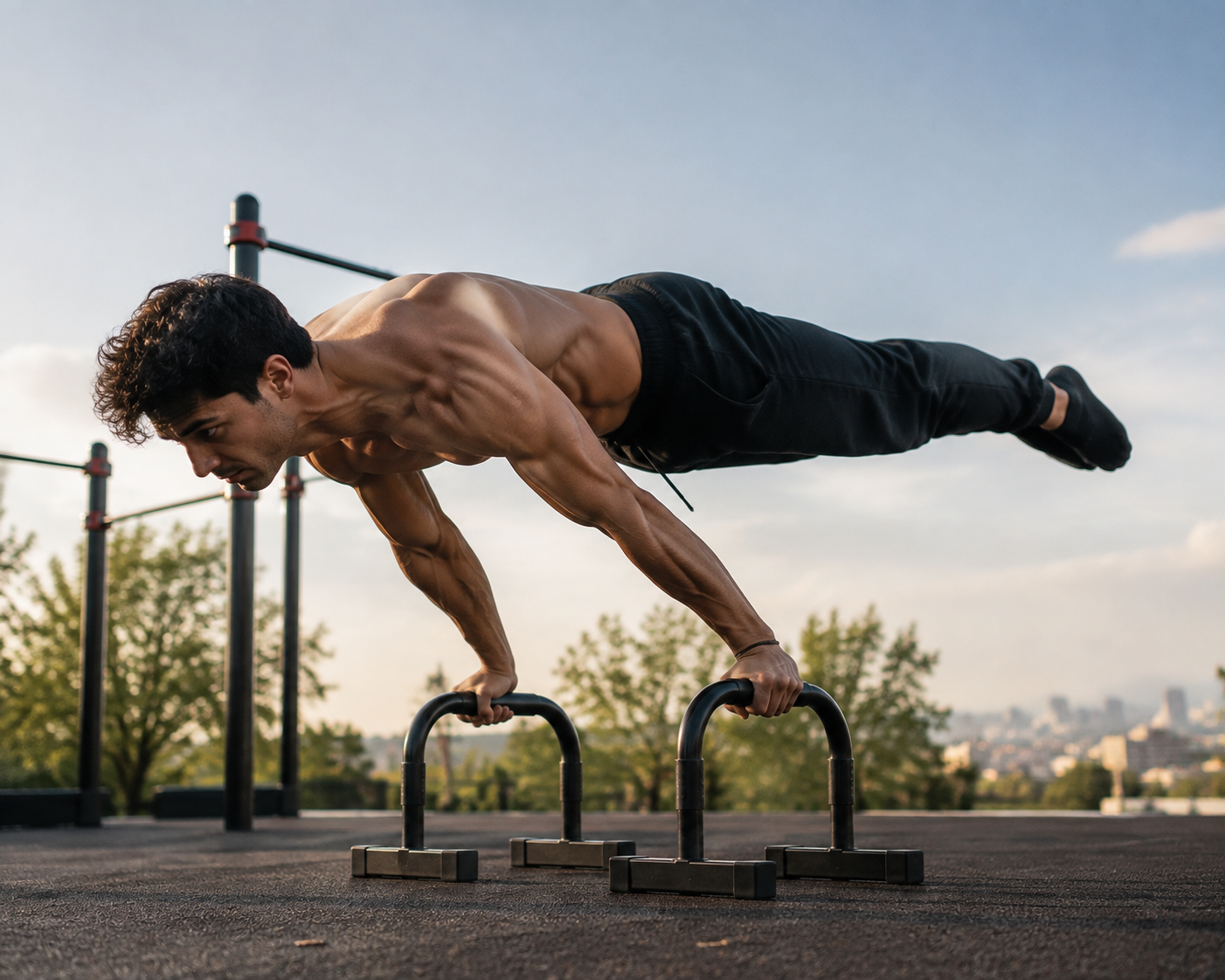
How to Train the Planche: A Guide to Scientific Progressions
Calisthenics skills represent the meeting point between strength, motor control, and coordination, and few abilities are as iconic as the Planche. Keeping the body parallel to the ground while supporting yourself exclusively on your hands requires an exceptional combination of relative strength, scapular stability, core control, and progressive adaptation of the wrists and tendons. This is not a skill conquered through natural talent, but a result achieved through methodical programming and well-structured progressions.
Many practitioners get stuck in the early stages of learning because they focus all their attention on pushing strength, neglecting fundamental elements such as joint preparation, wrist mobility, and the ability to maintain a correct scapular position. In most cases, the limit is not represented by the chest or shoulder muscles, but by the poor tolerance of tendons and joints to the high loads generated by the Planche lever.
This guide delves into the complete path to learning the Planche, from the first progressions to advanced variations, illustrating how to develop specific strength without unnecessarily increasing the risk of injury. We will also analyze the role of professional equipment and the importance of training on stable supports designed for technical work.
- Planche Biomechanics
- Essential Prerequisites
- Scientific Progressions
- Preparing Wrists and Tendons
- Programming Training
- Recommended Equipment
- Most Common Mistakes
- Why Invest in Professional Supports
Planche Biomechanics
The Planche is an extremely demanding isometric lever in which the body is kept parallel to the ground thanks to the coordinated action of the shoulders, pectorals, serratus anterior, triceps, abdominals, and stabilizing musculature. The entire body weight is transferred to the hands, generating high torque moments that increase proportionally to the distance of the center of mass from the shoulders.
To support this position, it is necessary to maintain strong scapular protraction and depression, avoiding pelvic sagging or lumbar compensations. Even minimal variations in alignment change the biomechanical levers, making the skill much more difficult.
Understanding these principles allows you to approach training with a rational approach, avoiding random attempts that rarely produce significant improvements.
The Role of Levers
Every change in the position of the legs directly influences the difficulty of the exercise. For this reason, progressions represent the most effective method to gradually increase the load while maintaining correct technique.
Scapular Control
Stable scapular protraction allows for better load distribution on the shoulders and increases the ability to maintain an efficient position throughout the hold.
Essential Prerequisites
Before tackling Planche progressions, it is necessary to possess solid foundations of pushing strength, an extremely stable core, and good shoulder and wrist mobility.
Push-ups, dips, pseudo planche push-ups, and advanced planks represent fundamental exercises to prepare the body for the high loads required by the skill.
Joint preparation is equally important. Tendons and ligaments require longer adaptation times than muscles and should not be subjected to overly rapid load increases.
Basic Strength
A good ability to perform fundamental exercises with control constitutes the starting point for tackling more advanced progressions without compromising technical quality.
Joint Mobility
Mobile shoulders and prepared wrists allow for more efficient load distribution, reducing unnecessary tension during sessions.
Scientific Progressions
The most effective path follows a sequence of well-defined progressions: Planche Lean, Frog Stand, Tuck Planche, Advanced Tuck, Straddle Planche, and finally Full Planche. Each variation allows you to progressively increase the difficulty while maintaining control of the position.
A good planche tutorial should always prioritize execution quality and time under tension rather than the immediate pursuit of the full version.
Tuck planche progressions allow you to develop specific strength, improve scapular control, and progressively adapt wrists and tendons to increasing loads.
Planche Lean
The Lean represents one of the most important progressions because it teaches you how to gradually transfer weight forward while maintaining a correct position of the scapulae and torso.
From Tuck to Advanced Variations
Consolidating each progression before moving on to the next allows you to build a solid base, reducing the risk of plateaus and improving the quality of technique.
Preparing Wrists and Tendons
One of the main obstacles in learning the Planche concerns the ability of the wrists to tolerate high loads maintained for prolonged periods. Ignoring this aspect means significantly increasing the risk of inflammation and chronic discomfort.
Progressive preparation should include joint mobilizations, forearm strengthening exercises, and gradual increases in the time spent supporting yourself on your hands.
The best exercises for planche are those that allow you to increase the load while always maintaining impeccable technique and high movement quality.
Wrist Strengthening
Sessions dedicated to mobility and strengthening the forearm musculature improve the ability of the joints to withstand the loads typical of the Planche.
Tendon Adaptation
Tendons respond positively to progressive load increases, but require consistency and adequate recovery times to develop greater resistance.
Programming Training
The Planche is a highly neural skill that requires high executive quality. For this reason, it is preferable to train it at the beginning of the session, when the level of fatigue is still low.
Two or three specific workouts per week generally represent an effective frequency to promote improvements without compromising joint recovery.
Monitoring hold time, position quality, and perceived effort allows you to accurately evaluate progress and modify programming when necessary.
Volume Management
It is advisable to accumulate numerous short and technically impeccable sets rather than a few maximal attempts performed with compensations.
Recovery
Adequate recovery allows muscles, tendons, and the nervous system to adapt to the high levels of tension required by the Planche.
Recommended Equipment
Training the Planche on stable supports significantly improves technical quality and safety. Oscillations in the structure increase compensation work and make it more difficult to maintain correct body alignment.
Low parallettes are one of the most used tools because they allow for a neutral wrist position, reducing joint load and allowing for more comfortable sessions compared to direct support on the floor.
To tackle progressions with maximum safety, it is advisable to use professional calisthenics parallettes, designed to offer stability, a secure grip, and comfort during technical work.
Why Choose Parallettes
An ergonomic grip reduces stress on the wrists and allows you to focus more on position quality and lever control.
The Importance of Stability
Rigid and well-designed supports allow you to transfer all force to the exercise without dispersion caused by vibrations or unwanted movements.
Most Common Mistakes
One of the most frequent mistakes is attempting the Full Planche too early, without having consolidated the intermediate progressions. This almost always leads to technical compensations and long periods of stagnation.
Another mistake concerns the lack of attention to joint health. Persistent pain in the wrists or elbows should never be ignored, but interpreted as a signal of the need to modify volume, intensity, or progression.
Finally, training to failure every time reduces technical quality and slows down motor learning, especially in a complex skill like the Planche.
Skipping Progressions
Building solid foundations through preparatory exercises allows you to develop more efficient technique and significantly reduce the risk of injury.
Prioritizing Quality
Every repetition should be performed with maximum control, maintaining a correct position from the beginning to the end of the set.
Why Invest in Professional Supports
The Planche represents one of the most advanced calisthenics skills and requires a path built with patience, method, and attention to joint health. Intelligent programming allows you to progressively develop strength, control, and stability while minimizing the risk of overload.
Success depends on the ability to respect progressions, consolidate each phase, and dedicate time to strengthening wrists and tendons, elements that are often decisive for overcoming the most common plateaus.
Training on professional equipment and extremely stable supports improves the quality of every session, makes technical work safer, and allows you to approach the path toward the Full Planche with greater efficiency, comfort, and continuity.
Comments (0)