
Trolley
You have no items in your shopping cart

 Budgets
 Dumbers
 Discs
Discs
 Benches
 Racks and Rigs
 Weights Holders
 Isotonic machines
 Calisthenics
 Cardio
 Kettlebells
 Flooring
 Gym Set
 Accessories
 Combat
 ARTI MARZIALI
 CONTAINER GYM
 Tug-Of-War
 Used Gym Equipment
 PILATES MACCHINARI
 GINNASTICA ARTISTICA
 CAMPI DA PADEL
 Prodotti in Pronta Consegna
 Informazioni
 IRONMAN
 Gift Card
- Donatif
- General information
- 0 I like it
- 427 Views
- 0 comments
- gym flooring, safety flooring, gym safety, shock-absorbing materials
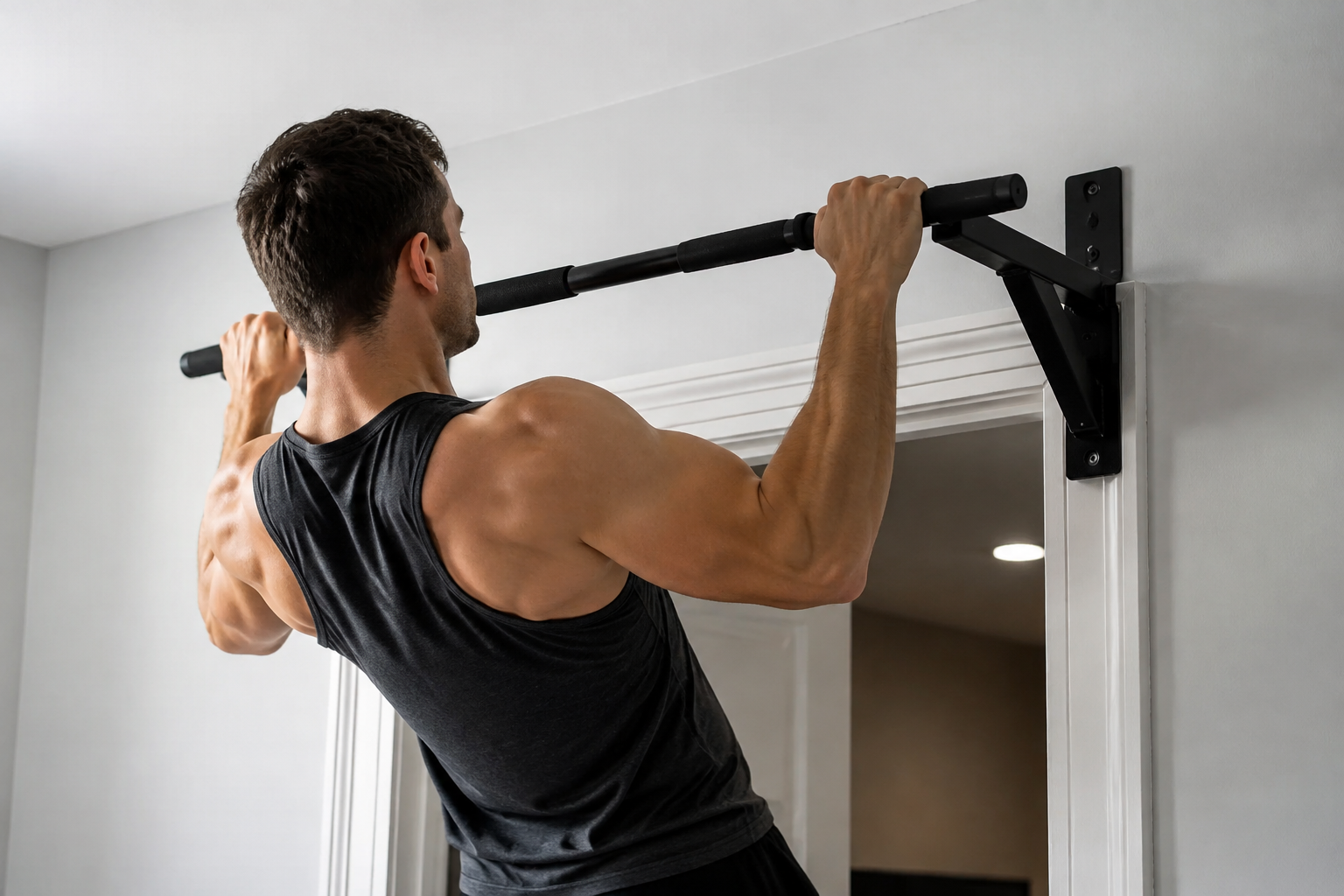
Pull-Up Bar for Drywall: Technical Solutions and Secure Reinforcements
Installing a drywall pull-up bar is one of the most frequent questions among those who want to create a home gym in a modern apartment. Drywall is, in fact, a very common material in recent construction thanks to its lightness, speed of installation, and versatility, but it presents structural characteristics that are completely different from a concrete or solid brick wall. For this reason, it is not possible to treat its mounting like that of a normal load-bearing wall.
The good news is that having drywall walls does not mean having to give up pull-ups or calisthenics. The solution consists of correctly designing the anchoring system, distributing the load through dedicated structural elements, and using supports designed specifically for this type of installation. In many cases, the problem is not the drywall itself, but the method used to transfer the forces generated during training.
In this guide, we will analyze the characteristics of drywall walls, the limits of traditional fasteners, the most reliable technical solutions, the role of backplates and load distribution structures, and the alternatives available when direct mounting is not the best choice.
- Why drywall requires a different approach
- The forces generated during pull-ups
- Backplates and load distribution systems
- How to design a safe installation
- Alternatives to direct mounting
- The most common mistakes
- Checks and maintenance
- Why choose professional solutions
Why drywall requires a different approach
Drywall walls are designed primarily as partition elements and not as structures intended to support high dynamic loads. A simple sheet of drywall possesses mechanical characteristics that are very different from a reinforced concrete or solid brick wall.
When performing pull-ups, muscle-ups, or other bodyweight exercises, stresses are applied repeatedly to the mounting points. If these forces are concentrated on a small surface area, the risk of deformation or failure increases significantly.
For this reason, the design of the installation must focus on load distribution rather than simply using stronger wall plugs.
How a drywall wall is built
A drywall wall is generally composed of an internal metal structure covered by one or more sheets. Every installation therefore requires a preliminary assessment of the existing configuration.
Why traditional wall plugs are not enough
A wall plug designed to support pictures or shelves is not automatically suitable for withstanding the forces developed during dynamic training.
The forces generated during pull-ups
During a pull-up, the load applied to the wall varies continuously. Accelerations, decelerations, oscillations, and changes in direction can produce forces significantly higher than the user's simple body weight.
Explosive exercises such as muscle-ups, chest-to-bar, or weighted pull-ups further increase these stresses, making accurate structural design essential.
Understanding the behavior of dynamic loads allows one to understand why a correct distribution of forces is much more important than the mere resistance of a single mounting point.
Dynamic loads
Pull-ups do not generate a constant weight, but continuous variations of force that must be absorbed by the entire installation system.
The safety margin
A well-executed project always provides an adequate margin relative to the expected usage conditions, increasing reliability and durability over time.
Backplates and load distribution systems
The most effective solution consists of using systems that distribute the load over a much wider surface than a simple anchor point. Pull-up bar backplates represent exactly this construction principle.
Through distribution elements, it is possible to transfer stresses to the load-bearing structure in a much more uniform manner, reducing load concentrations that could damage the drywall.
Every installation must, however, be evaluated based on the actual structure of the wall and the characteristics of the building, avoiding standard solutions applied indiscriminately to any situation.
Distributing the load
The greater the surface area involved in the transmission of forces, the lower the localized stress on the individual elements of the wall.
A dedicated design
The best installations are those developed by considering the existing structure, type of training, and equipment characteristics simultaneously.
How to design a safe installation
Mounting a pull-up bar on a fragile wall requires a preliminary phase of wall verification. It is important to identify the internal metal structure, evaluate any reinforcements already present, and understand how to correctly distribute the loads.
Every building has different characteristics, and for this reason, there is no universal solution valid for all drywall walls. The design must always adapt to the real situation.
When there are doubts about the capacity of the wall or the installation methods, it is advisable to rely on qualified personnel capable of evaluating the most appropriate solution.
Analyzing the wall
Knowing the composition, thickness, and internal structure of the wall is the first step toward a reliable installation.
When to consult a technician
A preventive assessment allows you to avoid incorrect interventions and choose the system most suitable for the characteristics of the home.
Alternatives to direct mounting
When mounting on drywall is not the ideal solution, there are valid alternatives that still allow you to create a complete station for calisthenics.
Freestanding structures completely eliminate the need to anchor to walls and distribute the load directly onto the floor through a base designed to ensure high stability.
This solution is particularly interesting for rented apartments, buildings with construction constraints, or situations where it is not possible to intervene on the walls.
Freestanding structures
An independent structure allows you to train without modifying the walls and can be repositioned in case of moving or reorganizing spaces.
Multifunction Power Rack
Professional racks allow you to perform pull-ups, squats, dips, and numerous other exercises without requiring any permanent mounting.
The most common mistakes
The most frequent mistake consists of treating drywall like a normal masonry wall, using mounting systems designed for completely different materials.
Another mistake concerns choosing based solely on price. A quality structure installed incorrectly can be less safe than a solution designed specifically for the type of wall present.
Finally, ignoring the possibility of distributing the load through dedicated systems often means unnecessarily increasing the stress on the wall and reducing the reliability of the entire system.
Avoid improvised installations
Every intervention should be planned by considering materials, wall structure, and the characteristics of the equipment to be installed.
Always check compatibility
Supports, fasteners, and structure must work as a single system designed to support the specific stresses of training.
Checks and maintenance
Even an installation performed correctly should be checked periodically, especially during the first months of use. Checking the tightening of connections and the absence of abnormal movements allows for the timely identification of any problems.
A regular visual inspection of the wall, the structure, and the anchor points helps to maintain high levels of safety during workouts.
Preventive maintenance is a good practice that increases the reliability of the entire system and allows you to approach physical activity with greater peace of mind.
Periodic checks
Regularly checking fasteners and components helps to maintain the performance of the structure over time.
Monitor wear
Intervening promptly on any anomalies prevents small problems from turning into more important critical issues.
Why choose professional solutions
Training in the presence of drywall walls is absolutely possible, but it requires a different technical approach compared to traditional installations. The fundamental principle consists of designing a system capable of effectively distributing the forces generated during training, avoiding concentrating them on a few points of the wall.
The use of load distribution systems, a correct assessment of the existing structure, and the choice of equipment designed to be integrated with professional solutions allow you to obtain a stable and safe station even in modern homes.
To create a reliable home gym destined to last over time, choosing a professional Donatif structure designed with criteria of modularity and construction quality represents the ideal solution for training with peace of mind even when the characteristics of the wall require particular attention.
Comments (0)