
Trolley
You have no items in your shopping cart

 Budgets
 Dumbers
 Discs
 Benches
 Racks and Rigs
 Weights Holders
 Isotonic machines
 Calisthenics
 Cardio
 Kettlebells
 Flooring
 Gym Set
 Accessories
 Combat
 ARTI MARZIALI
 CONTAINER GYM
 Tug-Of-War
 Used Gym Equipment
 PILATES MACCHINARI
 GINNASTICA ARTISTICA
 CAMPI DA PADEL
 Prodotti in Pronta Consegna
 Informazioni
 IRONMAN
 Gift Card
- Donatif
- General information
- 0 I like it
- 165 Views
- 0 comments
- gym flooring, safety flooring, gym safety, shock-absorbing materials
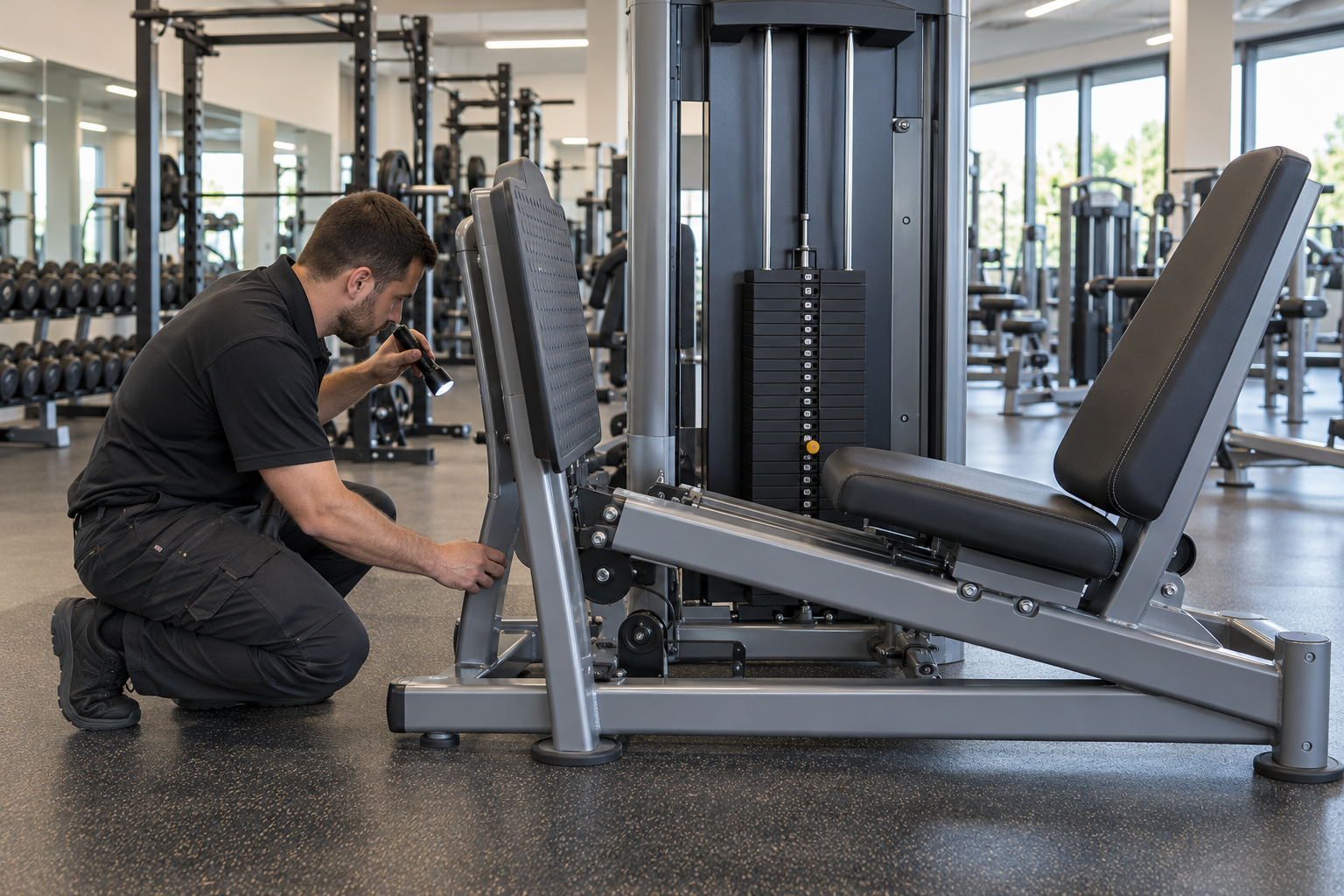
What the Annual Fitness Equipment Inspection Includes
An annual inspection proposal may seem clear until you try to list the included services. Does the check cover all machines or only certain families? Are any spare parts included? Does the report describe anomalies or just state that the visit took place? These differences change the operational value of the service, even when the name used by suppliers is identical.
Understanding what the annual fitness equipment inspection includes means reading a concrete assignment, not attributing a universal content to the expression. Relevant frequencies and activities depend on the products and applicable instructions. A scheduled visit every year can serve a summary function, but it does not automatically replace intermediate checks, maintenance, or interventions required by an anomaly.
The manager should arrive at the booking with an inventory and leave the intervention with usable outcomes. The connection between these two moments is the scope of the service: identified equipment, agreed activities, and documentation methods. This guide examines these elements to help compare offers, without promising that a single visit will solve every problem or indiscriminately certify the room.
- Define which equipment falls under the assignment
- Distinguish check, maintenance, and repair
- Prepare access and documents for a useful intervention
- Clarify how components and spare parts are handled
- Read the report as a management tool
- Organize decisions after the visit
- Compare the service through content and overall cost
Define which equipment falls under the assignment
The scope should start from a recognizable list of equipment, with identifiers and sufficient data to distinguish models and configurations.
A generic formulation like gym inspection can leave doubts about secondary machines, accessories, or rarely used stations. The client and the operator must know which elements are the subject of the agreed activity.
The fitness machine inspection can include product families with different needs. Cardio, strength machines, and free weights do not necessarily share the same checks. The proposal must make it clear whether the operator will handle all present categories or if some require an additional assignment or competence.
Agree on the list before the visit
The list should be updated if a machine is added, removed, or replaced before the appointment. Variations can influence the timing and content of the service. An attached or referenced inventory in the offer allows identifying the basis of the agreement and avoiding different interpretations when the staff arrives to perform the work.
Manage stopped machines and accessories
Stopped equipment must be reported explicitly, along with already known anomalies. The scheduled inspection and the diagnosis of a failure can be different services. Accessories and removable components must also be discussed when relevant, without assuming that every object present in the room is automatically included in the visit price.
Distinguish check, maintenance, and repair
A check produces observations and outcomes related to the planned activities.
Maintenance can include specific operations, while a repair intervenes on an identified problem. These categories can be present in the same service, but they must be named: the word inspection does not clarify on its own whether the technician will also perform corrective interventions during the appointment.
Activities must refer to the products present and the relevant documentation. If the proposal includes standard operations, it is useful to ask how they are adapted to different machines. A long but indistinguishable list can be less informative than a targeted description, capable of explaining what will be checked and with what reference.
Understand the service described in the offer
The manager should know what results to expect from each activity. An examination of observable conditions is not equivalent to every possible technical test, nor does it imply the disassembly of all components. Clarification must be obtained before the assignment, so as to compare equivalent services and schedule any in-depth checks possibly excluded from the ordinary visit.
Read the conditions for additional activities
If an additional intervention emerges during the check, its management must follow the agreed conditions. It is necessary to know how authorizations are requested and economic proposals are formulated when needed. Separating these phases prevents the client from interpreting the technician's presence as the automatic inclusion of spare parts, processing, and subsequent appointments.
Prepare access and documents for a useful intervention
The quality of the intervention also depends on accessible information.
Manuals, previous reports, and reports help reconstruct the history of the machines. The manager must not turn these documents into an autonomous diagnosis, but can put them in order to prevent problems already observed from being described only through incomplete memories of the staff.
The equipment documentation should be linked to individual identifiers. When a report concerns a machine subsequently moved, the link remains valid and allows following the product over time. This approach makes collected data more usable, especially in facilities with multiple rooms or frequent replacement of contact persons.
Gather the anomaly history
The history must distinguish reported symptom, date, and any intervention performed. A noise that appeared under particular conditions can be described without inviting users to reproduce it specifically. The operator thus receives concrete elements and can evaluate how to investigate them according to their competence and the conditions relevant to the machine concerned.
Make agreed stations available
Stations must be available according to the agreed plan, with adequate access and operating space. The technician should clarify what preparations are required from the facility and what activities are up to the appointed personnel. The class schedule must take into account the involved areas, avoiding assuming that the inspection can take place without any interference with use.
Clarify how components and spare parts are handled
An inspection may reveal the need to replace a component without automatically including the spare part.
The offer should clarify which materials are included and how further needs are managed. This distinction allows the manager to evaluate the cost of the initial service without confusing it with the final cost of interventions that might emerge.
For requests for information on professional isotonic machines, precise product identification remains essential. Consulting the commercial category does not prove the compatibility of a component with an already present machine. Model, version, and relevant references must be verified through appropriate channels before ordering.
Identify compatibility and availability
Compatibility must be confirmed on the specific equipment. External similarity or trade name are not enough to establish equivalence between components. The intervention file should keep the useful identifiers, so that a subsequent order can be linked to the technical proposal rather than reconstructed through photographs or generic descriptions.
Separate the visit from procurement
Procurement and assembly can require different phases from the scheduled visit. The manager must know which times are confirmed and which depend on availability yet to be verified. If the machine remains unavailable, internal communication must reflect this status, without announcing a return date to use before the necessary confirmations.
Read the report as a management tool
The inspection report should make it possible to identify examined equipment, performed activities, and relevant outcomes.
A summary that only confirms the presence of the technician offers little information for subsequent management. Before the assignment, it is useful to clarify what documentation will be delivered and how anomalies or limitations that emerged during the work will be reported.
Information must be readable even by those who did not participate in the visit. Identifiers, dates, and references to proposed actions allow the manager to plan subsequent purchases and appointments. The report should not be interpreted beyond its content: the outcomes are valid for the activities actually performed and for the indicated conditions.
Request outcomes referring to individual machines
For each machine, the connection between check and observation should be recognizable. This allows updating the inventory and following any recurring problems. When an item is unclear, the manager should ask for explanations instead of translating it independently into a general judgment on the availability or remaining duration of the equipment.
Distinguish observations and still open actions
Still open actions must remain visible, with reference to the subject who will follow them. A component to order, an additional check, and an intervention already performed represent different states. Keeping them separate prevents the administrative closure of the visit from being confused with the technical resolution of all identified anomalies.
Organize decisions after the visit
The end of the appointment does not necessarily coincide with the return to full availability of each station.
The instructions received must be transferred to the organization of the room. If a machine requires further activities, the manager must know how to manage it according to relevant conditions, avoiding decisions based solely on the need to fill the class schedule.
The scheduling of interventions should connect each open action to a contact person and an identifiable subsequent phase. Not all items will immediately have a definitive date, but it must be clear what is missing to obtain it. This makes the report operational and reduces the risk that it is archived without translating into concrete activities.
Manage any suspensions of use
When a limitation is planned, the staff must receive coherent information and know which procedure to apply. The management of the station cannot depend on contradictory messages between shifts. Technical decisions remain linked to the outcomes and relevant competences, while the room contact person coordinates communication and space organization.
Update schedule and responsibilities
The maintenance schedule must be updated with performed activities, received instructions, and relevant deadlines. The annual cadence remains only part of the system. If different needs emerge for a product or for conditions of use, they must be considered through applicable references rather than automatically postponed to the same visit the following year.
Compare the service through content and overall cost
The price of two inspections is not comparable without knowing the included equipment and services.
An offer may include activities that another treats separately, or refer to a different inventory. The manager should therefore build the comparison on the same scope, keeping visible materials, documentation, and conditions for any additional interventions.
A useful proposal also clarifies the organization of the visit, requested information, and management methods for unexpected events. These elements influence the continuity of the room and the work of the staff. There is no need to attribute unproven future savings to the inspection: value is evaluated through defined services and outcomes that can be used in management.
Read inclusions and exclusions on the same basis
Comparison can distinguish visit cost, explicitly included materials, and other activities to quote. Undefined items must remain recognizable, without being assumed as free. This allows approving the service while understanding which expenses are consolidated and which still depend on conditions that will be detected on the machines.
Prepare a verifiable assignment
The final assignment should recall inventory, agreed activities, requested preparations, and expected documents. Any exclusions must be understood by the client and compatible with the facility's schedule. In this way, the annual inspection becomes a verifiable service, linked to actual equipment and the decisions that the manager will have to face after the intervention.
Comments (0)