
Trolley
You have no items in your shopping cart

 Budgets
 Dumbers
 Discs
 Benches
 Racks and Rigs
 Weights Holders
 Isotonic machines
 Calisthenics
 Cardio
 Kettlebells
 Flooring
 Gym Set
 Accessories
 Combat
 ARTI MARZIALI
 CONTAINER GYM
 Tug-Of-War
 Used Gym Equipment
 PILATES MACCHINARI
 GINNASTICA ARTISTICA
 CAMPI DA PADEL
 Prodotti in Pronta Consegna
 Informazioni
 IRONMAN
 Gift Card
- Donatif
- General information
- 0 I like it
- 150 Views
- 0 comments
- gym flooring, safety flooring, gym safety, shock-absorbing materials
How to choose equipment for a postural gymnastics room: a practical guide
Understanding how to choose equipment for a postural gymnastics room means starting from the activities you intend to offer, the characteristics of the users, and the real conditions of the available space. For the owner of a Pilates or postural studio, the goal should not be to purchase the largest possible number of tools, but to build a functional, safe, and sufficiently versatile environment to support different exercise programs.
Postural gymnastics includes activities oriented toward body awareness, motor control, mobility, and the improvement of movement capacities. Operational methods vary according to the training of the professionals, the goals of the lessons, and the characteristics of the participants. For this reason, a room dedicated primarily to floor exercises presents different needs compared to a studio that regularly uses Pilates machinery, small equipment, and resistance systems.
The choice of equipment also involves economic and organizational aspects. Dimensions, maintenance, ease of cleaning, adjustments, and availability of spare parts can influence daily management. This guide presents technical criteria, application examples, and a checklist to compare alternatives without confusing product features with benefits that depend on the quality of teaching.
- Define the goals of the postural gymnastics room
- Evaluate dimensions, layout, and characteristics of the room
- Choose the fundamental equipment
- Evaluate Pilates machinery and specialized solutions
- Compare quality, adjustments, and safety
- Configure the room according to planned activities
- Organize maintenance, hygiene, and storage
- Define the budget and use a purchasing checklist
- Plan a sustainable investment for the studio
Define the goals of the postural gymnastics room
Design must begin with a precise description of the activities offered. A studio that organizes collective mobility and motor control classes primarily needs free surfaces, mats, and small equipment. A center that offers individual sessions with Pilates machinery, on the other hand, must provide specific stations, operational spaces, and usage procedures consistent with the manufacturers' instructions.
It is useful to distinguish motor activities aimed at general well-being from health or rehabilitative interventions. The use of equipment does not automatically transform a gymnastics lesson into a therapeutic treatment. When health services are proposed, applicable professional, organizational, and authorization requirements must be met.
For an owner, this distinction influences the selection of tools and the communication of the service. A room can be designed for adults, athletes, or groups with different motor capacities, but it is incorrect to attribute to the equipment the ability to correct pathologies or prevent specific disorders without adequate evidence and an appropriate professional context.
Identify the main activities
Before making purchases, it is advisable to list the types of lessons planned, their duration, and the maximum number of participants. Mobility activities, stabilization exercises, and work with light resistances can share part of the equipment, while programs with machinery require dedicated equipment.
This functional inventory makes it possible to identify the tools actually needed. If a tool is used only in an occasional variant, it might not represent a priority compared to materials used daily.
Consider user characteristics
Age, motor experience, autonomy, and ability to use adjustments influence the organization of the room. It is important to provide exercises and tools adaptable to different levels, without assuming that all participants can use the same resistances or positions.
The evaluation of individual conditions is the responsibility of qualified professionals according to their respective fields of activity. The manager must ensure that the available tools are consistent with the staff's competencies and the services actually provided.
Evaluate dimensions, layout, and characteristics of the room
The surface area of the room represents one of the main design constraints. However, the figure in square meters is not enough to determine how many people or pieces of equipment can be accommodated. It is necessary to consider the shape of the room, the presence of columns, accesses, pathways, and the space required during the execution of exercises.
For a room intended for floor activities, sufficient space must be provided so that participants can extend their limbs and change positions without interfering with each other. When machinery is present, operational dimensions and access spaces indicated by the manufacturers must be respected.
Flooring, lighting, ventilation, and acoustic conditions also contribute to functionality. An environment designed for controlled exercises must allow the professional to observe participants and communicate clearly, avoiding visual obstacles and excessive noise.
Distribute workstations in a functional way
A practical solution consists of distinguishing the central area intended for exercises from the equipment storage area. If machinery is planned, it is useful to place it in positions that allow the professional to easily reach adjustments and assist users.
The final arrangement should be verified through a dimensioned floor plan. The number of workstations must not be established solely on the basis of the dimensions of mats or machinery, because movements and pathways also occupy space.
Flooring and environmental comfort
Flooring must offer stability conditions appropriate to the planned activities, be compatible with cleaning, and maintain adequate characteristics during use. Excessively slippery surfaces or unsuitable materials can create difficulties during exercises.
The choice of covering must also consider any heavy machinery and the characteristics of the underlying support. Not all soft floors are appropriate for installing equipment that requires a stable base.
Choose the fundamental equipment
An initial setup can include mats, small mobility tools, resistance bands, and support tools. These elements allow you to organize different exercises without permanently occupying large surfaces. The choice must still depend on the educational program and the instructors' competencies.
Mats must be evaluated for dimensions, stability, wear resistance, and ease of cleaning. Greater thickness does not automatically represent an advantage, because some activities require a relatively stable surface to maintain movement control.
Resistance bands, small balls, and supports can expand exercise possibilities. It is advisable to select different resistances and dimensions, avoiding tools that require levels of force inconsistent with user characteristics. Material quality and the availability of instructions for use are more useful criteria than the simple quantity of accessories.
Mats, cushions, and supports
Mats represent one of the most used equipment items in floor postural activities. The choice must consider grip on the floor, comfort in the planned positions, and the material's ability to maintain its characteristics during repeated use.
Cushions and supports can facilitate certain positions and adaptations, but must be used according to the professional's indications. It is not appropriate to consider them universal therapeutic tools or substitutes for an individual evaluation.
Resistance bands, balls, and small tools
Resistance bands allow you to introduce different resistances in exercises for upper limbs, lower limbs, and trunk. The choice should include appropriate tension levels, checking the manufacturer's instructions and the condition of the material before use.
Small balls, rings, and other tools can be used for coordination and motor control exercises. Their value depends on integration into the program, not on the presence of particularly elaborate commercial features.
Evaluate Pilates machinery and specialized solutions
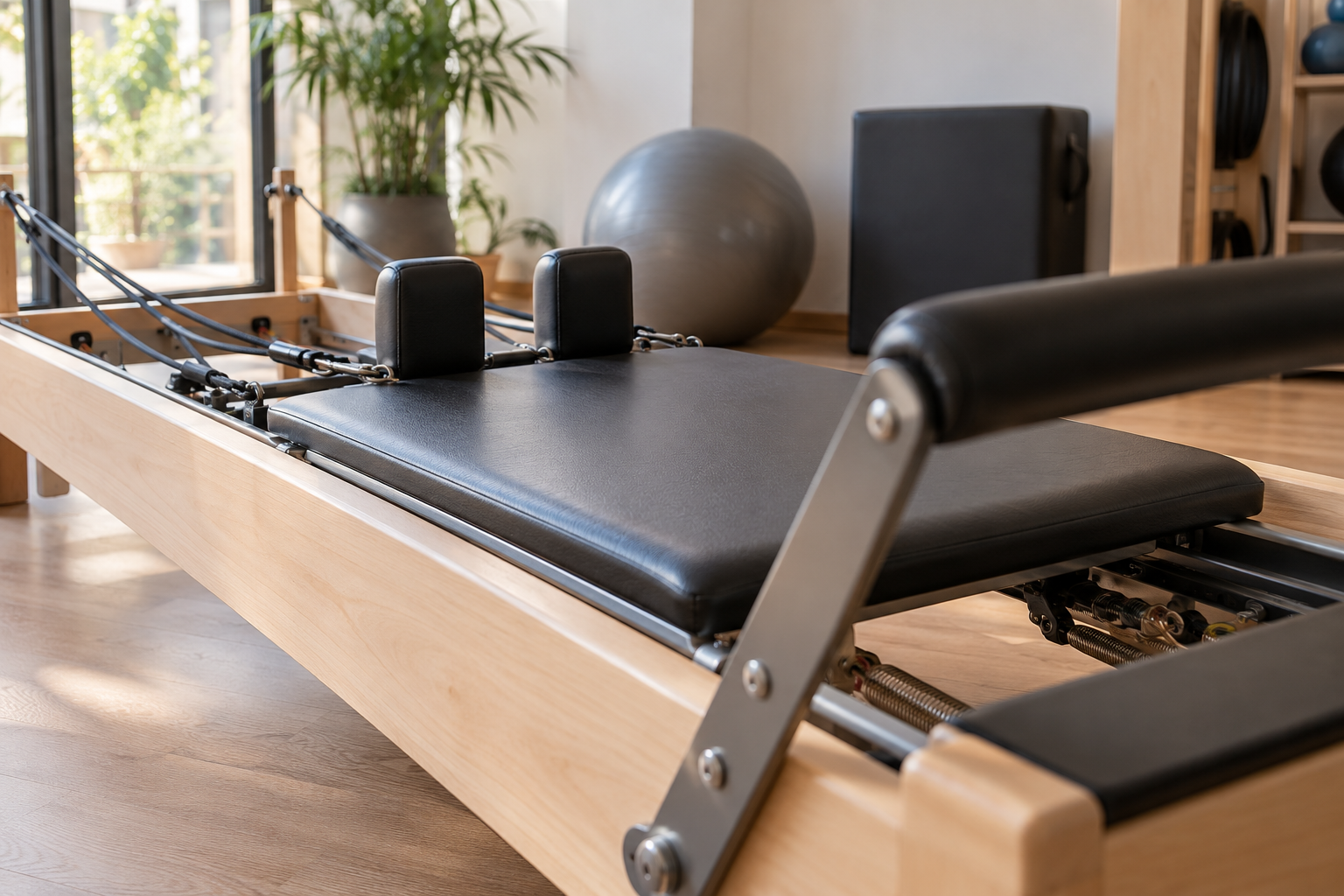
When the studio offers Pilates classes with dedicated equipment, machinery selection requires deeper analysis. Reformer, Cadillac, Chair, and Barrel present different characteristics and should not be considered interchangeable. The choice depends on the planned exercises, operator training, and room configuration.
The Reformer generally uses a moving carriage and an adjustable resistance system. Its installation requires attention to dimensions and spaces needed to access adjustments. Other machinery can offer different exercise possibilities, but requires larger surfaces or more specialized usage modes.
Before purchase, it is important to consult technical sheets and verify intended use, dimensions, load limits, adjustment systems, and maintenance instructions. The number of exercises declared in a catalog alone does not represent a sufficient criterion to evaluate the usefulness of the machinery.
When to include a Reformer
The Reformer can be relevant for studios that provide a structured offering of individual classes or small group classes with this method. The decision should consider the number of workstations needed and the staff's ability to correctly manage adjustments.
To compare alternatives, it is useful to examine professional Pilates equipment considering dimensions, construction characteristics, components subject to wear, and availability of assistance. The purchase must be consistent with the program actually offered.
Cadillac, Chair, and Barrel: usage criteria
This machinery can expand exercise possibilities, but presents different requirements in terms of space and competencies. The choice should start from the activities the staff is qualified to propose and the expected frequency of use.
In a compact room, introducing too many specialized machines can reduce the surface available for floor exercises. It is therefore useful to compare the operational benefit of each piece of equipment with the space it occupies and related management costs.
Compare quality, adjustments, and safety
Postural gymnastics equipment must be evaluated through verifiable characteristics. Stability, material quality, wear resistance, and clarity of instructions constitute important elements. Evaluation must be adapted to the type of tool, because the requirements of a resistance band are different from those of machinery with moving parts.
For adjustable equipment, it is useful to verify that mechanisms are accessible and correctly maintain the selected position. In systems equipped with springs, cables, or transmission components, the manufacturer's instructions regarding checks, replacements, and maintenance must be followed.
Safety also depends on installation and activity organization. Technically adequate equipment can become problematic if used in insufficient space, on an unsuitable surface, or by people lacking necessary competencies.
Materials and durability in professional use
Material quality must be evaluated considering frequency of use, cleaning, and environmental conditions. Coverings and padding must maintain appropriate characteristics even when used by numerous participants during the day.
For machinery, it is advisable to verify the availability of spare parts and the possibility of replacing components subject to wear. A robust structure does not eliminate the need to periodically check mobile systems.
Adjustments, stability, and technical instructions
Adjustments must be consistent with user characteristics and planned exercises. A system that is difficult to set up can slow down the lesson and increase the risk of incorrect use.
It is important to keep the manufacturer's instructions and verify any operational limits. Generic safety declarations do not replace technical documentation, correct installation, and control procedures.
Configure the room according to planned activities
To understand how to apply choice criteria, it is useful to compare different scenarios. A room intended for collective postural gymnastics classes can be organized with predominantly mobile equipment. A Pilates studio with machinery, on the other hand, requires stricter planning of workstations and operational spaces.
Let us consider a first hypothetical scenario: a studio has a rectangular room of about 45 square meters and offers floor classes for small groups. Equipment could include mats, resistance bands of different tensions, small balls, and supports, with a storage system that keeps the surface free during activities.
In a second scenario, the owner has a larger space and wants to integrate individual classes with Reformers. In this case, it is necessary to verify machine dimensions, pathways, and assistance needs. The actual capacity of the room cannot be deduced from square footage alone, but requires a floor plan and specific technical data.
Room for collective floor classes
A configuration for small groups can prioritize lightweight and easily storable equipment. This allows layout modification based on exercises and keeps a sufficiently free central space.
The quantity of tools should be calculated based on the maximum number of participants and lesson modalities. It is useful to provide a reserve supply to quickly replace deteriorated materials without accumulating unused tools.
### Studio with dedicated Pilates workstations
When machinery is planned, the layout must allow the instructor to reach workstations and control adjustments. Distances must respect manufacturer instructions and the operational needs of activities.
A gradual solution can involve the initial introduction of a limited number of workstations, subsequently evaluating actual demand. This strategy is feasible only if space and facilities allow possible expansions without compromising safety.
Organize maintenance, hygiene, and storage
Daily management affects equipment longevity and service quality. A cleaning and control program makes it possible to identify deteriorated materials, damaged components, and functional problems. Procedures must be proportionate to tool characteristics and manufacturer indications.
For small equipment, it is useful to provide regular visual checks. Bands with signs of deterioration, damaged mats, or unstable supports must be evaluated and replaced when no longer adequate for use. For machinery, maintenance may require specific technical interventions.
Storage is an often-underestimated aspect. Equipment left in pathways can obstruct movement and make cleaning more difficult. Racks, containers, and supports must be chosen based on available materials and space.
Cleaning and product compatibility
Cleaning must be performed with products compatible with equipment materials. Some substances can damage coverings, bands, or machine components, making it necessary to consult the manufacturer's instructions.
It is useful to establish cleaning responsibilities and frequencies in relation to usage intensity. Surfaces shared by multiple participants require particular attention, but procedures must remain compatible with product characteristics.
Periodic checks and technical assistance
A Pilates equipment maintenance plan should identify checks provided by the manufacturer and the people responsible for performing them. Systems with springs, cables, and moving parts require different checks compared to small tools without mechanisms.
When a potentially dangerous anomaly is identified, equipment must be excluded from use until appropriate verification. Repairs must be entrusted to competent personnel when required by technical characteristics.
Define the budget and use a purchasing checklist
The budget should be built starting from planned activities and not from a generic list of products. A room dedicated to floor postural gymnastics may require different investments compared to a studio with Pilates machinery. Installation and maintenance needs also change significantly.
It is useful to distinguish the initial cost of equipment from subsequent expenses. Transport, installation, cleaning, maintenance, and component replacement can impact total cost. The presence of spare parts and assistance must be verified before purchase, especially for specialized machinery.
The checklist for setting up a postural room should include offered activities, number of participants, usable surface, technical requirements, dimensions, adjustment possibilities, maintenance, and available budget. These criteria allow comparison of alternatives without placing excessive value on marginally relevant commercial features.
Separate initial investment and recurring costs
Initial cost includes equipment, any room interventions, transport, and installation. Recurring expenses, on the other hand, concern cleaning, maintenance, and replacement of materials subject to wear.
For a correct comparison, it is advisable to request quotes that clearly distinguish these items. It is prudent not to assign standard durations or maintenance costs without considering selected models and usage conditions.
Questions to ask suppliers
Before purchasing, it is useful to ask what declared intended use is, what operational dimensions are, what adjustments are available, and what maintenance activities are required. For machinery, warranty conditions, assistance, and spare parts availability must also be verified.
Documentation should allow evaluation of usage limits and installation requirements. When information is insufficient, it is preferable to request technical clarifications before proceeding.
Plan a sustainable investment for the studio
For the owner of a Pilates or postural studio, equipment choice should be linked to service strategy. Essential but consistent equipment can be more functional than a set of specialized machinery used rarely. The decision must consider lesson schedules, staff competencies, and room operational capacity.
A sustainable investment also requires evaluation of future evolution. If the project plans to expand activities, it is useful to verify that the room can accommodate new workstations without compromising necessary pathways and spaces. However, purchasing equipment today merely for hypothetical expansion can immobilize resources that could be destined for more immediate needs.
Comparison between alternatives should prioritize safety, functionality, and expected frequency of use. Design, materials, and finishes can contribute to studio perception, but must be evaluated together with technical characteristics and overall costs.
Establish priorities based on lessons
A possible strategy consists of initially purchasing tools necessary for the most frequent activities. For floor classes, this can mean prioritizing mats and small equipment of adequate quality, maintaining free space for movements.
If machine classes represent the main service, priority can concern specialized workstations and their correct installation. Choice depends on the operational model, not on a universal hierarchy among product categories.
Monitor equipment usage and performance
After opening, it is useful to record instrument usage frequency, needs reported by instructors, and maintenance interventions. These data help identify underutilized equipment and not-yet-satisfied needs.
Investment performance must not be evaluated solely through number of uses. Equipment contribution to service quality, reliability, and necessary maintenance cost to keep it available must also be considered.
Build equipment expandable over time
A room designed with flexible criteria can be adapted when activities change or demand increases. The presence of free areas, orderly storage systems, and versatile equipment can facilitate modifications without requiring complete reorganization.
Every expansion must still be verified against operational spaces and technical characteristics of the room. Availability of residual surface does not automatically guarantee that new machinery can be added.
Transform technical criteria into an informed choice
The final decision should be based on a documented evaluation of activities, users, spaces, and product characteristics. Comparing homogeneous quotes and consulting technical sheets reduces the risk of purchasing equipment inconsistent with studio needs.
For a professional postural gymnastics room, equipment value derives from its capacity to support operator work under adequate conditions. Reasoned selection allows better space utilization, expense planning, and maintaining an environment functional to actually proposed activities over time.
Comments (0)