
Trolley
You have no items in your shopping cart

 Budgets
 Dumbers
 Discs
 Benches
 Racks and Rigs
 Weights Holders
 Isotonic machines
 Calisthenics
 Cardio
 Kettlebells
 Flooring
 Gym Set
 Accessories
 Combat
 ARTI MARZIALI
 CONTAINER GYM
 Tug-Of-War
 Used Gym Equipment
 PILATES MACCHINARI
 GINNASTICA ARTISTICA
 CAMPI DA PADEL
 Prodotti in Pronta Consegna
 Informazioni
 IRONMAN
 Gift Card
- Donatif
- General information
- 0 I like it
- 141 Views
- 0 comments
- gym flooring, safety flooring, gym safety, shock-absorbing materials
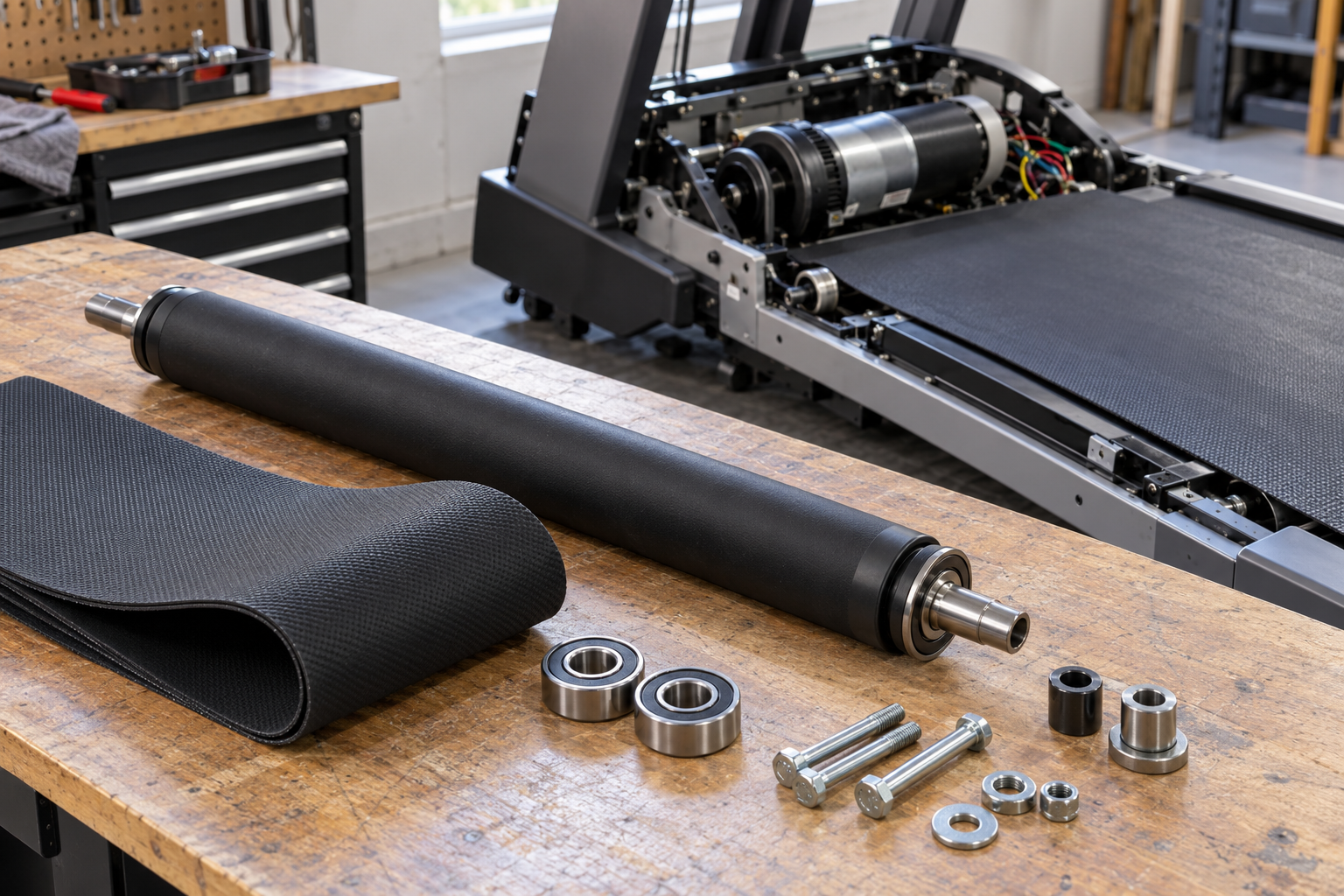
Professional treadmill spare parts: identification and selection
A stopped treadmill immediately raises a practical question: which part is needed to get it back into working order? However, the answer requires distinguishing the symptom from the cause and identifying the machine without ambiguity. A noise, a display message or irregular movement can guide the report, but do not prove on their own which component needs to be purchased.
The search for professional treadmill spare parts should therefore start with product documents and references. Model, version and serial number when available help customer service verify the request. External appearance can also be useful as support, provided it is not used to deduce compatibility between machines that look similar or share part of their name.
This guide covers the organization of the request and intervention, without proposing remote diagnoses or DIY repair procedures. The manager can gather information and coordinate the steps, while technical evaluation and replacement follow relevant skills and instructions. The objective is to connect the correct spare part to a verified need, keeping costs, availability and return-to-use conditions legible.
- Identify the treadmill before the component
- Describe the symptom without turning it into a diagnosis
- Distinguish component families in the request
- Verify compatibility before authorizing the order
- Read the cost of the spare part together with the intervention
- Prepare the installation and document the outcome
- Evaluate the economic decision on the overall situation
Identify the treadmill before the component
The first record should contain the internal identifier, model and manufacturer references present on the machine.
When available, serial number and version complete the identification. These data make it possible to distinguish different configurations and prevent a request from being evaluated based solely on the trade name or a photograph of the console.
The spare parts catalog, when available through the relevant channels, must refer to the specific machine. A document for a different version may show similar components without confirming their equivalence. The manager should record where the information came from and ask for verification when the link between document and product is unclear.
Gather machine data
A legible photograph of the references can reduce transcription errors. The image must show useful data without replacing an orderly description of the request. If a nameplate is deteriorated or illegible, the point must be reported to customer service along with the other available elements, avoiding completing the data by analogy with nearby machines.
Link documents and photographs
Manual, purchase documents and previous reports must be linkable to the same identifier. An updated inventory maintains this connection even when the treadmill is moved. Initial collection takes up little space, but can prevent each service request from starting over with the reconstruction of the installed configuration and its history.
Describe the symptom without turning it into a diagnosis
The report should explain what was observed and when.
Stoppages, noises or irregularities must be described with concrete words and linked to the correct machine. There is no need to create additional evidence to make the defect more obvious: staff gather what emerged during use and follow the procedures established for equipment management.
Treadmill diagnosis requires a competent evaluation of the information and machine conditions. The manager can provide the history, but should not automatically order the component named in an informal discussion. Separating observation and diagnosis prevents a replacement from being chosen before verifying the cause of the problem.
Note observed conditions
Useful conditions may include time of appearance, indicative frequency and activity underway when the symptom was noticed. Information must remain descriptive: there is no need to interpret it as proof of a specific failure. If the problem requires suspending use, management must follow relevant instructions and facility procedures.
Use messages and errors as information
A displayed message must be reported correctly, along with the context in which it appears. The same text may require further investigation linked to the specific version and available documentation. Customer service must be able to read the original information, avoiding imprecise summaries or attempts to clear the message through interventions not provided for in the instructions.
Distinguish component families in the request
The treadmill includes components with different functions, and a request must identify them through the relevant references.
The generic denomination motor or board can leave room for different interpretations. When customer service proposes a spare part, it must be possible to link the item to the product and the indicated intervention, without reconstructing its identity solely from an image.
Professional cardio machines can be explored further through commercial and technical documentation of individual models. For pre-existing equipment, spare part verification remains specific nonetheless. The availability of products in the same category does not prove component compatibility nor the immediate availability of every requested part.
Separate mechanical and electronic parts
Mechanical and electronic parts may require different information for identification and intervention. The customer should ask what data are needed and who will confirm compatibility. Any checks or specialized operations do not become floor staff activities simply because the component is accessible or the spare part was purchased online.
Consider items subject to wear
Even components subject to wear must be evaluated with respect to the product and detected conditions. The time elapsed since purchase is not enough to automatically establish what to replace. Manuals, usage and observations by the person in charge contribute to the evaluation, which should translate into an understandable proposal referring to the specific machine.
Verify compatibility before authorizing the order
Compatibility should be confirmed through product and component references.
Similar dimensions, the same color or a partially matching name do not constitute sufficient verification. The manager must know what data the proposal is based on, especially when the machine has undergone previous interventions or has a configuration different from the initial one.
Spare parts compatibility must remain documentable in the order or relevant communications. This helps connect what is delivered to the evaluated need and allows clarifying any differences. A recognizable description of the component reduces ambiguities between estimate, delivery and the report of the intervention that will follow.
Request precise spare part references
The reference should be precise enough to allow the operator to identify the proposed part and the destination machine. If the documentation shows a code, it must be kept along with the confirmation received. When essential elements are missing, the order should be preceded by necessary clarification rather than completed with information gathered from similar listings.
Manage any proposed alternatives
An alternative proposed as a replacement requires confirmation referring to the actual configuration and intervention methods. Equivalence must not be deduced solely from the fact that the component can be physically mounted. The manager should ask what conditions and checks accompany the proposal, maintaining the connection with the original technical evaluation.
Read the cost of the spare part together with the intervention
The price of the part represents only a part of the possible expense.
Identification, diagnosis, transport and installation can be treated separately according to the offer. To compare alternatives, the manager must know the scope and distinguish included items from those still to be evaluated, without assuming that the sale of the component includes every subsequent activity.
Times must refer to the actually identified spare part. Generic availability does not equal confirmation of the part suitable for the machine. The operational schedule should distinguish order, delivery and intervention appointment, avoiding announcing the return to use before the necessary conditions have been confirmed by those in charge.
Separate material and services
The estimate may include material, call-out fee and workmanship with different conditions. It is useful to ask how any additional needs that emerge during the intervention will be handled. Economic clarity does not eliminate technical uncertainty, but allows the customer to know which amounts are consolidated and which depend on checks still open on the machine.
Know procurement conditions and times
Procurement may require a phase separate from the technical visit. If the treadmill remains stopped, staff must have consistent information on the case status. An indicative date must be communicated as such, distinguishing it from the confirmed appointment and subsequent relevant checks before the station is made available again.
Prepare the installation and document the outcome
The intervention must be organized with the assigned party, clarifying access conditions and preparations required of the facility.
Staff should not anticipate disassembly or other specialized operations without relevant instructions. The plan must be compatible with the work area and the management of present users, keeping logistical coordination and technical activity distinct.
The report should allow identifying the machine, the component involved and the operations performed. Any instructions for subsequent management should be kept along with the history. A documented outcome is useful even when the symptom reappears, because it avoids treating the episode as a new problem devoid of connection with previous interventions.
Agree on access and required preparations
The facility contact person can arrange the appointment, accessibility and documentation, while the technical conditions of the intervention follow appropriate skills. If impediments arise, they must be communicated promptly. A team present without access to the station or without the required information may fail to complete the work, despite having the correct spare part.
Update the machine file
The file must record what was actually replaced and the instructions received, without limiting itself to the repaired machine note. Return to use follows outcomes and procedures relevant to the situation. Informal testing by staff must not replace the checks required for the intervention and specific equipment.
Evaluate the economic decision on the overall situation
The choice between repair and replacement requires data on the problem, the proposed intervention and the general conditions detected.
There is no universal percentage of the purchase price that solves every case. The comparison must consider documented costs and operational consequences, keeping confirmed information and hypotheses on future operation separate.
History helps recognize repeated problems and formulate more precise requests, but must not become an automatic diagnosis. A series of different interventions can have different meanings. The manager should use the data to ask for a reasoned evaluation and to plan room availability without attributing an arbitrary residual lifespan to the machine.
Compare repair and replacement homogeneously
The comparison can report the repair proposal, any additional checks and the alternative of new supply with equivalent services. A new machine also entails delivery, installation and management of the previous one, to be considered when relevant. Highlighting these perimeters avoids comparing only the cost of the spare part with a product presented without services.
Use history to plan purchases
Purchase planning can start from collected evidence and facility priorities. An updated inventory and linked reports allow discussing investments with greater clarity. The decision remains referred to the actual treadmill, the intervention conditions and the center's capacity to manage equipment and assistance in its own context.
Comments (0)