
Trolley
You have no items in your shopping cart

 Budgets
 Dumbers
 Discs
Discs
 Benches
 Racks and Rigs
 Weights Holders
 Isotonic machines
 Calisthenics
 Cardio
 Kettlebells
 Flooring
 Gym Set
 Accessories
 Combat
 ARTI MARZIALI
 CONTAINER GYM
 Tug-Of-War
 Used Gym Equipment
 PILATES MACCHINARI
 GINNASTICA ARTISTICA
 CAMPI DA PADEL
 Prodotti in Pronta Consegna
 Informazioni
 IRONMAN
 Gift Card
- Donatif
- General information
- 0 I like it
- 647 Views
- 0 comments
- gym flooring, safety flooring, gym safety, shock-absorbing materials
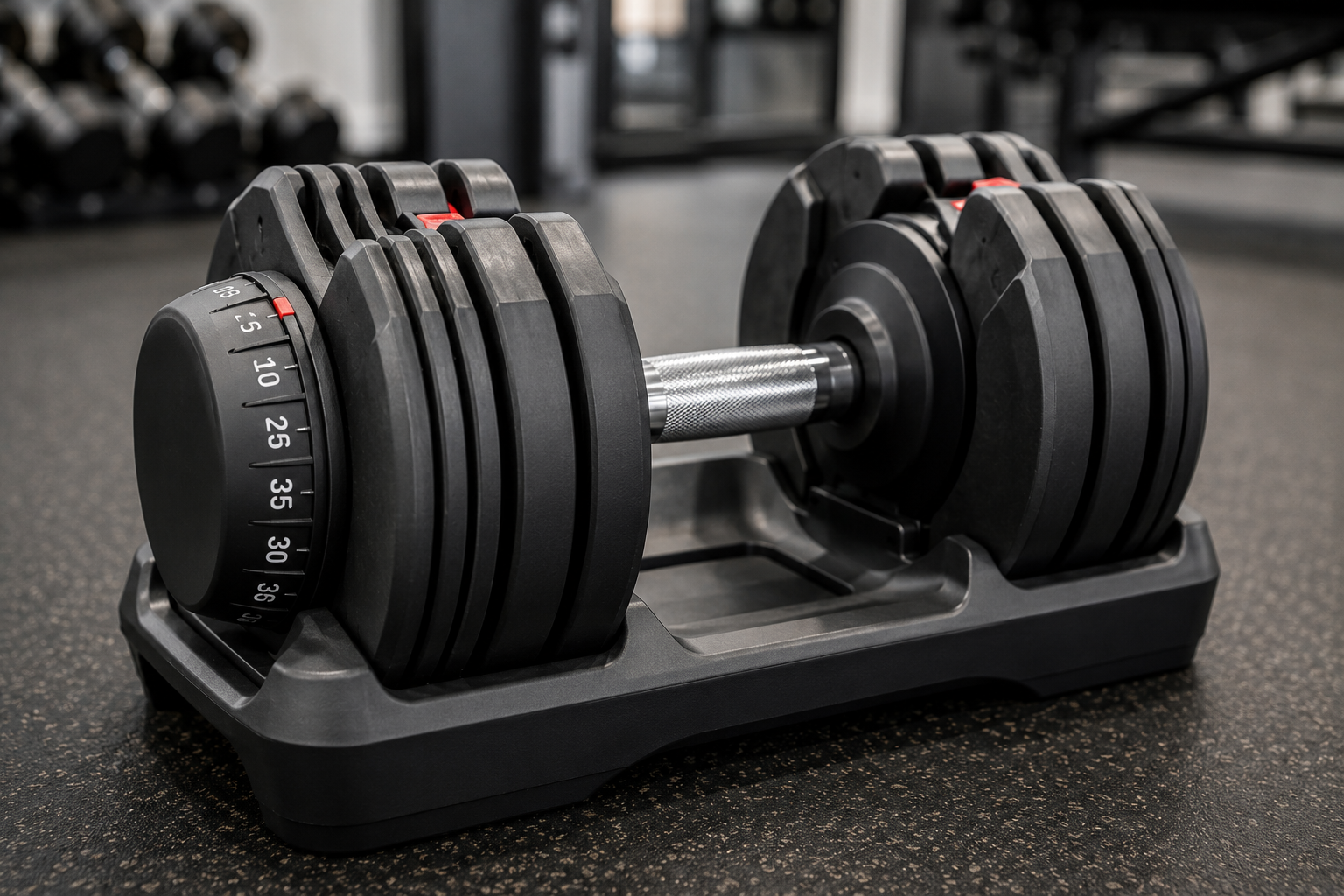
Adjustable dumbbell maintenance: how to make your equipment last a lifetime
An adjustable dumbbell represents an investment designed to accompany years of training. Its main strength is the ability to adapt to different needs, offering numerous loads in a single compact tool. However, like any mechanical instrument subjected to frequent use, an adjustable dumbbell also requires attention and care to maintain high performance over time.
Proper maintenance does not require complex operations, but a consistent approach made of cleaning, periodic checks, and attention to detail. A well-maintained system more easily retains fluidity in movements, precision in mechanisms, and reliability during every training session.
Taking care of your adjustable weight dumbbell means protecting the value of your purchase and reducing the risk of problems such as rust, jamming of the selection system, or premature wear of components. A small maintenance routine can make the difference between equipment that loses efficiency quickly and a product capable of lasting for many years.
- Why adjustable dumbbell maintenance is fundamental
- How to properly clean adjustable dumbbells
- Checking and caring for internal mechanisms
- Lubrication and wear prevention
- How to avoid rust and material deterioration
- Common mistakes in equipment management
- How to increase the lifespan of your dumbbells
Why adjustable dumbbell maintenance is fundamental
Adjustable dumbbells have a more complex structure than standard fixed weights. The ability to modify the load through selection systems or moving components offers great practical advantages, but requires greater attention in daily management.
Every workout subjects the equipment to stress: sweat, dust, temperature variations, and numerous adjustment cycles can progressively affect the functioning of the components. Proper maintenance allows the system to be kept in ideal conditions.
Equipment care should not be seen as an extraordinary activity, but as a natural part of the training routine, just as it is for any frequently used tool.
Preventing instead of repairing
One of the main advantages of preventive maintenance is the ability to identify small signs before they become more significant problems. A slightly less fluid mechanism, an accumulation of dirt, or a component that needs attention can be easily managed if detected in time.
Intervening early allows you to avoid unnecessary downtime and keep the equipment always ready for use.
Maintaining consistent performance
A well-maintained dumbbell offers a more precise and reliable feel during use. Weight adjustment remains smoother, components work correctly, and the training experience remains consistent over time.
The perceived quality of equipment also depends on the ability to keep it in the best possible condition.
How to properly clean adjustable dumbbells
Cleaning represents the first level of maintenance and should be performed regularly. During workouts, sweat and dust can deposit on surfaces, creating conditions favorable to wear or the formation of oxidation over time.
Proper cleaning allows you to preserve both the aesthetic appearance and the functioning of the components. It is important to use appropriate products and methods so as not to damage coatings, metal surfaces, or adjustment systems.
The frequency of cleaning depends on the intensity of use, but simple attention after more demanding sessions can contribute significantly to the lifespan of the equipment.
Cleaning the handle and external parts
The handle is one of the areas that comes into contact with the user the most. Removing sweat and dirt residue helps maintain a comfortable and hygienic grip.
The external surfaces of the plates and components must be cleaned while avoiding overly aggressive products that could compromise materials and finishes.
Pay attention to difficult areas
Adjustable systems have points where dust or small residues can accumulate. These areas require special attention because they can affect the movement of the components.
Thorough cleaning helps keep the system's operation smoother.
Checking and caring for internal mechanisms
The heart of an adjustable dumbbell is the system that allows you to change the load. This mechanism must be checked periodically to verify that it continues to function correctly.
Regular checking allows you to identify any variations in the fluidity of movement, difficulty in selecting the weight, or signs of component wear.
Maintenance of the mechanisms is particularly important because these elements are responsible for the safety and reliability of the entire tool.
Checking the selection system
The selector must move smoothly and allow for precise load selection. Any change from normal operation should be analyzed.
Keeping the adjustment system clean and free helps preserve its efficiency.
Verifying stability and connections
The components that connect the handle and weights must maintain stability during use. Periodically checking the correct functioning of the fastening systems contributes to training safety.
Good maintenance always includes a general check before sessions with heavy loads.
Lubrication and wear prevention
Some mechanical components can benefit from proper lubrication to maintain fluidity and reduce friction. Lubrication must be performed following appropriate instructions and using products compatible with the system.
An excessive amount of lubricant can attract dust and residue, so the goal must be to achieve the right balance between protection and cleanliness.
Mechanical maintenance must always be precise and targeted.
Keeping movements fluid
Reducing friction helps moving components work correctly and limits wear caused by repeated movements.
This contributes to maintaining a more professional feel during use.
Creating a verification routine
Scheduled maintenance allows you to not neglect necessary interventions. Simple but constant checks are often sufficient to keep the equipment efficient.
How to avoid rust and material deterioration
The presence of humidity is one of the main factors that can compromise metal components and surfaces that are not adequately protected. For this reason, it is important to store dumbbells in a dry and clean environment.
Proper management of the training environment contributes to the overall lifespan of the equipment.
Storing dumbbells correctly
Avoiding very humid areas, prolonged contact with wet surfaces, and accumulations of dirt helps protect materials over time.
Care of cast iron components
Cast iron dumbbell cleaning requires special attention because the surface must be kept dry and protected to avoid oxidation phenomena.
Proper storage allows cast iron components to maintain strength and functionality for many years.
Common mistakes in equipment management
Many problems can be avoided simply by changing some daily habits. Leaving weights dirty after use, ignoring small signs of wear, or storing equipment in unsuitable environments are behaviors that can reduce its lifespan.
Proper management requires attention but not necessarily a lot of time.
Ignoring regular cleaning
Lack of cleaning promotes accumulations that can affect the functioning of the components.
Using the system incorrectly
Forcing selectors or moving components can cause premature wear. Each mechanism must be used according to its intended operation.
How to increase the lifespan of your dumbbells
Quality equipment can accompany an athlete for many years, but the lifespan also depends on how it is used and maintained. Taking care of your tools means protecting an investment and maintaining consistent training quality.
Following a simple routine of cleaning, checks, and proper storage allows you to reduce problems and maintain high performance.
Gym equipment maintenance therefore represents a fundamental element for those who want to make the most of their equipment over time. A properly treated adjustable dumbbell continues to offer precision, safety, and reliability session after session.
Comments (0)