
Trolley
You have no items in your shopping cart

 Budgets
 Dumbers
 Discs
Discs
 Benches
 Racks and Rigs
 Weights Holders
 Isotonic machines
 Calisthenics
 Cardio
 Kettlebells
 Flooring
 Gym Set
 Accessories
 Combat
 ARTI MARZIALI
 CONTAINER GYM
 Tug-Of-War
 Used Gym Equipment
 PILATES MACCHINARI
 GINNASTICA ARTISTICA
 CAMPI DA PADEL
 Prodotti in Pronta Consegna
 Informazioni
 IRONMAN
 Gift Card
- Donatif
- General information
- 0 I like it
- 10 Views
- 0 comments
- gym flooring, safety flooring, gym safety, shock-absorbing materials
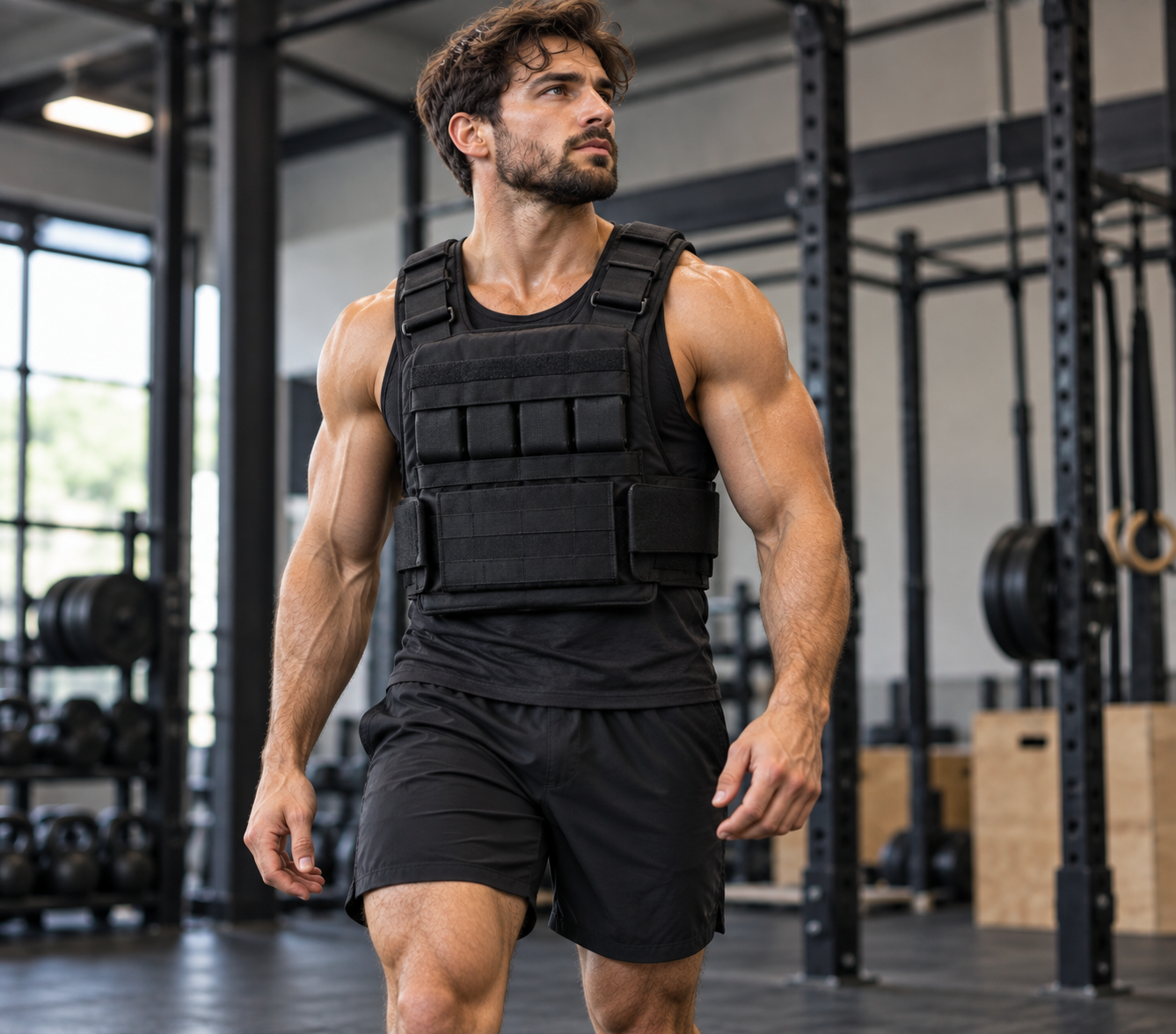
Adjustable or Fixed Weighted Vest: Which to Choose Safely
The weighted vest is a weighted vest designed to increase the load during bodyweight exercises, functional training, athletic preparation, calisthenics, and other training programs. The choice between an adjustable and a fixed model affects not only the ability to change the weight, but also the stability of the vest, progression management, and safety during the execution of exercises.
A model well-suited to your training allows you to maintain control of movement, properly distribute the load, and reduce unwanted shifting of the ballast. For this reason, it is important to carefully evaluate the adjustment system, fit, and compatibility with planned exercises before purchasing.
This guide analyzes the main aspects related to the safety of fixed and adjustable weighted vests, highlighting the most common risks, checks to perform before use, and mistakes to avoid.
- Quick response
- What are the main risks?
- What safety requirements must a weighted vest have?
- Checks before use
- When to choose a fixed or adjustable model
- Mistakes to avoid
- FAQ
- Evaluating the investment
Adjustable or fixed weighted vest: which to choose?
A fixed weighted vest always maintains the same load and reduces adjustment operations between sessions. An adjustable model, on the other hand, allows you to modify the total weight through special inserts, adapting the load to the exercises and the training progression. In both cases, safety depends on a correct fit, the securing of the vest, and compliance with the manufacturer's instructions.
Before each workout, it is advisable to verify that the vest is worn correctly and that all closure systems are securely fastened.
The construction characteristics and limits of use must always be confirmed in the manufacturer's technical documentation.
Decision criteria
Fit, adjustment system, weight distribution, stability during movement, and compatibility with exercises represent the main aspects to evaluate.
Technical sources
For maximum weight, adjustment methods, maintenance, and use, it is necessary to consult the instructions and technical data sheets provided by the manufacturer.
What are the main risks?
The most frequent risk concerns the use of a vest that is not correctly adjusted or has closure systems that are not adequately secured.
An unstable weighted vest can shift during running, jumps, pull-ups, or push-ups, altering the load distribution and reducing movement control.
Even a weight that is inconsistent with the user's level can compromise the quality of technical execution.
Inadequate load
Excessive load can limit the correct execution of exercises, while one that is too low might not be consistent with the program's goals.
Insufficient adjustment
In adjustable models, it is important to verify that all ballast elements are inserted and secured according to the manufacturer's instructions.
What safety requirements must the weighted vest have?
The vest should adhere to the body without limiting freedom of movement.
A good fit helps reduce load shifts during activity while maintaining greater stability in dynamic movements.
The adjustment system must also be simple to use and easily checkable before each workout.
Closure system
Closures must be intact and properly tightened before use to prevent unwanted movement of the vest.
Weight distribution
A uniform distribution of the ballast helps maintain balance and comfort during exercises.
What checks to perform before use?
Before starting the workout, it is advisable to check the general condition of the vest and verify the correct positioning of the adjustments.
In adjustable models, it is useful to make sure that the inserts are fixed correctly and that there are no loose components.
Periodic checks also help identify any signs of wear on the closures or materials.
Pre-workout check
Checking seams, closure systems, adjustments, and the stability of the vest is a good practice before every session.
Scheduled checks
Maintenance should follow the manufacturer's instructions, including cleaning, inspection of seams, and verification of adjustment systems.
When to choose a fixed or adjustable model?
The decision should be guided by the type of training and the need to modify the load over time.
A fixed model can be practical when the program always provides the same intensity, whereas an adjustable vest facilitates the management of progression through load increases.
To complete a station dedicated to functional training, it is possible to integrate the vest with functional training accessories.
When to prefer the fixed model
It can represent a suitable solution for programs with constant load and repetitive use.
When to prefer the adjustable model
It is indicated when you want to progressively adapt the load to different exercises or to users with different levels.
What mistakes should be avoided?
Wearing the weighted vest without adjusting it correctly represents one of the most frequent mistakes.
It is also important to avoid increasing the weight without having consolidated the exercise technique or using a vest designed for different purposes compared to the training program.
Before each use, it is also advisable to check that the work area is free of obstacles and equipped with adequate shock-absorbing flooring when required.
Incorrect adjustment
A poorly fitted vest tends to shift during movement, reducing comfort and stability.
Progression too rapid
The increase in load should be gradual and consistent with the user's capabilities.
FAQ
Is an adjustable weighted vest safer?
Not necessarily. Both solutions can be used safely if correctly adjusted and compatible with the training program.
How to verify that the vest is worn well?
The vest should adhere to the body without evident movement during the execution of exercises and with all closures correctly fastened.
Is it possible to use a weighted vest for all exercises?
It depends on the manufacturer's instructions and the type of training planned. It is advisable to verify compatibility with each exercise.
Better weighted vest, dipping belt, or ankle weights?
Dipping belt, weighted vest, and ankle weights distribute the load differently and are designed for specific uses. The choice depends on the exercises and the program's objectives.
Evaluating the investment
The choice between an adjustable or fixed weighted vest should be made considering safety, manufacturing quality, adjustment system, and method of use. A stable, correctly adjusted vest compatible with the training program allows you to manage the load more effectively, favoring controlled progression both in individual sessions and in activities carried out in the gym.
Comments (0)