
Trolley
You have no items in your shopping cart

 Budgets
 Dumbers
 Discs
 Benches
 Racks and Rigs
 Weights Holders
 Isotonic machines
 Calisthenics
 Cardio
 Kettlebells
 Flooring
 Gym Set
 Accessories
 Combat
 ARTI MARZIALI
 CONTAINER GYM
 Tug-Of-War
 Used Gym Equipment
 PILATES MACCHINARI
 GINNASTICA ARTISTICA
 CAMPI DA PADEL
 Prodotti in Pronta Consegna
 Informazioni
 IRONMAN
 Gift Card
- Donatif
- General information
- 0 I like it
- 132 Views
- 0 comments
- gym flooring, safety flooring, gym safety, shock-absorbing materials
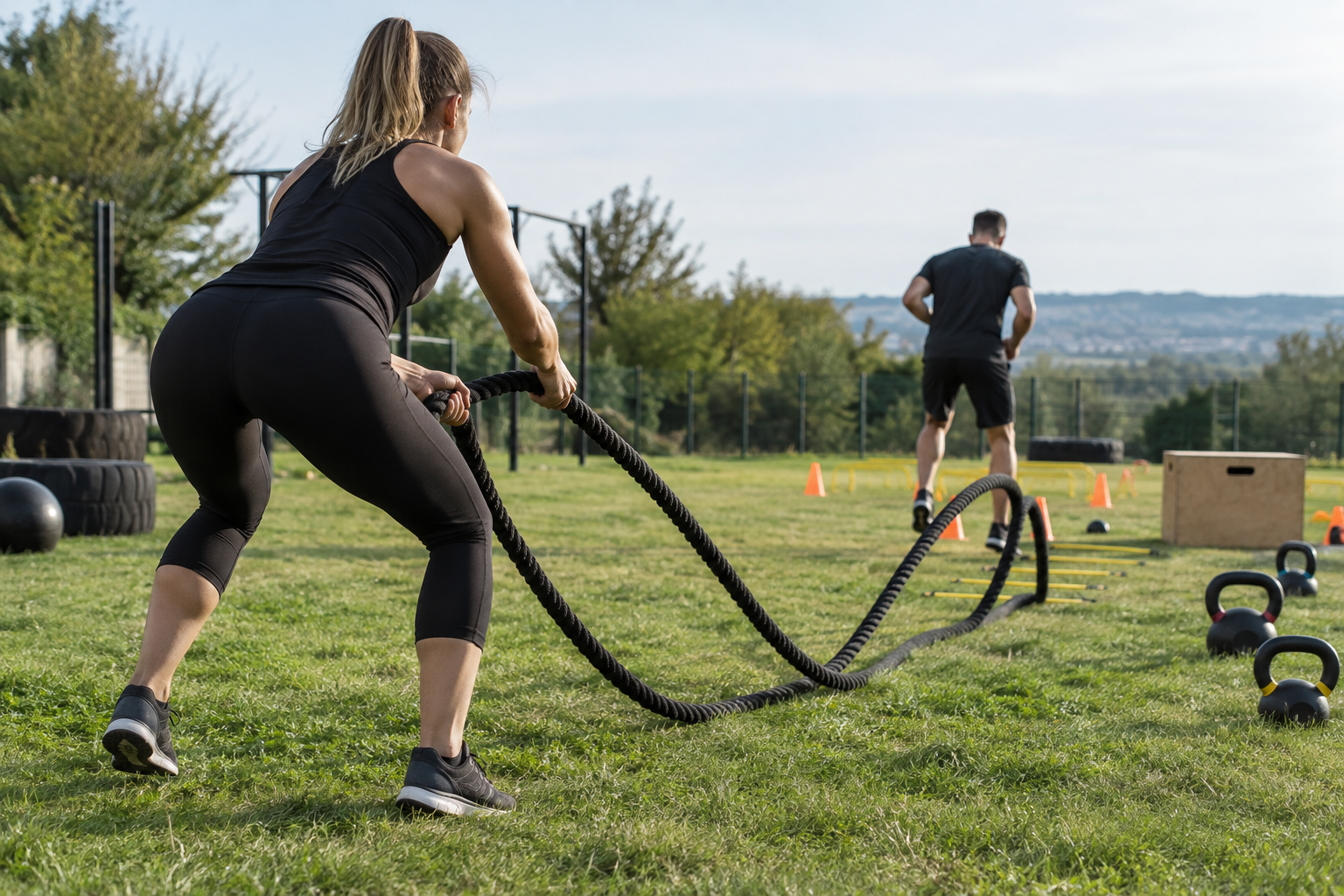
Bootcamp workout equipment: designing the stations
A bootcamp brings together exercises and people in an organized sequence. The choice of materials must support this sequence: each station requires appropriate space, instructions, and variations, while the transition between activities must remain understandable even when the group moves together.
To define the equipment needed to organize a bootcamp workout, it is best to start with the program and the instructor's skills. There is no universal set: the number of participants, the location, and the type of exercises change what is actually needed.
This guide helps those who manage a gym or a functional area to build a coherent supply. Activities must be adapted by competent professionals and carried out in compliance with product instructions, without using intensity as an excuse to neglect technique and organization.
Before preparing the circuit, describe the transitions: where to enter, where to wait, and how to change stations. A class may have suitable exercises but prove difficult to manage if people and materials concentrate in the same passage.
Imagine a group divided between a station with loads, a bodyweight station, and a movement station. If the path crosses the area where weights are placed, the problem is not solved by explaining to be careful. The layout or sequence must be modified so that the passages are compatible with the work being done.
Another example is a station with resistance bands that requires various adjustments. For experienced users the change can be quick, while a new group may need more explanation. The instructor can simplify the setup or choose a more immediate variation, without considering complexity a training goal.
These tests also help determine the useful number of accessories. Buying more pieces does not solve a bottleneck caused by unclear instructions; conversely, an insufficient quantity can make a well-explained sequence unfeasible. For this reason, program, materials, and timing must be evaluated together.
A brief meeting among instructors after the first classes allows them to compare observations and decide which changes to test in the next session.
- From program to equipment
- Loads and small equipment
- Accessories for coordination and resistance
- Space and placement
- Timing and activity changes
- Control and tidying up
- Evaluating and developing the circuit
From program to equipment
Movements and purpose
Identify the movements you want to propose and the role of each station in the program. Alternating activities does not necessarily mean introducing many tools. Some exercises can be performed with bodyweight, while others require specific resistances or supports.
The choice must consider the participants' experience and capabilities. An instructor can provide variations for the same function while keeping the sequence understandable. Do not assign a tool just because it is associated with the idea of intense training: it must serve the movement and the actual group.
Number of users
Establish how many people will work at each station and what tools they will need to share. The total number of participants is not enough to define the necessary quantity. Two people can take turns if the program allows it, but wait times and changes must be anticipated.
Test the circuit with the staff before the class. Observe whether accessories are easily handed over and where they are placed. A sequence that is feasible on paper may require more time when adjustments, explanations, and differences between users are added.
Loads and small equipment
Choosing manageable resistances
Dumbbells, kettlebells, and other loads can be included when consistent with the group's exercises and skills. Provide options that allow control to be maintained without turning a single weight into a requirement to participate. The instructor must be able to adapt the proposal.
Quantities must reflect simultaneous use and expected variations. If everyone is looking for the same load, a seemingly large assortment can still create wait times. Gather observations during classes and update the equipment based on real needs.
Grip and storage
Evaluate the shape, grip, and placement methods of the products. People must know where to put loads before changing stations. A tool left along the path can interfere with the group even if the exercise is finished.
Check the condition of handles, coatings, and components according to the instructions. Do not use a damaged or unidentified product just to complete the number of stations. Availability must be verified before participants arrive.
Accessories for coordination and resistance
Cones and markers
Cones, markers, and other references can make paths and station limits visible. They must be placed so they do not become obstacles in the intended trajectories. Their usefulness depends on the clarity of instructions, not the number of items distributed.
If the circuit includes movements, check space and surface in real conditions. Do not design runs or direction changes within an area that remains crossed by other users. The path must be compatible with the location and the instructor's ability to observe.
Resistance bands, ropes, and supports
Resistance bands and ropes require condition checks and approved attachment points. An unapproved anchor does not become suitable just because it seems sturdy. Follow the instructions and involve those with the necessary skills to verify the installation.
Mats and supports can facilitate certain positions, but they must be appropriate for the activity and the person. Provide alternatives when floor work or an unstable element is not suitable. The variation must be chosen by the professional, not improvised during a quick change.
Space and placement
Designing each station
Mark the moving person, the tool, and the area needed by the instructor on the layout. A station with wide trajectories requires a different evaluation than one with a static exercise. Do not assign the same surface to all of them just to achieve a symmetrical layout.
Gym accessories can offer options to compare, but each product must be evaluated in the planned activities. Check specifications, intended use, and installation conditions before permanently adding it to the circuit.
Passages and supervision
Leave legible paths between stations and consider where the group will listen to explanations. The instructor's voice and line of sight must reach people in real conditions, without depending on everyone staying perfectly aligned.
If the class is held outdoors, evaluate surface conditions, weather, and the relationship with other users of the location. Any authorizations and venue conditions must be verified with the competent contacts. Transportable equipment does not make every area suitable for its use.
Timing and activity changes
Timer and instructions
A timer can help coordinate work, but the duration must be defined by the professional based on the program and the group. The signal should not force a person to abruptly interrupt a movement to immediately reach the next station.
Explain how to start, finish, and change activities beforehand. If an exercise requires adjustments, include the necessary time. The number of repetitions or speed must not replace the technical criteria with which the instructor assesses whether the proposal remains appropriate.
Understandable adaptations
Prepare variations that can be explained without rebuilding the entire circuit. A person can use a different resistance or an agreed-upon alternative movement, keeping it clear where to work. The instructor must know how to handle differences in experience and fatigue.
If technique changes or unusual symptoms appear, the person must be able to stop and ask for assistance. Organization should not make this choice difficult. For special clinical needs, the activity should be agreed upon with competent professionals when necessary.
Control and tidying up
Preparation before the class
Check materials, fasteners, and surfaces before the group starts. Verify quantities and conditions of the tools and remove those that require evaluation or maintenance. A short checklist can connect each station to what needs to be ready.
Identify who prepares and who performs the final check. If multiple people are setting up, a designated contact person must confirm the overall configuration. The fact that each operator has arranged a part does not prove that passages and areas remain coherent as a whole.
Cleaning and storage
Follow the material instructions for cleaning and storage. Tools used outdoors may require attention to storage conditions, without automatically transferring procedures from one product to another. Do not store damaged components together with available ones.
Organize containers and supports so that tidying up does not block passages. Staff must know where to report a missing or worn piece. A subsequent class should not discover the problem only during the initial explanation.
Evaluating and developing the circuit
Useful observations
After the class, record transition difficulties, wait times, and poorly understood adjustments. Listen to group comments, distinguishing preferences from organizational problems. A poorly used station may require better instructions or a different placement, not necessarily another product.
Compare the experience with the program and modify one variable at a time when useful. If you change an exercise, re-verify space and materials. The availability of a tool does not imply that every variation of it is compatible with the same station.
Expanding with a specific reason
Before purchasing new materials, identify the missing function and how it will be integrated into the service. Evaluate quantity, storage, and maintenance in addition to the exercise demonstration. The growth of equipment should solve an observed need.
Keep an updated outline with activities, variations, and necessary materials. This document helps instructors share criteria and prepare the lesson while maintaining the ability to adapt it to the people. The circuit thus remains organized around a concrete and manageable program.
Comments (0)