
Trolley
You have no items in your shopping cart

 Budgets
 Dumbers
 Discs
 Benches
 Racks and Rigs
 Weights Holders
 Isotonic machines
 Calisthenics
 Cardio
 Kettlebells
 Flooring
 Gym Set
 Accessories
 Combat
 ARTI MARZIALI
 CONTAINER GYM
 Tug-Of-War
 Used Gym Equipment
 PILATES MACCHINARI
 GINNASTICA ARTISTICA
 CAMPI DA PADEL
 Prodotti in Pronta Consegna
 Informazioni
 IRONMAN
 Gift Card
- Donatif
- General information
- 0 I like it
- 60 Views
- 0 comments
- gym flooring, safety flooring, gym safety, shock-absorbing materials
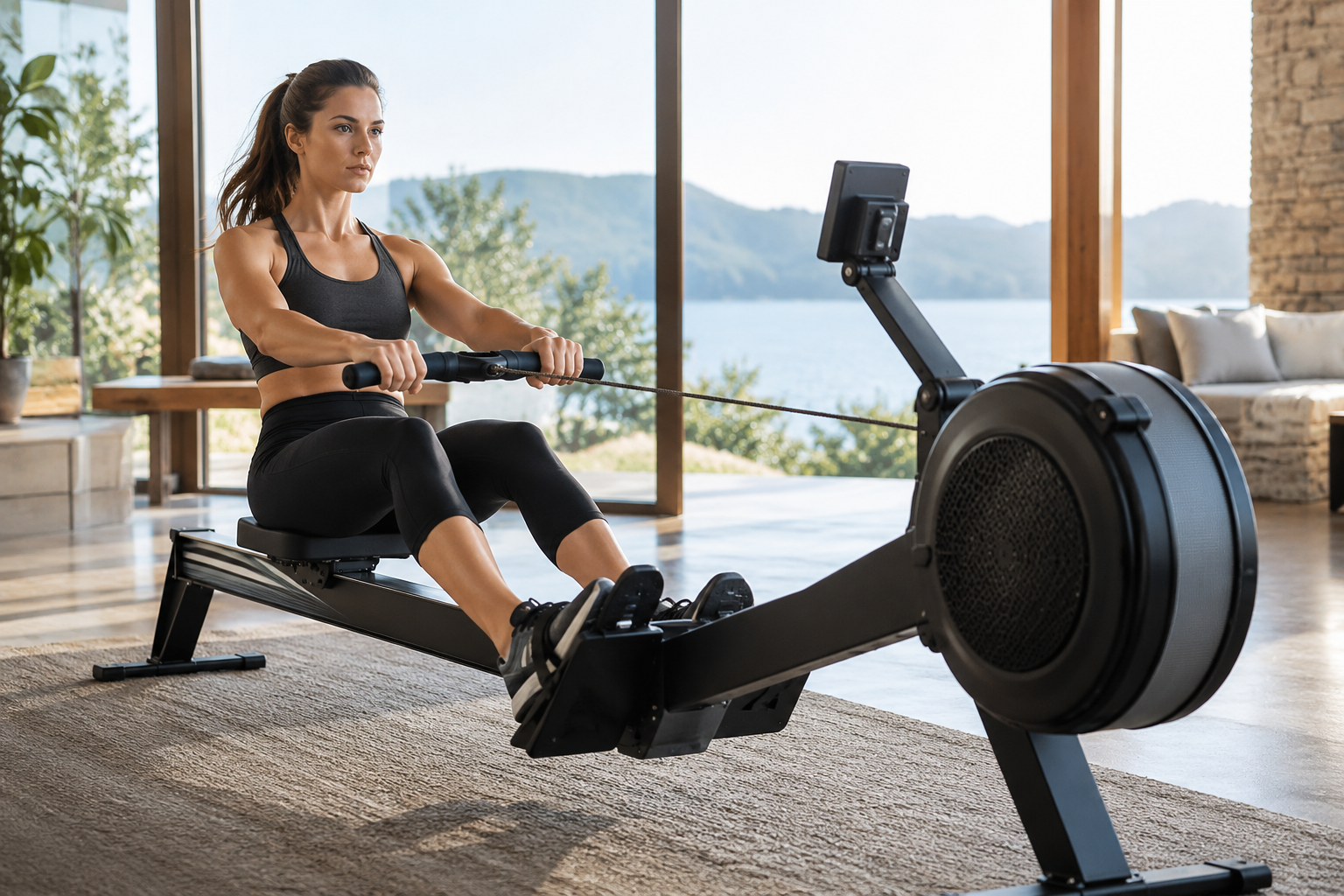
Buying a rowing machine online or from a specialized retailer: a guide to choosing
Deciding whether to buy a rowing machine online or from a specialized retailer is an important evaluation for procurement managers of gyms, fitness centers, hotels, and sports facilities. The choice of the purchasing channel involves not only the initial price but also technical aspects, supplier reliability, warranty terms, spare parts availability, and the operational continuity of the equipment.
A rowing machine intended for a professional environment must meet different requirements than a model used occasionally in a home setting. Frequency of sessions, characteristics of the users, mechanical resistance, and ease of maintenance directly affect the quality of the investment. For this reason, comparing commercial offers without verifying technical specifications can lead to decisions that are not cost-effective in the medium term.
This guide analyzes practical criteria for evaluating the most suitable sales channel, distinguishing the advantages of buying online from the services offered by a specialized retailer. The objective is to provide procurement managers with a structured evaluation method, useful for comparing different proposals and selecting equipment consistent with the operational needs of their facility.
- Online purchase and specialized retailer: operational differences
- Technical features to evaluate before purchase
- How to choose the rowing machine based on its intended use
- Criteria for evaluating supplier reliability and expertise
- Purchase price and total cost of ownership
- Warranty, technical support, and maintenance
- Practical procedure for comparing offers
- How to turn the rowing machine choice into a sustainable investment
Online purchase and specialized retailer: operational differences
The fitness equipment market today offers numerous supply possibilities. Procurement managers can turn to e-commerce platforms, specialized shops with digital sales, or professional suppliers who combine distribution with technical consulting services. These channels are not necessarily alternatives: a specialized retailer can operate online while simultaneously guaranteeing qualified support.
The most important distinction therefore concerns the level of information and services available during the purchasing process. A complete digital catalog allows you to quickly compare dimensions, resistance systems, and construction features. A technical representative, on the other hand, can help interpret this information in relation to the actual conditions of the facility's use.
For professional purchasing, it is appropriate to consider the sales channel as an integral part of the supply. Delivery times, management of any anomalies, and availability of technical documentation must be verified before confirming the order, regardless of the chosen commercial method.
When buying online can be advantageous
Buying online allows you to consult multiple proposals without geographical constraints and gather preliminary information in a relatively short time. This method is particularly useful when the procurement manager already knows the required features and has sufficiently detailed technical specifications to make a reliable comparison.
However, it is necessary to verify that the site provides clear information on the seller's identity, sales terms, and how support is handled. The presence of a complete product sheet is an advantage only when the declared data are verifiable and relevant to the intended use.
The value of a specialized retailer's consulting
A specialized retailer can help define technical requirements before placing an order, especially when the rowing machine is to be installed in a gym with high user turnover. Consulting helps clarify aspects that often do not emerge from commercial descriptions, such as required maintenance, compatibility with available space, and warranty conditions for professional use.
The advantage does not depend exclusively on the possibility of speaking with a consultant, but on the quality of the answers obtained. A competent supplier should know how to support their recommendations with verifiable technical data, documentation, and contractual terms.
Technical features to evaluate before purchase
The rowing machine selection guide must start from the analysis of the mechanical and functional characteristics of the equipment. Two apparently similar models can have significant differences in structure, resistance system, and the ability to withstand continuous use. Limiting yourself to comparing display functions or aesthetic appearance does not allow you to determine the actual professional suitability.
Elements to examine include frame stability, quality of the sliding rails, smoothness of movement, and station ergonomics. Even the declared load capacity must be interpreted correctly: it represents a technical limit indicated by the manufacturer, but it does not alone describe the overall robustness of the device.
A procurement manager should request updated technical sheets and verify that the information is consistent with the model actually being proposed. Any differences between commercial versions, optional equipment, and available configurations must be clarified before comparing quotes.
Resistance systems and usage characteristics
Rowing machines can use air, magnetic, or water resistance systems, or combined solutions. In air models, resistance is linked to the movement of the fan and the speed of the pull, while in magnetic systems it is generated through adjustable magnetic components. Water models use the movement of fluid inside a tank to produce resistance.
No technology is automatically superior in every context. The choice depends on training needs, acceptable noise levels, adjustment methods, and planned maintenance operations. In a fitness center with several stations close together, for example, acoustic behavior may take on more importance compared to a room dedicated to individual training.
Ergonomics, structure, and movement quality
The length of the rail, the position of the footrests, the shape of the handle, and the seat height influence the accessibility of the rowing machine for users with different physical characteristics. A gym open to the public must be able to accommodate people with different levels of experience and body types while maintaining adequate usage conditions.
It is also useful to check the smoothness of the seat, the stability during the pulling phases, and the simplicity of adjustments. These aspects affect the daily experience and can determine significant differences between equipment that, on paper, has similar performance.
How to choose the rowing machine based on its intended use
The intended use is one of the most important criteria in selecting a rowing machine. Equipment intended for occasional sessions in a small hospitality facility may be subjected to different stresses compared to a model used daily in a fitness center with numerous members. Defining the operational scenario beforehand allows you to avoid both under-dimensioning and investments not justified by actual needs.
The frequency of use must be evaluated together with the duration of the sessions and the number of people who can alternate on the same machine. Supervision methods also influence the choice: in a room constantly monitored by technical staff, it is possible to manage equipment differently than in a fitness space accessible without continuous assistance.
Before requesting a quote, the procurement manager should describe the installation context to the supplier. This information allows for identifying more precise technical requirements and verifying that the intended use declared by the manufacturer is compatible with the planned activity.
High-traffic gyms and fitness centers
In facilities with a large number of users, the rowing machine must maintain regular behavior even when used by different people throughout the day. Resistance of components subject to wear, frame stability, and ease of adjustment therefore play a central role.
The choice should favor models with clear indications regarding maintenance and the availability of replaceable components. Equipment that is easily inspected allows staff to identify anomalies in time and schedule interventions without unnecessarily compromising the organization of activities.
Hotels, personal training studios, and compact fitness areas
In hotels and personal training studios, available space can be a deciding constraint. It is necessary to verify the operational dimensions of the rowing machine, considering not only the footprint of the structure but also the area needed to get on, get off, and move safely.
Some models provide vertical storage systems or foldable configurations, but these features must be evaluated together with the manufacturer's instructions. The possibility of reducing the footprint during storage must not compromise stability or introduce impractical handling procedures for staff.
Criteria for evaluating supplier reliability and expertise
The relationship between supplier and purchase takes on particular importance when the equipment is intended for professional use. The procurement manager should not limit themselves to identifying who offers the most convenient price, but verify which operator is able to guarantee correct information, transparent terms, and support consistent with the facility's needs.
A first element of evaluation concerns the completeness of the commercial documentation. Technical descriptions, warranty conditions, delivery methods, and procedures for requesting support should be easily accessible. The lack of essential information makes it more difficult to compare offers and can generate uncertainty after the purchase.
It is also appropriate to verify the supplier's experience in the professional sports equipment sector. Relevant references, knowledge of construction features, and the ability to answer specific questions can help distinguish a qualified representative from a simple commercial intermediary.
Technical documentation and commercial transparency
Before proceeding with the order, it is useful to request a complete sheet of the model, the available operating and maintenance instructions, and warranty information. For equipment subject to applicable regulatory requirements, relevant compliance and safety information must also be verified.
The quote should unambiguously identify the product, included equipment, any optional accessories, and delivery terms. A generic description can create difficulties in verifying that what is received actually corresponds to the purchased configuration.
Assistance capacity and request management
Service quality can be evaluated already during the preliminary phase. A supplier that answers questions about intended use, spare parts availability, and maintenance procedures with precision offers concrete elements for a more informed evaluation.
It is advisable to ask how technical reports are handled, what information must be provided to open a request, and whether interventions are carried out directly or through external service centers. The presence of a defined procedure reduces operational uncertainty when a problem occurs.
Purchase price and total cost of ownership
The initial price is only part of the investment. To correctly compare two offers, it is necessary to consider the total cost of ownership, which includes the expenses necessary to purchase, install, use, and maintain the equipment during the expected service period.
A rowing machine offered at a lower price could entail additional costs for transport, assembly, or maintenance. Conversely, an initially more expensive solution could include services useful to the facility. Neither situation should be assumed: conditions must be verified through detailed quotes.
To make the comparison meaningful, the procurement manager should define a time horizon consistent with the gym's investment planning. Over this period, it is possible to estimate the main cost items and identify any economic differences between technically comparable alternatives.
Direct and indirect costs to include in the comparison
Direct costs include the price of the rowing machine, transport, any assembly, and the materials necessary for routine maintenance. If the equipment uses electrical power, it is appropriate to also consider expected consumption, distinguishing it from models that operate without a mains connection for mechanical resistance.
Indirect costs can include the time spent by staff on checks and interventions, repair management expenses, and the organizational consequences of machine downtime. These items are more difficult to quantify, but they take on importance in facilities that use the rowing machine within regular training programs.
How to build a reliable economic comparison
A practical method consists of preparing an internal table that shows, for each offer, the initial price, included services, delivery costs, duration and conditions of the warranty, planned maintenance, and spare parts availability. Missing information must be flagged rather than replaced with unverified assumptions.
It is important to distinguish certain costs from estimates. The purchase price and transport can be indicated in the quote, while future interventions depend on the conditions of use and the actual reliability of the machine. This distinction allows for more rigorous economic evaluations.
Warranty, technical support, and maintenance
The maintenance of the professional rowing machine affects the availability of the equipment and the quality of the service offered to users. Even a model built with robust components requires periodic checks, cleaning, and verifications according to the manufacturer's instructions. Neglecting these activities can accelerate wear and make identifying any problems more complex.
The frequency of interventions depends on the resistance system, mechanical characteristics, and usage intensity. It is therefore not correct to apply the same maintenance schedule to any rowing machine. The procurement manager should check the procedures provided for the selected model and evaluate whether they are compatible with the facility's technical resources.
The warranty must also be examined carefully. Duration, covered components, exclusions, and intervention methods can vary between manufacturers and suppliers. In particular, it is essential to verify that the declared conditions are applicable to the intended commercial use, without assuming that a warranty intended for the domestic consumer automatically offers the same coverage.
Preventive checks and components subject to wear
Control activities can include checking the condition of the chain or traction system, inspecting the seat rail, checking the footrests, and examining structural connections. The operations actually necessary must follow the manufacturer's manual, avoiding unauthorized interventions that could damage the device.
An internal verification procedure allows you to record anomalies, interventions performed, and user reports. This documentation helps to schedule maintenance and can be useful in relations with the support service, especially when a problem manifests intermittently.
Spare parts availability and warranty conditions
Before purchasing, it is advisable to ask which components can be ordered separately and through which channels. The availability of parts subject to normal wear can affect the possibility of keeping the rowing machine operational without having to prematurely replace the entire piece of equipment.
It is equally important to know the procedure provided in the event of a defect covered by warranty. Declared response times, any shipping costs, and responsibilities relating to disassembly or reinstallation must be clarified when relevant. This information allows you to evaluate the after-sales service in a concrete way.
Practical procedure for comparing offers
Applying practical purchasing criteria means transforming the gym's needs into verifiable requirements. Before consulting catalogs, the procurement manager should define the number of rowing machines needed, the user profile, frequency of use, and any constraints related to space, noise, and maintenance.
Once these requirements are identified, it becomes possible to compare different proposals without being led exclusively by the most obvious features. Evaluation should distinguish essential elements from preferential ones, avoiding placing excessive importance on accessory functions that do not produce concrete benefits for the facility.
To explore the main types available and identify equipment consistent with the professional context, it may be useful to consult a category dedicated to cardio machines for gyms, using product information as a basis for subsequent technical and commercial verifications.
Defining a requirements sheet before the quote
The sheet should at least report intended use, maximum allowable dimensions, preferred or acceptable resistance system, required ergonomic features, and support needs. When possible, it is useful to also indicate the estimated number of daily sessions, specifying that this is an operational forecast.
This documentation facilitates communication with suppliers and reduces the risk of receiving offers that are difficult to compare. If a requirement cannot be met, the seller should clearly indicate the difference and propose any motivated alternatives.
Comparing quotes with homogeneous criteria
Comparison should start by eliminating proposals that do not meet the essential requirements. Subsequently, it is possible to evaluate the remaining alternatives considering technical features, economic conditions, included services, and quality of support. An internal scoring system can be useful, provided that the criteria and relative weights are established before the evaluation.
For example, a gym with high traffic might place more importance on resistance to intensive use and spare parts availability, while a hotel facility might consider footprint, ease of use, and noise as priorities. Weighting must reflect real operational needs and not generic commercial preferences.
Final checks before order confirmation
Before authorizing the purchase, it is advisable to check the correspondence between the quote and the selected model, payment terms, delivery times, and responsibilities regarding transport. It is also necessary to verify if assembly services, commissioning instructions, and procedures for reporting any damage found upon delivery are planned.
For multiple supplies, it may be useful to agree on reception and verification methods for equipment compatible with the facility's organization. Recording the received models and their serial numbers, when present, simplifies subsequent management of warranties and technical interventions.
How to turn the rowing machine choice into a sustainable investment
For a procurement manager, the decision between online sales and a specialized retailer should be the result of an analysis of technical, economic, and organizational needs. The most suitable purchasing channel is one that allows for obtaining equipment compliant with the facility's requirements, accompanied by reliable information and adequate supply terms.
The economic evaluation must be linked to operational continuity. A rowing machine that requires frequent interventions or presents difficulties in finding spare parts can generate costs not immediately visible in the quote. Conversely, a machine correctly selected and maintained according to the manufacturer's instructions can help make the management of the cardio area more predictable.
It is important to also consider the evolution of the facility. If expansions or an increase in users are planned, choosing equipment with homogeneous features can facilitate maintenance management, staff training, and station organization. This evaluation does not necessarily require the immediate purchase of multiple machines, but planning consistent with future goals.
The sustainability of the investment also depends on the ability to document the reasons for the choice. Keeping technical sheets, comparative quotes, contractual terms, and cost evaluations allows the decision-making process to be transparent and verifiable. This approach is particularly useful in organizations where purchases must be approved by multiple managers.
Finally, a structured process allows for distinguishing the actual value of the services offered from the seller's simple commercial positioning. An online purchase can fully satisfy professional needs when complete documentation, adequate support, and transparent terms are available. Similarly, a specialized retailer can represent an advantageous solution when technical consulting and operational support respond to concrete gym needs.
The decision should therefore be based on measurable requirements, compatibility with intended use, and evaluation of costs over the equipment's life cycle. In this way, the procurement manager can select the most appropriate rowing machine without depending exclusively on the initial price or commercial promises, maintaining control over required performance and resources necessary for future management.
Comments (0)