
Trolley
You have no items in your shopping cart

 Budgets
 Dumbers
 Discs
Discs
 Benches
 Racks and Rigs
 Weights Holders
 Isotonic machines
 Calisthenics
 Cardio
 Kettlebells
 Flooring
 Gym Set
 Accessories
 Combat
 ARTI MARZIALI
 CONTAINER GYM
 Tug-Of-War
 Used Gym Equipment
 PILATES MACCHINARI
 GINNASTICA ARTISTICA
 CAMPI DA PADEL
 Prodotti in Pronta Consegna
 Informazioni
 IRONMAN
 Gift Card
- Donatif
- General information
- 0 I like it
- 1 Views
- 0 comments
- gym flooring, safety flooring, gym safety, shock-absorbing materials
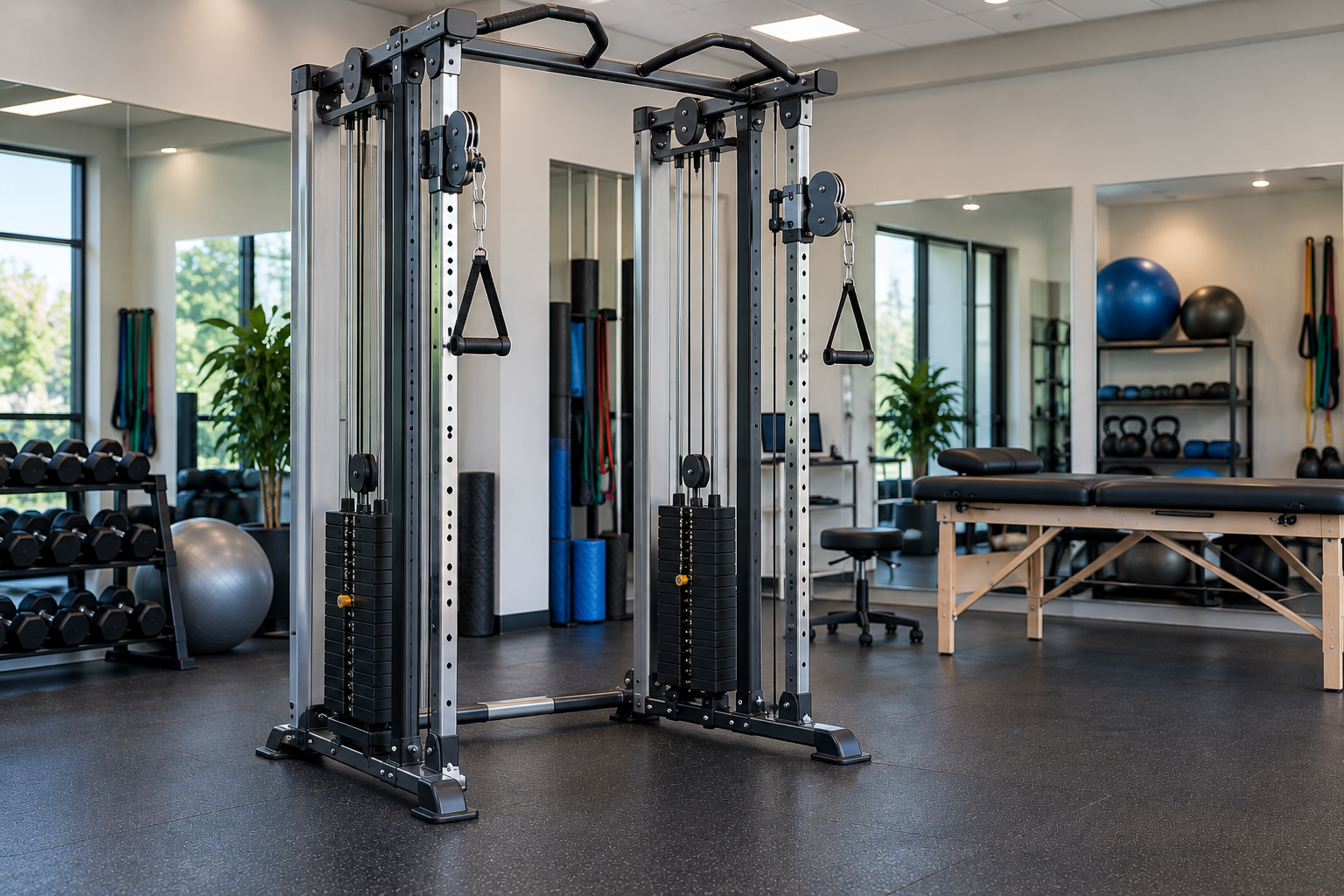
Cable machine for PT studio: selection criteria and professional configuration
A cable machine represents one of the most versatile pieces of equipment within a personal training studio because it allows you to perform a high number of exercises while occupying a relatively limited space. However, choosing the most suitable model does not depend solely on the number of available accessories or the installed weight stack, but above all on the type of clients, training goals, and the overall layout of the studio.
In an environment dedicated to personal training, every square meter must be used efficiently. The configuration of the machine must therefore allow the trainer to work safely, quickly transition from one exercise to another, and easily adapt the load to the different fitness levels of the users.
This guide provides practical criteria for choosing and configuring a cable machine in a PT studio without delving into the general operation of the machine, the pulley ratio, or technical maintenance, topics covered in dedicated articles.
- Quick answer
- What requirements must a cable machine have for a PT studio?
- How to evaluate space and layout
- How to configure the machine
- Safety and operational maintenance
- Design errors to avoid
- FAQ
- Why choose the correct configuration
How to choose a cable machine for a PT studio?
The choice of a cable machine for a personal training studio must be based on the space actually available, the number of users managed simultaneously, the variety of exercises planned, and the possibility of making quick adjustments. A well-designed configuration improves the fluidity of sessions and makes the personal trainer's work more efficient.
The evaluation should also consider the future evolution of the studio and the potential expansion of the services offered.
A machine chosen exclusively based on price risks limiting the quality of daily work.
What is the main criterion?
The machine must adapt to the trainer's working method and allow the execution of main pulls, pushes, unilateral exercises, and functional movements without continuous setup modifications.
What is the goal of the configuration?
Reduce downtime between one exercise and another while always maintaining an orderly, safe, and easily usable environment.
What requirements must a cable machine satisfy?
Before choosing, it is useful to define the real operational needs of the studio.
A machine intended for individual work has different characteristics compared to one used by multiple people during the same time slot.
Analyzing the service offered helps avoid purchases inconsistent with the project.
Type of users
A studio oriented towards athletic preparation may require greater load availability, while an activity focused on general wellness often prioritizes movement fluidity, simplicity of adjustment, and broad adaptability to users.
Exercise versatility
The machine should allow a high number of exercises without having to resort continuously to workstation changes, favoring complete workouts even in small spaces.
How to organize space and layout?
The position of the machine directly influences the quality of daily work.
The surrounding space must allow complete movements and the use of accessories without interference with other equipment.
The layout should facilitate the trainer's movements throughout the entire session.
Leave a free working area
It is advisable to provide sufficient space in front of and on the sides of the machine to allow standing exercises, lunges, unilateral movements, and the use of accessories without limitations.
Integrate other equipment
The cable machine should be placed so as to work in continuity with benches, dumbbells, and other stations while avoiding crossing paths with users' movements. To complete the area dedicated to training with cable machines, you can evaluate the isotonict machines compatible with the studio's overall project.
How to configure the machine?
An effective configuration must favor operational speed and simplicity of adjustment.
Each element should be easily reachable during sessions.
The initial configuration can be adapted over time according to the evolution of the activity.
Pulley adjustment
The ability to quickly modify the height of the pulleys allows you to perform numerous exercises without interrupting the rhythm of the workout.
Accessory management
Handles, ropes, bars, and other accessories should be organized near the machine to reduce preparation time and keep the work area tidy.
What safety aspects to consider?
Safety depends both on the quality of the installation and on the daily management of the equipment.
Periodic checks help maintain the machine's performance constant.
The manufacturer's instructions always represent the primary reference.
Periodic checks
Regularly check the correct functioning of adjustments, locking systems, handles, and most frequently used accessories.
Flooring and surrounding area
The surface must be stable, regular, and kept free of obstacles that could interfere with the execution of exercises.
What design errors to avoid?
Many operational problems stem from insufficient space planning.
Preliminary analysis allows you to better utilize the machine and improve studio organization.
Subsequent modifications are generally more expensive compared to correct initial design.
Underestimate operating space
Installing the machine too close to walls or other equipment limits numerous exercises and reduces the trainer's freedom of movement.
Neglect workflow
An irrational arrangement of accessories and other equipment increases preparation times and makes training sessions less fluid.
FAQ
Is a cable machine sufficient for a PT studio?
It depends on the type of service offered. In many studios, it represents one of the main pieces of equipment but is normally integrated with other tools to expand training possibilities.
Is it preferable to prioritize maximum load?
Not necessarily. For a PT studio, movement fluidity, adjustment speed, and machine versatility are often more important.
When is it advisable to review the configuration?
It is appropriate to reassess the layout when working methods change, the number of clients increases, or new equipment is introduced into the studio.
Why properly design the workstation?
A cable machine configured consistently with studio activities allows you to optimize spaces, improve session quality, and make the personal trainer's daily work more efficient.
Carefully analyzing layout, paths, adjustments, and accessory organization also allows you to easily adapt the workstation to the evolution of the service without intervening on the entire layout of the studio.
A design based on operational and verifiable criteria enhances the investment and helps maintain high functionality of the area dedicated to training in the long term.
Comments (0)