
Trolley
You have no items in your shopping cart

 Budgets
 Dumbers
 Discs
Discs
 Benches
 Racks and Rigs
 Weights Holders
 Isotonic machines
 Calisthenics
 Cardio
 Kettlebells
 Flooring
 Gym Set
 Accessories
 Combat
 ARTI MARZIALI
 CONTAINER GYM
 Tug-Of-War
 Used Gym Equipment
 PILATES MACCHINARI
 GINNASTICA ARTISTICA
 CAMPI DA PADEL
 Prodotti in Pronta Consegna
 Informazioni
 IRONMAN
 Gift Card
- Donatif
- General information
- 0 I like it
- 594 Views
- 0 comments
- gym flooring, safety flooring, gym safety, shock-absorbing materials
Calisthenics and Weight Training Integration: The Ultimate Hybrid Routine
In recent years, more and more athletes have abandoned the idea that calisthenics and weight training are two opposing disciplines. On the contrary, the Hybrid Training trend demonstrates how the intelligent combination of bodyweight and external loads allows for superior results in terms of strength, hypertrophy, motor control, and athletic performance. The goal is not to choose between a pull-up bar and a barbell, but to leverage the strengths of both methodologies to build a complete physique.
Calisthenics develops coordination, mobility, joint stability, and relative strength, while barbells and dumbbells allow you to easily increase training volume and work precisely on load progression, especially for muscle groups that are more difficult to develop exclusively with body weight, such as the legs and posterior chain.
This guide analyzes how to build a calisthenics and weight training routine, which exercises to integrate, how to organize sessions, and what equipment to choose to create a truly versatile home gym without having to replace the equipment you already own.
- Why integrate calisthenics and weights
- The benefits of hybrid training
- How to train legs and the posterior chain
- A weekly hybrid routine
- The ideal equipment
- The most common mistakes
- How to progress over time
- A complete ecosystem for the home gym
Why integrate calisthenics and weights
Many practitioners begin their journey by choosing only one discipline. Those coming from bodybuilding tend to focus almost exclusively on work with barbells and machines, while those who practice calisthenics dedicate most of their sessions to pull-ups, dips, muscle-ups, planches, and front levers. Both paths are effective, but they inevitably present some limitations.
Bodyweight training excels in the development of relative strength, stability, and motor control. However, progressively increasing the load on certain muscle groups can become complex, especially when it comes to training the legs and posterior chain. Conversely, weights allow for linear progression, but they do not always improve the ability to control the body in space.
Integrating the two methodologies allows you to bridge these gaps, creating a complete training system that improves both absolute and relative strength.
Overcoming the limits of individual disciplines
An athlete who performs only bodyweight exercises may encounter difficulties in developing maximal lower-body strength. Similarly, those who use only barbells risk neglecting coordination, mobility, and scapular control.
Combining both methodologies allows for more harmonious muscle development and better performance in numerous sporting contexts.
A 360-degree preparation
Hybrid training simultaneously improves strength, endurance, explosiveness, and movement control. This approach is particularly effective for those who want complete athletic preparation without giving up the specific benefits of each discipline.
Integrating compound exercises with bodyweight movements also makes sessions more varied and stimulating.
The benefits of hybrid training
A hybrid strength workout allows you to leverage the load progression typical of powerlifting and powerbuilding along with the functional advantages of calisthenics. This means being able to increase maximal strength without losing agility, balance, and coordination.
Using a barbell allows you to program gradual load increases, while bodyweight exercises improve body weight management and the quality of movement.
The result is a more complete preparation, useful both for home gym enthusiasts and for athletes who practice CrossFit, functional training, or sports disciplines that require high motor skills.
Strength and power
Squats, deadlifts, and military presses increase the ability to generate force, while explosive pull-ups, weighted dips, and muscle-ups improve the expression of power.
The combination of these exercises creates an extremely versatile athletic base.
Hypertrophy without sacrificing functionality
Barbells and dumbbells facilitate reaching the volume necessary for muscle growth, while bodyweight training maintains a high quality of athletic movement.
This balance avoids developing strength that is not easily transferable to complex movements.
How to train legs and the posterior chain
One of the main reasons that pushes many calisthenics practitioners to introduce weights concerns lower-limb training. Although pistol squats, shrimp squats, and single-leg variations are effective exercises, reaching high levels of strength and muscle mass is generally simpler through the use of barbells.
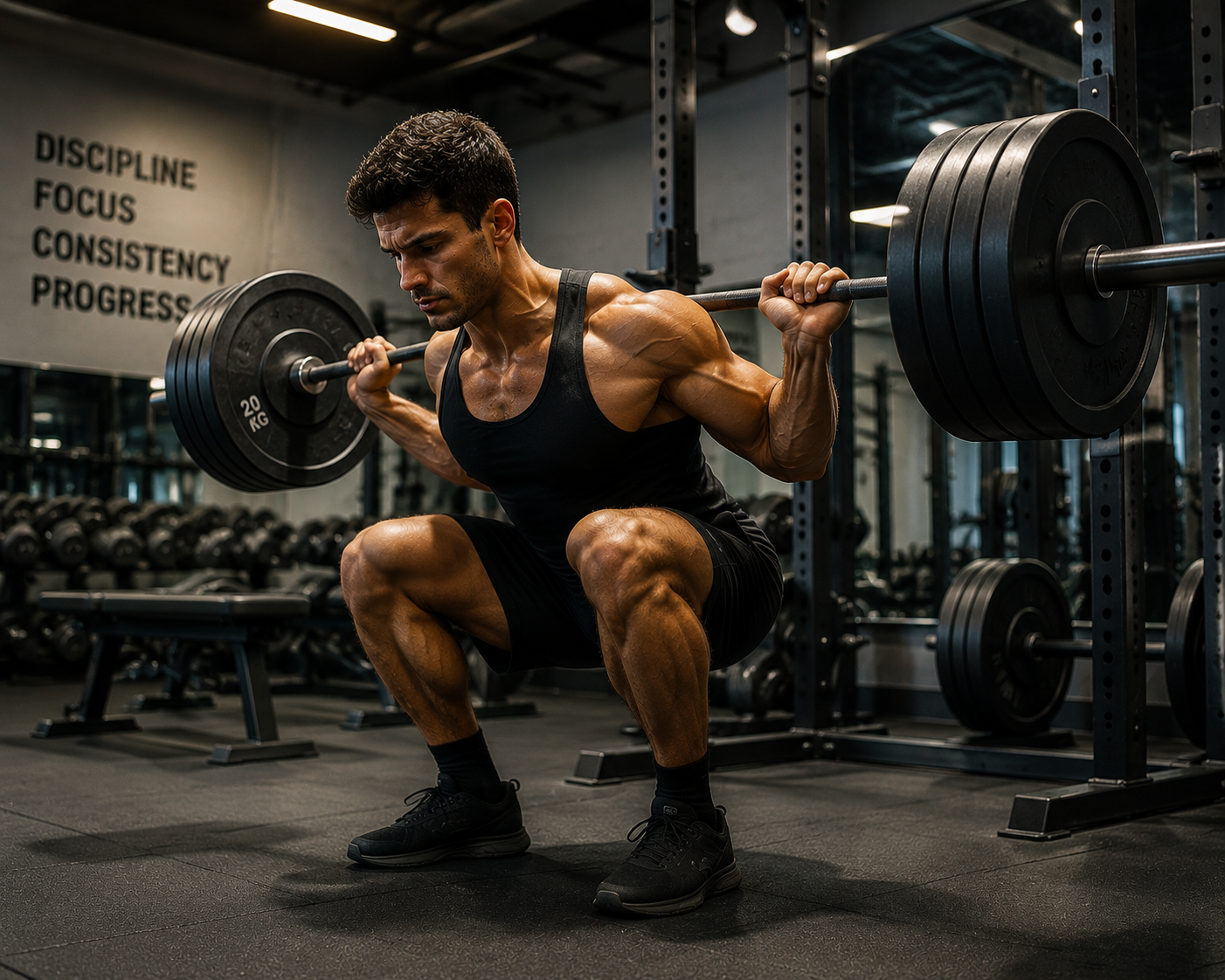
The barbell squat represents the benchmark for the development of quadriceps, glutes, and general stability. The deadlift, on the other hand, intensely involves the entire posterior chain, improving strength, posture, and the ability to transfer power.
Integrating these exercises into a calisthenics routine allows you to eliminate one of the historical limitations of exclusively bodyweight training.
Squats and variations
Back squats, front squats, and Bulgarian split squats form the basis of lower-limb development.
Load progression allows for constant improvements in both strength and hypertrophy.
The importance of the deadlift
The deadlift strengthens the glutes, hamstrings, lower back, and grip, qualities that are also fundamental for improving pull-ups, front levers, and other advanced calisthenics exercises.
A strong posterior chain also contributes to the prevention of muscle imbalances.
Example of a weekly hybrid routine
A balanced program alternates bodyweight exercises and barbell movements, avoiding overlaps that could compromise recovery.
One possible organization involves four weekly sessions, in which each workout has a specific goal while maintaining strong integration between the two disciplines.
The distribution of volume must be adapted to the athlete's level, always prioritizing execution quality and gradual progression.
Upper body
A session can include pull-ups, dips, muscle-ups, military presses, barbell rows, and complementary work for the rotator cuff and core.
In this way, relative strength and absolute strength are developed simultaneously.
Lower body
Leg-focused sessions can include squats, Romanian deadlifts, lunges, hip thrusts, and mobility work for the hips and ankles.
This approach ensures complete development without neglecting any muscle group.
The ideal equipment for a hybrid home gym
One of the most common fears concerns the compatibility between calisthenics and weight training equipment. In reality, today there are modular solutions capable of accommodating both bodyweight exercises and Olympic barbells, avoiding the need to purchase two separate structures.
A half rack equipped with a pull-up bar represents one of the most versatile configurations. It allows you to perform squats, bench presses, military presses, pull-ups, dips, and numerous other exercises using the same space.
This solution also allows you to make the most of the plates and barbells already present in your home gym, avoiding unnecessary expenses and maximizing existing equipment.
Recommended configurations
A half rack with a pull-up bar, a 50mm Olympic barbell, adjustable safety spotters, and adapters represent an excellent base for any hybrid athlete.
Subsequently, you can add pulleys, jammer arms, and other accessories without modifying the main structure.
The power of modularity
Investing in an expandable structure means being able to change your training methodology without replacing the entire gym.
To learn more about the available configurations, you can consult calisthenics and weight training routine and evaluate multifunctional racks designed to perfectly integrate bodyweight and external loads.
The most common mistakes in hybrid training
The first mistake is trying to train everything at once. Including too many exercises in the same session reduces quality, intensity, and recovery.
Another frequent mistake is neglecting load progression or increasing volume in both calisthenics and weight training simultaneously, generating excessive fatigue.
Finally, many athletes underestimate the importance of mobility and recovery, which are essential aspects when the total load increases.
Programming with criteria
Every exercise must have a precise purpose within the routine. Eliminating redundant work allows you to achieve better results with less effort.
The quality of execution always remains more important than quantity.
Recovery and nutrition
Increasing training volume requires adequate sleep, proper nutrition, and intelligent management of deload weeks.
Recovering well means being able to continue progressing in the long term.
How to progress over time
Hybrid training offers numerous possibilities for progression. It is possible to gradually increase the load in barbell movements and, in parallel, work on increasingly complex variations of bodyweight exercises.
Many athletes alternate periods focused on maximal strength with others oriented toward developing calisthenics skills, while still maintaining a common base of fundamental exercises.
Powerbuilding and bodyweight training also represent an interesting strategy for those who want to combine hypertrophy, strength, and motor control without giving up training variety.
Monitoring progress
Recording loads, repetitions, and skill levels allows you to evaluate the effectiveness of the program and make changes when necessary.
Measurable progression keeps motivation high.
Setting priorities
Alternating phases dedicated to strength, hypertrophy, and technical skills avoids stagnation and makes the training journey more sustainable.
Each period can be built by maintaining a balance between bodyweight exercises and external loads.
A complete ecosystem for training without compromise
Integrating calisthenics and weights means taking advantage of the best of two worlds that should not be considered alternatives. Intelligent programming allows you to develop strength, muscle mass, mobility, and body control through complementary exercises that reinforce each other.
Choosing a modular structure also allows you to make the most of the equipment you already own, avoiding the need to replace plates, barbells, or racks every time you want to change your training approach. This represents an economic and practical advantage for those building a home gym intended to evolve over time.
Investing in a versatile ecosystem means creating a space capable of adapting to new needs, new methodologies, and new goals, while always maintaining high standards of safety, efficiency, and performance.
Comments (0)