
Trolley
You have no items in your shopping cart

 Budgets
 Dumbers
 Discs
Discs
 Benches
 Racks and Rigs
 Weights Holders
 Isotonic machines
 Calisthenics
 Cardio
 Kettlebells
 Flooring
 Gym Set
 Accessories
 Combat
 ARTI MARZIALI
 CONTAINER GYM
 Tug-Of-War
 Used Gym Equipment
 PILATES MACCHINARI
 GINNASTICA ARTISTICA
 CAMPI DA PADEL
 Prodotti in Pronta Consegna
 Informazioni
 IRONMAN
 Gift Card
- Donatif
- General information
- 0 I like it
- 9 Views
- 0 comments
- gym flooring, safety flooring, gym safety, shock-absorbing materials
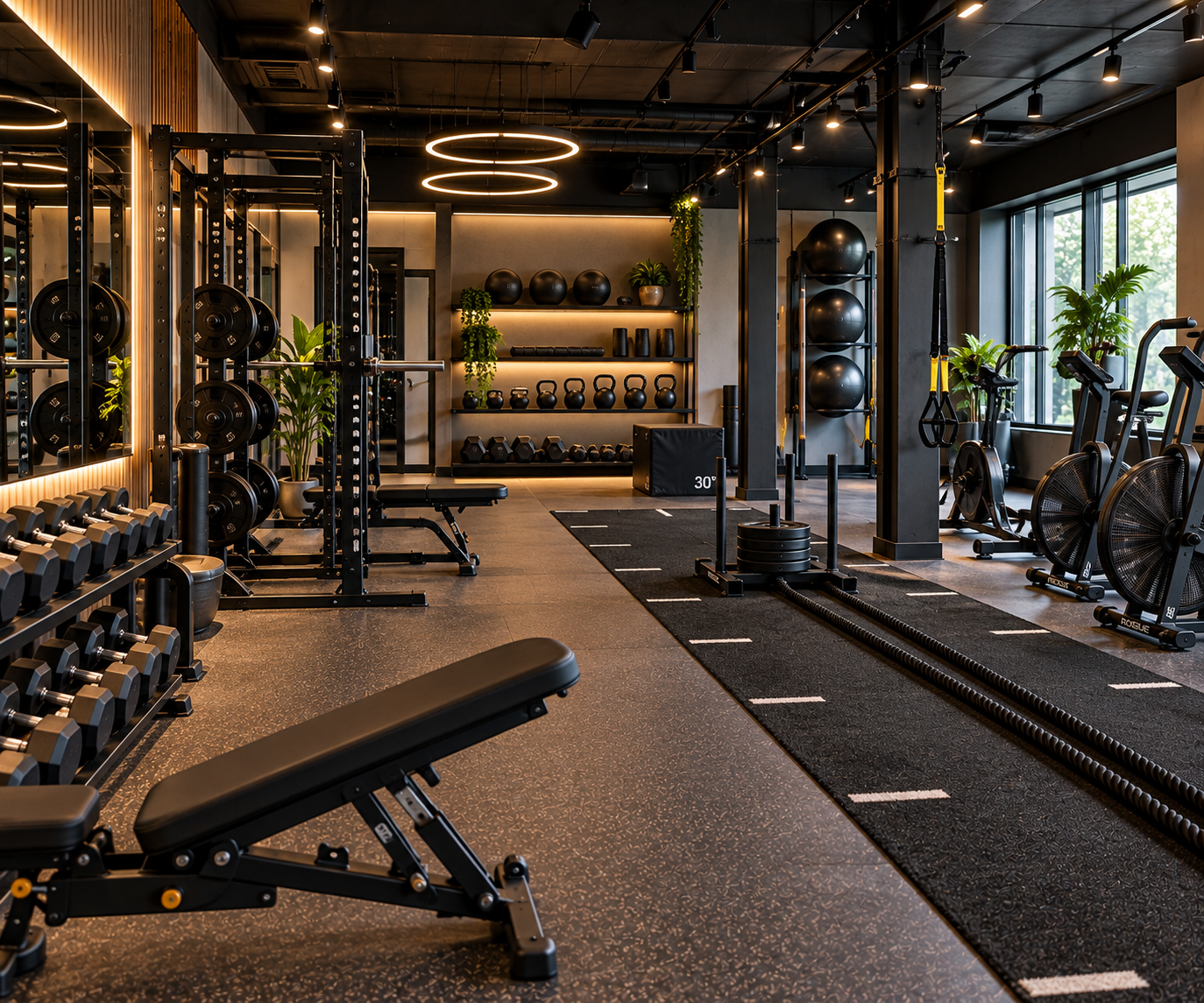
Fitness center vs boutique gym: differences and selection criteria
The comparison between a fitness center and a boutique gym concerns two different organizational models, designed to respond to different needs, audiences, and methods of service delivery. Both types can offer a quality training experience, but they differ in size, space organization, breadth of offerings, and activity management.
To choose the most suitable model, it is useful to evaluate verifiable criteria such as the target audience, available surface area, expected number of users, variety of services, and configuration of training areas. Preliminary analysis allows for designing a structure consistent with business goals without relying solely on market trends.
This guide compares fitness centers and boutique gyms through practical criteria, providing useful indications to understand the main differences without delving into the detailed complete design of individual structures.
- Quick answer
- What are the main differences?
- Comparison table
- How to choose between a fitness center and a boutique gym
- When to prefer one model over the other
- Mistakes to avoid
- FAQ
- How to evaluate long-term investment
Fitness center or boutique gym: which model to choose?
The choice depends on the target audience, the services you intend to offer, the available space, and the organization of the facility. A fitness center generally proposes a broader and more structured offer, while a boutique gym tends to focus on specialized activities or specific formats with a more focused experience.
The evaluation should be carried out considering the entire business project and not exclusively the size of the structure.
A preliminary analysis of the local market and operational needs facilitates more consistent planning.
What is the main criterion?
Precisely define the user target, planned services, and management model before designing spaces and investments.
Is there a better model?
No. Both solutions can be effective if consistent with the operational context, audience, and goals of the facility.
What are the main differences?
The two models stand out above all for the organization of spaces, breadth of offerings, and methods of using the facility.
Understanding these differences allows you to set up a more consistent project.
Each choice should be supported by an analysis of the actual needs of the clientele.
Characteristics of the fitness center
A fitness center normally includes different areas dedicated to cardiovascular activities, weight training, classes, accessory services, and locker rooms, offering a proposal aimed at a heterogeneous public.
Characteristics of the boutique gym
A boutique gym is generally organized around a discipline, a training method, or a specific format, with more specialized environments and services built around a more focused experience.
Comparison table
The comparison between the two models can be carried out through objective criteria.
| Criterion | Fitness center | Boutique gym |
|---|---|---|
| Service offering | Generally broad | More specialized |
| Space organization | More structured | More focused |
| Target | Heterogeneous public | Users interested in specific activities |
| Training areas | Multiple dedicated zones | Prevalence of functional areas for the discipline |
| Operational management | More complex | More concentrated on specific services |
How to interpret the comparison?
The table represents general characteristics. Each project can present different configurations depending on the management model and the needs of the structure.
Which indicators to compare?
Available surface area, expected number of users, type of classes, accessory services, and expansion possibilities represent useful criteria for analysis.
How to choose between a fitness center and a boutique gym?
The choice should be consistent with the business project and the desired positioning.
The characteristics of the property can also influence the final configuration.
Accurate planning facilitates the sustainability of the project over time.
Analyze the target audience
Understanding expectations, habits, and the type of training requested allows you to design services that are more consistent with the destination market.
Evaluate layout and equipment
The layout must be developed based on the planned activities. To complete the structure, it is also possible to evaluate the range of gym equipment compatible with the overall project.
When to prefer one model over the other?
Each context presents different needs.
The characteristics of the local market can guide the design.
The availability of space also represents an important element.
When to design a fitness center
A fitness center may be suitable when you want to offer numerous services, different training methods, and a structured organization of environments.
When to design a boutique gym
A boutique gym can represent a consistent solution when the project is oriented towards a specific discipline or a highly specialized format.
What mistakes to avoid?
Many projects encounter difficulties when the chosen model is not consistent with the market or available spaces.
A preventative evaluation reduces the risk of subsequent modifications.
Initial planning represents a decisive phase.
Not defining the target
Designing services without clearly identifying the target audience can make the organization of the facility less effective.
Underestimating the layout
Distributing spaces and equipment in a non-functional way can compromise the user experience and operational efficiency.
FAQ
Are a fitness center and a boutique gym the same thing?
No. These are different organizational models that may share some equipment but differ in setup, services, and space organization.
Can a boutique gym expand its services?
Yes. Every structure can evolve over time, as long as the modifications are consistent with the business project and available spaces.
Which model requires a more structured design?
Complexity depends on the planned services, available surface area, and the organization of the structure, rather than just the name of the model.
How to evaluate long-term investment?
Comparing a fitness center and a boutique gym through objective criteria allows you to plan an investment consistent with the reference market and available resources.
Analyzing layouts, surfaces, services, user paths, and expansion possibilities allows you to design a more efficient structure that is more adaptable to the evolution of operational needs.
An approach based on verifiable criteria also facilitates the future management of the facility, making it easier to program expansions, equipment updates, and the development of new services without compromising the overall organization.
Comments (0)