
Trolley
You have no items in your shopping cart

 Budgets
 Dumbers
 Discs
Discs
 Benches
 Racks and Rigs
 Weights Holders
 Isotonic machines
 Calisthenics
 Cardio
 Kettlebells
 Flooring
 Gym Set
 Accessories
 Combat
 ARTI MARZIALI
 CONTAINER GYM
 Tug-Of-War
 Used Gym Equipment
 PILATES MACCHINARI
 GINNASTICA ARTISTICA
 CAMPI DA PADEL
 Prodotti in Pronta Consegna
 Informazioni
 IRONMAN
 Gift Card
- Donatif
- General information
- 0 I like it
- 9 Views
- 0 comments
- gym flooring, safety flooring, gym safety, shock-absorbing materials
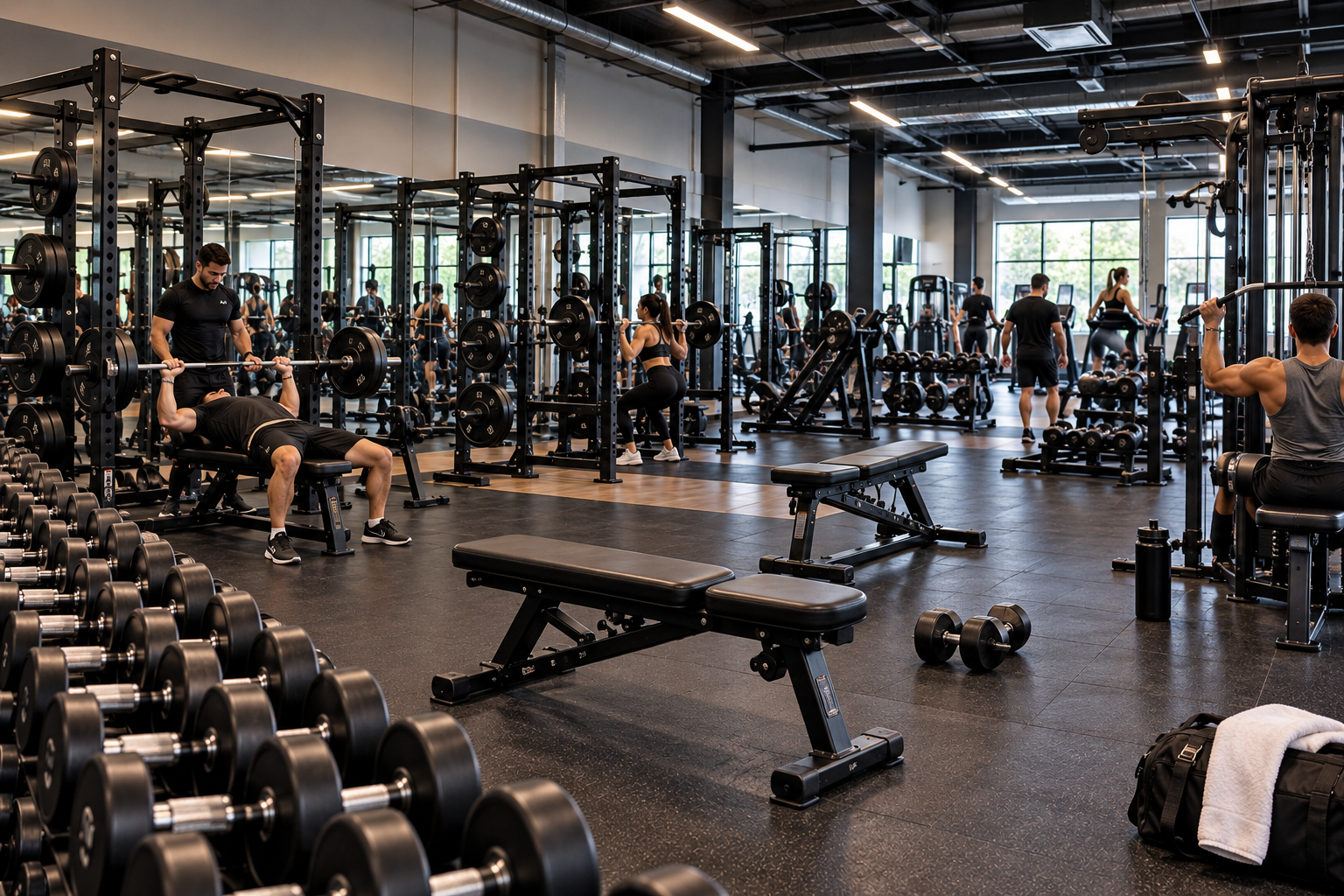
Fitness center vs traditional gym: differences and evaluation criteria
The terms fitness center and traditional gym are often used as synonyms, but they can indicate different organizational models. A fitness center generally offers a wider range of services, activities, and spaces dedicated to training, while a traditional gym may focus primarily on the weight room, essential equipment, and a more limited number of complementary services.
Understanding the differences between the two models is useful both for those who need to design a new facility and for those who wish to renovate an existing business. Evaluation should be based on verifiable criteria such as facility size, space organization, type of services, user target, and potential for future development.
This guide compares fitness center and traditional gym through practical parameters, without delving into specific aspects related to complete design or other gym formats covered separately.
- Quick answer
- What are the main differences?
- Comparison table
- How to evaluate the two models
- When to choose a fitness center or a traditional gym
- Errors to avoid
- FAQ
- How to plan a sustainable facility over time
What is the difference between a fitness center and a traditional gym?
A fitness center generally offers a greater variety of areas dedicated to training, ancillary services, and organized activities, while a traditional gym focuses its offerings primarily on the weight room and individual training. The choice depends on project objectives, the target audience, and the characteristics of the available space.
Both models can be effective if designed consistently with the operating context.
Evaluation should consider both current needs and the possibilities for future evolution of the facility.
What is the main criterion?
Define the type of users you want to serve and the services you intend to offer before organizing spaces and investments.
Are a fitness center and a traditional gym the same thing?
Not necessarily. The denominations may overlap in common language, but they often identify different organizations in terms of the breadth of services and articulation of spaces.
What are the main differences?
The two models share the goal of offering spaces dedicated to physical activity but differ in their overall organization.
The differences mainly concern the number of services, layout of environments, and management methods.
Each project must be evaluated individually.
Characteristics of the fitness center
A fitness center normally includes several areas dedicated to cardiovascular training, free weights, isotonic machines, classes, functional training, ancillary services, and common areas designed to meet different needs.
Characteristics of the traditional gym
A traditional gym is often organized around the weight room and major training equipment, with a generally more essential range of services compared to a complete fitness center.
Comparison table
A summary comparison highlights the main organizational differences.
| Criterion | Fitness center | Traditional gym |
|---|---|---|
| Available services | Generally numerous | More essential |
| Training areas | Several specialized zones | Prevalence of the weight room |
| Target | Diverse public | Variable depending on the facility |
| Space organization | More articulated | Generally simpler |
| Operational management | More complex | More linear |
How to read the comparison?
The characteristics shown represent general indications. Each facility may differ depending on the business project and the organization adopted.
Which indicators to evaluate?
Number of functional areas, services offered, available surface area, internal pathways, and expansion possibilities represent useful criteria for comparison.
How to evaluate the two models?
The choice must be consistent with the facility's objectives and the target market.
The available space represents one of the most important elements in design.
Preventive planning helps avoid costly modifications in the future.
Analyze the target audience
Understanding user needs helps determine which services to include and how to distribute environments within the facility.
Evaluate the layout
Efficient organization of areas improves facility utilization and facilitates daily management. To complete the project, you can evaluate the range of gym equipment best suited to the planned configuration.
When to choose a fitness center or a traditional gym?
Both solutions can be appropriate depending on the project.
Surface availability and planned services directly affect the choice.
The future development plan also represents an important element.
When to design a fitness center
It may be indicated when you want to offer numerous activities, different training areas, and complementary services aimed at a broad audience.
When to design a traditional gym
It can represent a consistent solution when the project involves a more essential organization focused primarily on weight training and fundamental equipment.
What errors to avoid?
Incomplete evaluation can lead to an inefficient configuration.
Design should always start from the facility's objectives.
Preventive analysis reduces the risk of subsequent interventions.
Include inconsistent services
Adding areas or activities incompatible with the target can increase management complexity and costs without improving facility effectiveness.
Underestimate space distribution
An unfunctional layout can limit equipment usability and make user circulation less smooth.
FAQ
Can a fitness center and a traditional gym offer the same services?
Yes. Some facilities feature intermediate characteristics, but the fitness center generally offers a greater variety of environments and activities.
Does the difference depend only on size?
No. Space organization, available services, and the management model also contribute to distinguishing the two formats.
Is it possible to transform a traditional gym into a fitness center?
Yes, provided the project includes an adaptation of spaces, equipment, and services according to the facility's objectives.
How to plan a sustainable facility over time?
Evaluating a fitness center and a traditional gym through objective criteria allows you to design a facility more consistent with the target market and business development goals.
Analyzing layout, surfaces, services, user pathways, and expansion possibilities makes it possible to organize spaces efficiently and facilitate any future updates without radical modifications.
Accurate planning represents the basis for creating a functional facility, easily manageable and capable of adapting to the evolution of operational needs over time.
Comments (0)