
Trolley
You have no items in your shopping cart

 Budgets
 Dumbers
 Discs
Discs
 Benches
 Racks and Rigs
 Weights Holders
 Isotonic machines
 Calisthenics
 Cardio
 Kettlebells
 Flooring
 Gym Set
 Accessories
 Combat
 ARTI MARZIALI
 CONTAINER GYM
 Tug-Of-War
 Used Gym Equipment
 PILATES MACCHINARI
 GINNASTICA ARTISTICA
 CAMPI DA PADEL
 Prodotti in Pronta Consegna
 Informazioni
 IRONMAN
 Gift Card
- Donatif
- General information
- 0 I like it
- 487 Views
- 0 comments
- gym flooring, safety flooring, gym safety, shock-absorbing materials
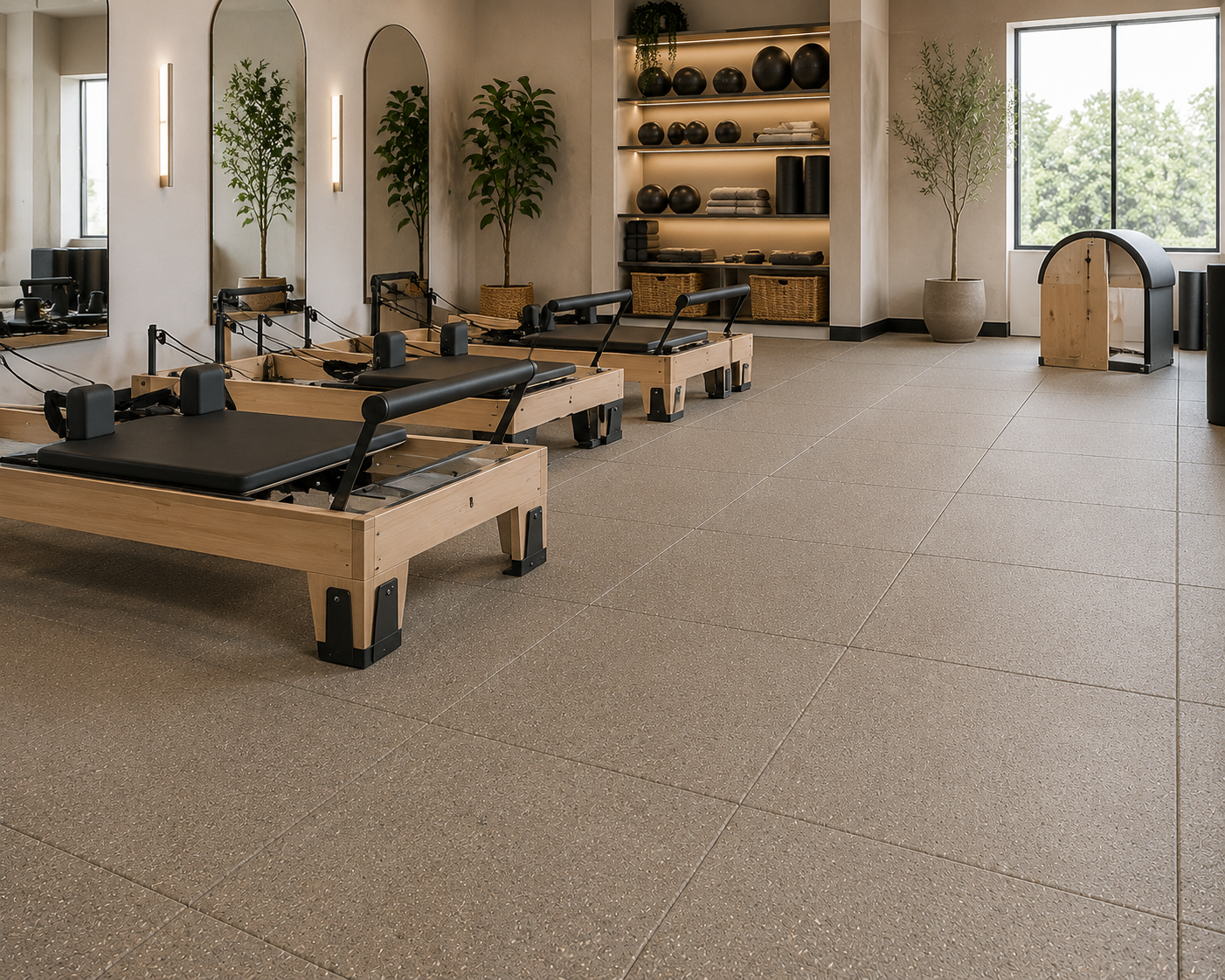
Flooring for Yoga and Pilates Studios: Comfort and Hygiene
Choosing the right yoga gym flooring is one of the most important elements in designing a studio dedicated to wellness. Unlike weight rooms or functional areas, environments intended for Yoga and Pilates require a surface capable of offering joint comfort, stability, thermal insulation, and maximum hygiene. The flooring becomes an integral part of the practitioner's experience, contributing to the sense of balance, relaxation, and safety during every lesson.
A very common mistake is using the same rubber flooring designed for weightlifting in rooms dedicated to holistic disciplines. Although these materials are extremely durable, they are often too rigid, have an uncomfortable finish, and do not guarantee the level of well-being required for exercises performed in direct contact with the floor.
Modern technical flooring for Yoga and Pilates is instead designed with closed-cell materials, easily sanitizable surfaces, and mechanical characteristics studied to support joints, the spine, and muscles during static and dynamic workouts. In this guide, we analyze the best solutions available, the criteria for choosing, and the technical aspects to consider before investing.
- The needs of a Yoga and Pilates studio
- Why weightlifting flooring is not suitable
- Ideal materials for wellness
- Joint comfort and safety
- Hygiene and ease of sanitization
- How to design a professional studio
- The most common mistakes
- How to evaluate the investment
The needs of a Yoga and Pilates studio
Yoga and Pilates are disciplines in which direct contact with the floor is continuous. Seated positions, exercises resting on knees, elbows, and the back require a surface capable of correctly distributing pressure without being either too rigid or excessively soft.
In addition to comfort, professional flooring must ensure good insulation from the cold of the subfloor, offer a pleasant sensation to the touch, and contribute to creating a relaxing and harmonious environment. The aesthetic aspect also plays an important role, as colors, textures, and materials participate in the overall perception of the space.
The choice of surface also influences the quality of daily practice, the durability of the mats used by students, and the general satisfaction of those who attend the center.
Continuous contact with the floor
Unlike traditional fitness rooms, most exercises are performed directly on the ground. For this reason, the comfort of the surface directly affects the practitioner's experience.
Creating an environment dedicated to wellness
Flooring designed for holistic disciplines helps convey a sense of order, cleanliness, and tranquility, which are fundamental elements for a professional studio.
Why weightlifting flooring is not suitable
The flooring used in weight rooms is designed primarily to absorb impacts and resist the dropping of barbells and dumbbells. Consequently, they prioritize robustness and mechanical resistance over the comfort perceived during direct contact with the body.
These materials are often too hard for activities that involve long-held positions, mobility exercises, or relaxation. Furthermore, some very grainy surfaces can be unpleasant when practicing without a mat or during movements that involve hands, knees, and forearms.
For a Yoga or Pilates studio, it is therefore preferable to choose a solution specifically designed for this type of use, capable of offering the right balance between support and softness.
A rigidity that is not always ideal
Materials that are too rigid can increase joint discomfort during prolonged exercises and reduce the general comfort of the practice.
The importance of the sensory experience
Texture, surface temperature, and softness influence the perceived quality of the lessons just as much as the studio's furniture or lighting.
Ideal materials for wellness
The best flooring dedicated to Yoga and Pilates uses technical closed-cell materials, capable of limiting liquid absorption and facilitating daily cleaning operations.
Among the most widespread solutions, we find surfaces in professional EVA, high-density foams, and modular systems specifically designed for wellness environments. These materials guarantee an excellent balance between comfort, stability, and durability over time.
The choice of thickness must also be made considering the type of activity performed, the number of users, and the expected intensity of use.
When to choose a pilates tatami
Tatami mats dedicated to Pilates represent a valid solution for rooms where floor work is predominant and you want to further increase comfort during exercises.
Closed-cell materials
This technology limits moisture absorption, facilitates sanitization, and helps maintain high hygienic conditions even with intensive daily use.
Joint comfort and safety
Good flooring must support the body without creating instability. The goal is not to obtain a very soft surface, but to ensure uniform support that protects the joints and spine.
During balance exercises, it is essential that the floor offers adequate grip without hindering the natural movements of the foot. At the same time, in long-held positions, the material must correctly distribute body weight, avoiding excessive pressure points.
These characteristics improve student comfort and allow instructors to offer longer lessons without increasing physical fatigue.
The right soft gym flooring
A moderately elastic surface protects the joints without compromising stability and precision during balance exercises.
Controlled grip
A correct level of grip reduces the risk of slipping while maintaining the natural fluidity of movement typical of holistic disciplines.
Hygiene and ease of sanitization
In Yoga and Pilates studios, numerous exercises are performed in direct contact with the floor. For this reason, cleaning is one of the most important aspects in choosing flooring.
Low-porosity surfaces allow for rapid sanitization between lessons, reducing the absorption of sweat, moisture, and organic residues. This helps maintain high hygienic standards and improve the perception of quality by members.
Resistance to professional detergents is also an important parameter, as frequent cleaning must not compromise the color, consistency, or durability of the material.
The importance of a sanitizable yoga surface
Easily sanitizable materials allow for reduced cleaning times and keep the studio always ready to welcome new practitioners.
Simplified daily cleaning
Simple maintenance allows you to preserve the aesthetic appearance of the flooring over time and ensure an environment that is always tidy.
How to design a professional studio
Flooring should be chosen together with the other elements of the space: lighting, acoustic treatment, ventilation, and furnishings all contribute to the quality of the experience offered to users.
It is important to evaluate the purpose of the different areas. If the studio also hosts fitness classes or functional activities, it may be useful to differentiate the surfaces according to the intended use.
Careful design also allows you to improve the durability of the flooring and simplify the daily management of the center.
Space organization
Correct distribution of areas allows you to make the most of the flooring's characteristics and improve comfort during lessons.
Relying on professionals
Turning to specialized suppliers allows you to identify materials that are truly designed for the wellness sector and not just simple adaptations of products intended for other uses.
The most common mistakes
One of the most frequent mistakes is choosing flooring exclusively based on price or aesthetic appearance, neglecting the technical characteristics required by the disciplines practiced.
Another wrong choice is installing surfaces that are too rigid or too soft, compromising both comfort and the stability necessary during exercises.
Finally, underestimating the importance of sanitization can lead to higher maintenance costs and a worse experience for members.
Looking only at the initial cost
Flooring that is cheap but poorly suited to holistic disciplines may require early replacement and increase overall management costs.
Copying fitness room solutions
Each discipline has different needs and requires materials designed specifically for the type of training performed.
How to evaluate the investment
Flooring is one of the elements that most influences the perceived quality of a Yoga or Pilates studio. Comfort, hygiene, durability, and aesthetics contribute directly to member satisfaction and the professional image of the center.
Choosing materials specific to wellness means creating a welcoming space that is simple to maintain and designed to offer well-being during every lesson. Carefully evaluating material quality, ease of cleaning, joint comfort, and durability allows you to create a studio destined to maintain high performance over time.
To identify the professional solutions best suited to your project, you can explore the options dedicated to yoga gym flooring, choosing materials studied to guarantee comfort, hygiene, and a training experience that meets the expectations of practitioners and teachers.
Comments (0)