
Trolley
You have no items in your shopping cart

 Budgets
 Dumbers
 Discs
Discs
 Benches
 Racks and Rigs
 Weights Holders
 Isotonic machines
 Calisthenics
 Cardio
 Kettlebells
 Flooring
 Gym Set
 Accessories
 Combat
 ARTI MARZIALI
 CONTAINER GYM
 Tug-Of-War
 Used Gym Equipment
 PILATES MACCHINARI
 GINNASTICA ARTISTICA
 CAMPI DA PADEL
 Prodotti in Pronta Consegna
 Informazioni
 IRONMAN
 Gift Card
- Donatif
- General information
- 0 I like it
- 12 Views
- 0 comments
- gym flooring, safety flooring, gym safety, shock-absorbing materials
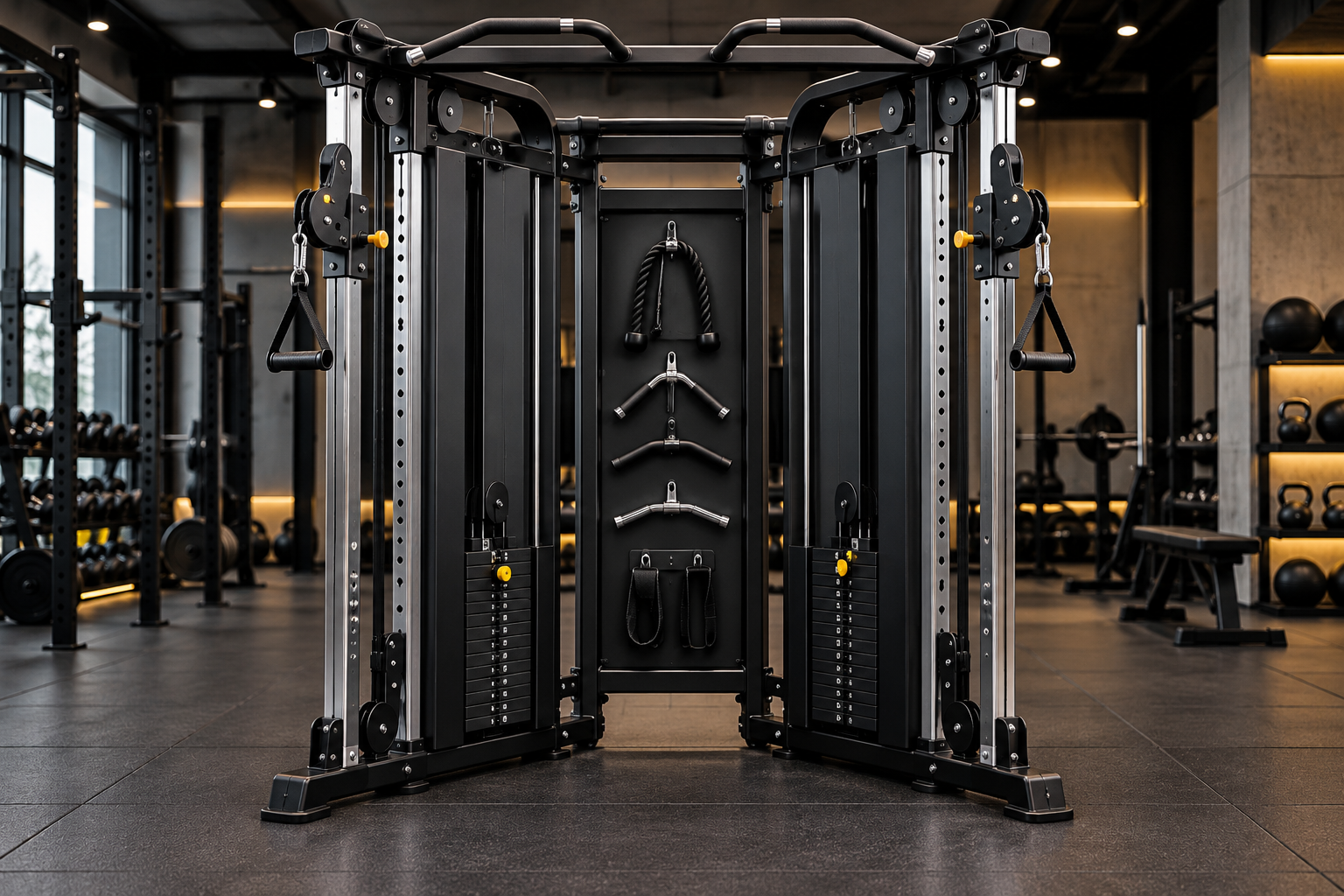
Functional trainer for a PT studio: selection criteria and setup
A functional trainer represents one of the most versatile pieces of equipment for a personal training studio thanks to the possibility of performing numerous exercises with adjustable cables, adapting to users with different fitness levels. To achieve a truly functional environment, however, it is necessary to carefully design the space, choose a machine consistent with the type of service offered, and properly organize the work area.
In a PT studio, every square meter has a high value. The setup must therefore favor freedom of movement, ease of use, and speed in transitioning from one exercise to another, while maintaining an orderly environment that is easily supervised by the trainer.
A design based on verifiable technical criteria helps improve studio efficiency, enhance the investment in equipment, and offer a more organized training session experience without turning the space into a traditional weight room.
- Quick answer
- What requirements a PT studio must have
- How to organize space and layout
- How to set up the functional trainer
- Safety and maintenance
- Design errors to avoid
- How to evaluate the investment
How to set up a functional trainer for a PT studio
To design an area dedicated to the functional trainer, it is necessary to evaluate available space, freedom of movement, machine features, accessories used, and the organization of training sessions. An effective setup must allow the personal trainer to follow the client without obstacles and to quickly modify exercises while maintaining operational continuity.
The design should start from the studio's goals, distinguishing between individual workouts, pairs of clients, or small groups, in order to identify the most suitable setup.
A modular arrangement of equipment facilitates any future modifications without requiring structural interventions on the entire environment.
Decision-making criteria
The main criteria concern the number of pulleys, quality of the adjustment system, transmission ratios, weight stack capacity, available accessories, operating area, and ease of maintenance.
Technical references
For installation, use, and maintenance, it is advisable to follow the manufacturer's manual. For fitness equipment, the EN ISO 20957 series standards can also represent a reference when applicable.
What requirements a PT studio must have
A studio dedicated to personal training should offer an orderly space, easily reconfigured, and sufficiently free to allow complete movements with the cables without interference from other equipment.
The functional trainer should be placed in a position that allows the trainer to observe the client from different angles during the execution of exercises, facilitating any technical corrections.
It is also advisable to provide a dedicated zone for accessory storage so as to keep the work area always tidy.
Accessibility
Access to the machine must be simple for both the client and the trainer, avoiding forced paths or overly narrow passages.
Space versatility
A PT studio benefits from a layout that allows the same area to be used also for bodyweight exercises or with small accessories.
How to organize space and layout
The layout should allow complete use of the pulleys along their entire range of motion without lateral or rear obstacles. The distance from walls and other machines also affects freedom of movement.
A rational arrangement facilitates the transition between different exercises and reduces the time needed to change adjustments and accessories during the session.
When the studio has a single main machine, it is advisable to design the rest of the environment based on the functional trainer, leaving the operating area free.
Open layout
An open configuration improves the ability to perform multi-directional exercises and makes technical supervision by the personal trainer easier.
Movement paths
Paths must always remain free of obstacles to allow fluid movements with different accessories connected to the cables.
How to set up the functional trainer
The machine setup should be consistent with the type of clientele and the working method adopted in the studio. The availability of rapid adjustments facilitates alternating between upper and lower body exercises.
Accessories should be organized in an orderly and easily reachable manner. Handles, ropes, bars, and other tools can be used according to the programming without slowing down the session.
A machine designed for full body workouts offers greater operational flexibility and allows building highly varied programs using a single station.
Accessory management
Storing accessories on dedicated supports facilitates quick changes between one exercise and the next and improves the overall order of the studio.
Machine adjustments
Before each session, it is advisable to check the position of the pulleys, load selection, and correct fastening of accessories.
Safety and maintenance
Safety depends both on the machine's quality and on the regularity of checks on wear-prone components. Cables, pulleys, adjustment systems, and accessories should be checked according to the manufacturer's scheduled maintenance program.
The support surface also contributes to the station's stability and floor protection during daily use.
A shock-absorbing flooring represents a suitable solution for personal training studios. To learn more about available solutions, you can consult gym shock-absorbing flooring.
Periodic checks
Regularly checking cables, pulleys, locking systems, and accessories keeps the machine efficient and ready for use.
Area cleaning
An orderly studio facilitates daily maintenance and improves the client's experience during sessions.
Design errors to avoid
One of the most frequent errors consists of installing the functional trainer in a space that does not allow the complete travel of the cables or limits the user's movement.
Another critical issue concerns choosing a machine with features inconsistent with the type of clientele or the absence of a space dedicated to accessories.
It is also advisable to avoid configurations that make it difficult for the trainer to monitor the client during the execution of exercises.
Unfunctional layout
An unplanned arrangement reduces the machine's versatility and limits the quality of training sessions.
Cluttered accessories
Poorly organized accessory management slows down the trainer's work and reduces studio efficiency.
How to evaluate the investment
The purchase of a functional trainer for a PT studio should be evaluated by considering build quality, adjustment possibilities, accessory versatility, ease of maintenance, and compatibility with available spaces.
A well-configured machine allows performing numerous training programs using a single station, optimizing available surface area and making studio organization more efficient.
Carefully analyzing technical specifications, planning the layout, and following the manufacturer's instructions for installation and maintenance allows creating a professional, orderly environment capable of sustaining the personal training business over time.
Comments (0)