
Trolley
You have no items in your shopping cart

 Budgets
 Dumbers
 Discs
Discs
 Benches
 Racks and Rigs
 Weights Holders
 Isotonic machines
 Calisthenics
 Cardio
 Kettlebells
 Flooring
 Gym Set
 Accessories
 Combat
 ARTI MARZIALI
 CONTAINER GYM
 Tug-Of-War
 Used Gym Equipment
 PILATES MACCHINARI
 GINNASTICA ARTISTICA
 CAMPI DA PADEL
 Prodotti in Pronta Consegna
 Informazioni
 IRONMAN
 Gift Card
- Donatif
- General information
- 0 I like it
- 8 Views
- 0 comments
- gym flooring, safety flooring, gym safety, shock-absorbing materials
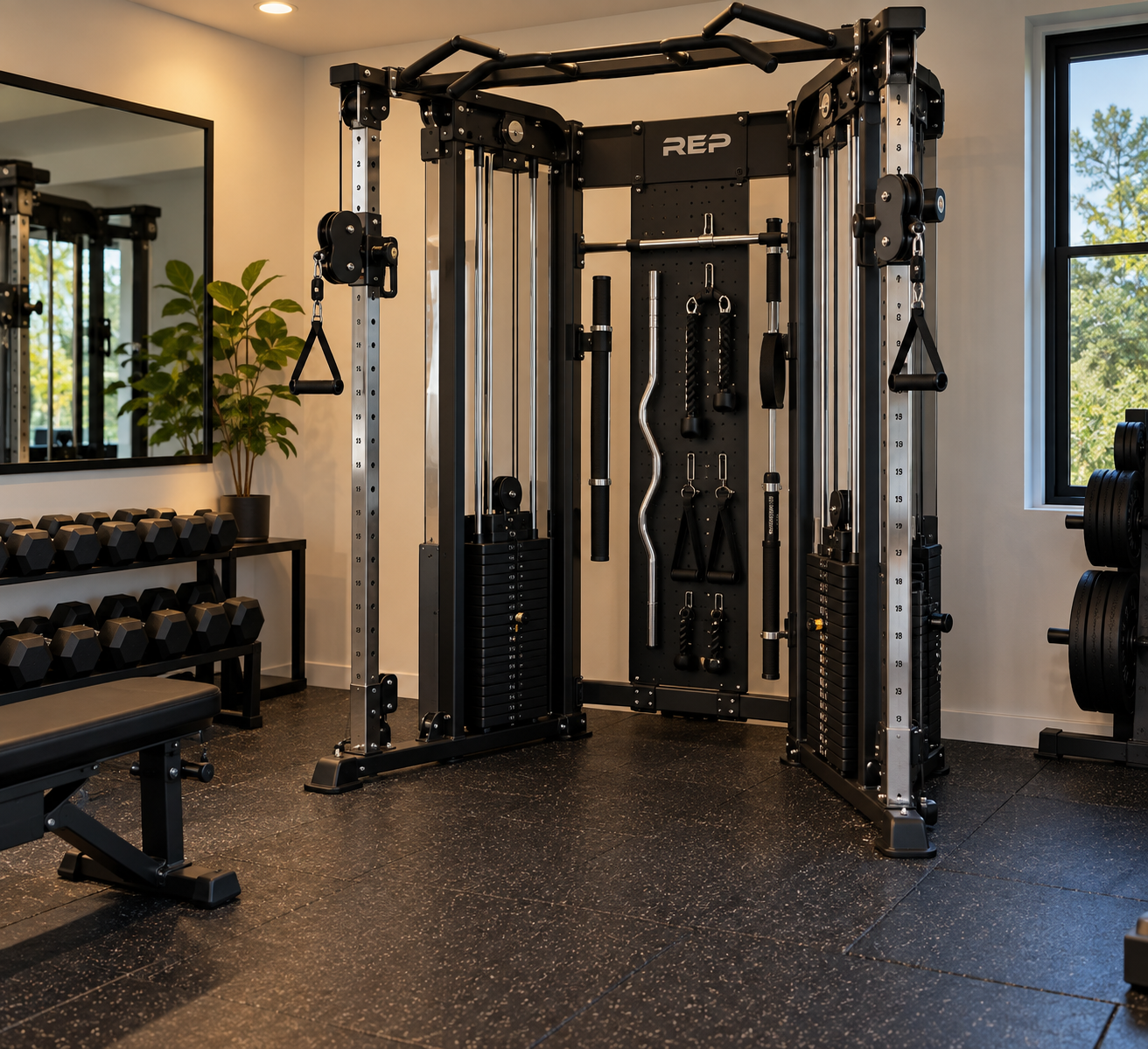
Functional trainer for functional fitness: requirements and usage
The functional trainer represents one of the most versatile pieces of equipment for functional fitness thanks to the possibility of performing multidirectional exercises with adjustable resistance through a pulley system. The machine allows users to develop programs oriented toward strength, motor control, and physical conditioning, adapting to users with different levels of experience.
In functional fitness, the choice of a functional trainer should be based on verifiable technical criteria such as build quality, pulley configuration, movement fluidity, adjustment possibilities, and compatibility with available space. Proper selection expands training possibilities while maintaining efficient organization of the fitness area.
Understanding requirements and usage methods allows gym managers, personal trainers, and athletes to integrate this machine into their programming without overlapping its role with other equipment present in the room.
- Quick answer
- What role does the functional trainer play in functional fitness
- How to use the functional trainer
- What requirements to evaluate
- How to include it in programming
- Errors to avoid and safety
- How to evaluate the investment
How to use a functional trainer in functional fitness
The functional trainer can be used in functional fitness to perform exercises with adjustable resistance intended for strength development and physical preparation. The choice of the machine should consider pulley configuration, build quality, available adjustments, and compatibility with programming goals, always following the manufacturer's instructions.
The versatility of the machine allows exercises to be quickly adapted to users with different levels of experience without modifying the general organization of the training area.
Before increasing the load, it is advisable to verify the correct setup of the machine and become familiar with the pulley adjustment system.
Decision-making criteria
The main criteria concern the number of pulleys, quality of transmission ratios, weight stack capacity, availability of accessories, movement fluidity, and ease of adjustment.
Technical references
For installation, use, and maintenance, it is appropriate to consult the manufacturer's manual. For fitness equipment, the EN ISO 20957 series standards can also represent a reference when applicable.
What role does the functional trainer play in functional fitness
In functional fitness, the functional trainer constitutes a multifunctional station that allows users to perform exercises with different trajectories using adjustable cables and numerous accessories. The machine can be integrated into programs oriented toward the development of strength, coordination, and general physical preparation.
The ability to quickly modify pulley positions and load levels makes the functional trainer suitable for individual sessions, personal training, and circuits organized in small groups.
The choice of configuration should always be consistent with the training method adopted by the facility.
Machine versatility
The availability of different accessories broadens training possibilities, allowing numerous exercise variations with a single station.
Areas of use
The functional trainer finds application in commercial gyms, personal training studios, centers dedicated to athletic preparation, and spaces designated for functional fitness.
How to use the functional trainer
Before training, it is necessary to correctly adjust the pulleys, select the load provided by the program, and verify the correct attachment of accessories. Every adjustment should be carried out following the procedures indicated by the manufacturer.
During execution, it is important to maintain movement control and trajectory continuity, avoiding sudden variations in technique due to incorrect adjustments or an inadequate load.
At the end of the session, it is good practice to unload the machine, put away the accessories, and leave the operational area clear.
Machine preparation
Verifying adjustments, accessories, and the load selection system helps start the session under appropriate conditions.
Exercise execution
A gradual progression of load and controlled technique promote training continuity and correct use of the machine.
What requirements to evaluate
When choosing a functional trainer intended for functional fitness, it is useful to consider structural robustness, pulley quality, ease of adjustment, and availability of accessories. Maintenance simplicity is also an important element, especially in facilities with intensive use.
Compatibility with the gym layout should be evaluated right from the design phase to ensure sufficient operational space around the machine.
A balanced configuration allows the functional trainer to be used continuously without limiting the organization of the fitness area.
Build quality
Robust materials and reliable adjustment systems contribute to the durability of the machine and the continuity of service.
Available accessories
A complete set of handles, ropes, and bars expands training possibilities while keeping the station's versatility high.
How to include it in programming
The functional trainer can be integrated into programs dedicated to strength development, general physical preparation, and full body training pathways. Frequency of use depends on programming goals and session structure.
In organized circuits, it is useful to set up simple and easily repeatable adjustments to reduce transition times between one exercise and the next.
Coherent planning makes it possible to exploit the versatility of the machine without overloading a single station.
Circuit training
The functional trainer can be included as one of the circuit stations while maintaining continuity between the scheduled exercises.
Training progression
Load increments should be gradual and consistent with the user's technical level.
Errors to avoid and safety
One of the most frequent errors consists of using random pulley adjustments without adapting them to the intended exercise or modifying the setup during movement. Neglecting the maintenance of cables and accessories can also compromise the correct functioning of the machine.
It is also advisable to avoid the use of incompatible accessories and sudden load increases without adequate technical progression.
Anti-shock flooring contributes to the stability of the training area and protects the floor and equipment. To learn more about available solutions, you can consult gym anti-shock flooring.
Incorrect setup
Correctly adjusting pulleys and accessories before starting the set improves usage quality and reduces the risk of operational errors.
Neglected maintenance
Periodically checking cables, pulleys, and adjustment systems helps keep the functional trainer efficient over time.
How to evaluate the investment
The purchase of a functional trainer intended for functional fitness should be evaluated by considering build quality, operational versatility, maintenance simplicity, and compatibility with available spaces.
A machine designed for professional use allows numerous training programs to be organized using a single station, adapting to different categories of users.
Analyzing technical specifications, verifying spare parts availability, correctly planning the layout, and following the manufacturer's instructions for installation and maintenance allows the functional trainer to be integrated effectively and consistently with the needs of a facility dedicated to functional fitness.
Comments (0)