
Trolley
You have no items in your shopping cart

 Budgets
 Dumbers
 Discs
Discs
 Benches
 Racks and Rigs
 Weights Holders
 Isotonic machines
 Calisthenics
 Cardio
 Kettlebells
 Flooring
 Gym Set
 Accessories
 Combat
 ARTI MARZIALI
 CONTAINER GYM
 Tug-Of-War
 Used Gym Equipment
 PILATES MACCHINARI
 GINNASTICA ARTISTICA
 CAMPI DA PADEL
 Prodotti in Pronta Consegna
 Informazioni
 IRONMAN
 Gift Card
- Donatif
- General information
- 0 I like it
- 498 Views
- 0 comments
- gym flooring, safety flooring, gym safety, shock-absorbing materials
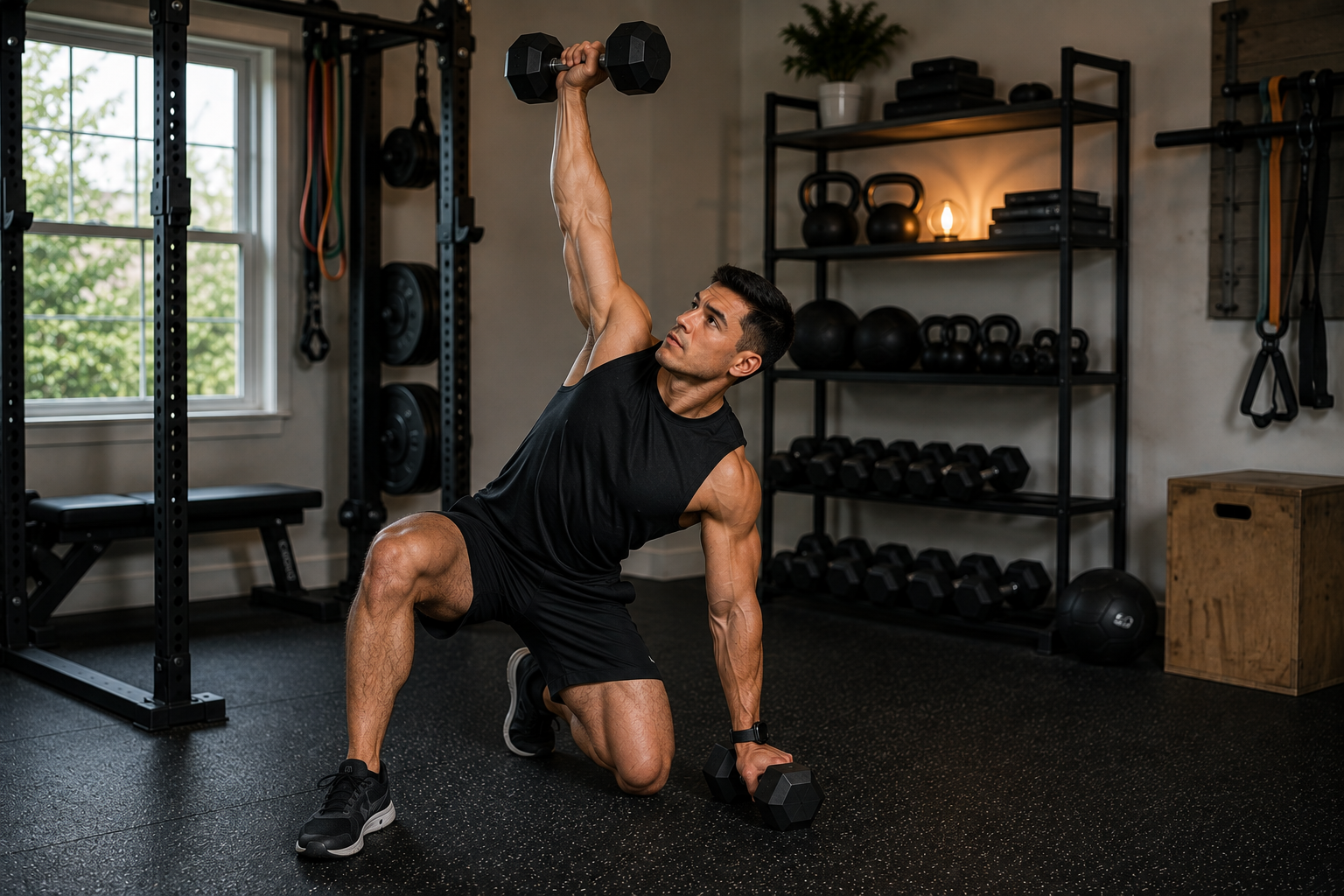
Functional training with dumbbells: develop strength, mobility, and control
Modern training is no longer limited to the simple pursuit of increasing muscle mass. More and more athletes and enthusiasts are choosing programs capable of improving movement quality, coordination, stability, and physical capabilities that are transferable to daily life and sports. In this context, dumbbell functional training represents an extremely effective solution because it allows for the development of strength through complete and dynamic movements.
Dumbbells are particularly versatile tools because they allow you to work on different planes of movement, involving multiple muscle groups simultaneously. Unlike many guided machines, they require greater body control, core activation, and the ability to stabilize the load during every phase of the exercise.
For those who practice sports like padel, martial arts, athletics, or disciplines that require changes of direction and explosive movements, using dumbbells in a functional way allows for building a more complete physical foundation. Strength, mobility, and coordination become integrated elements within the same training program.
- What is functional training with dumbbells
- Why dumbbells are ideal for functional training
- Multi-joint movements and strength development
- Most effective functional dumbbell exercises
- Training core and stability with dumbbells
- Dumbbells and athletic preparation
- Common mistakes in functional training
- Integrating dumbbells into a complete program
What is functional training with dumbbells
Functional training stems from the idea of improving the body's capabilities through movements that involve multiple joints and multiple muscle chains simultaneously. The goal is not just to increase the strength of a single muscle, but to improve the way the body produces, transfers, and controls force.
Using dumbbells in this context allows for the creation of exercises closer to real-life movements. Lifting, pushing, pulling, rotating, and stabilizing are actions that are part of daily life and many sports disciplines.
The value of functional training with dumbbells derives precisely from the ability to combine different physical qualities within the same exercise.
Difference between bodybuilding and functional training
Traditional bodybuilding focuses mainly on muscle isolation and aesthetic development. Functional training, on the other hand, focuses more on the body's ability to work as a coordinated system.
This does not mean that the two approaches are opposites, but that they pursue different goals. Dumbbells allow you to integrate both aspects thanks to their versatility.
Movements useful in daily life
Lifting an object from the ground, moving a weight, maintaining balance during a movement, or generating force rapidly are capabilities that are part of real life.
Functional exercises with dumbbells help improve these skills through complete motor patterns.
Why dumbbells are ideal for functional training
Dumbbells are one of the most used tools in functional training because they offer freedom of movement and the possibility of adaptation. Each hand can work independently, forcing the body to develop balance and control.
This characteristic allows you to correct any differences between the two sides of the body and improve the ability to stabilize the load during complex movements.
For this reason, dumbbells are often present in programs dedicated to athletes looking for more complete performance.
Working on planes of movement
Many traditional exercises are performed mainly on the sagittal plane, that is, with forward and backward movements. However, the human body also moves through rotations and lateral displacements.
Dumbbells allow you to train these patterns thanks to the possibility of combining displacements, twists, and changes of direction.
Greater activation of stabilizer muscles
When the load is not guided by a machine, the body must create stability autonomously. This involves deep muscles that contribute to position control.
The result is a more complete workout from the point of view of coordination.
Multi-joint movements and strength development
Multi-joint exercises represent the heart of functional training because they allow you to involve numerous muscle groups simultaneously. These movements require strength, balance, and coordination skills.
With dumbbells, it is possible to create sequences that combine pushing, pulling, squatting, and rotating, developing strength that is more applicable to real situations.
The quality of movement therefore becomes as important as the load used.
Explosive strength and power
Many sports require the ability to generate force rapidly. Jumps, changes of direction, and explosive strikes depend on the body's ability to quickly activate the musculature.
Dumbbells can be used to train this component through dynamic exercises performed with correct technique.
Load control and coordination
An effective functional movement requires control of the weight during all phases of the exercise. Coordination between the upper limbs, lower limbs, and trunk becomes fundamental.
Dumbbells favor this type of work because each side of the body must manage its own trajectory autonomously.
Most effective functional dumbbell exercises
There are numerous exercises that allow you to use dumbbells to improve strength and mobility. The choice must be based on the athlete's goals and level of experience.
The most effective exercises are generally those that involve multiple joints and require a high level of body control.
Proper programming allows you to combine intensity and technical quality.
Dumbbell snatch
The dumbbell snatch is an explosive exercise that involves the legs, hips, shoulders, and core. The movement requires a rapid extension of the hip followed by the push of the dumbbell upwards.
It is an exercise widely used in athletic preparation because it develops coordination and the ability to generate power.
Dumbbell clean and press
The dumbbell clean and press combines a pulling phase with a vertical push, involving numerous muscle groups in a single movement.
This exercise improves general strength, control, and the ability to transfer energy between the lower and upper body.
Training core and stability with dumbbells
The core represents the center of force transfer between the upper and lower body. A strong core does not just mean having visible abs, but possessing stabilization capabilities during complex movements.
Dumbbells allow you to create situations in which the trunk must resist external forces, improving control and stability.
This type of training is particularly useful for sports that require rotations and rapid changes of position.
Core exercises with dumbbells
Core exercises with dumbbells include movements like farmer's walks, controlled side bends, anti-rotation presses, and unilateral variations.
These exercises train the trunk's ability to maintain stability while the limbs produce force.
Stability and force transfer
During an athletic gesture, force must pass through different body structures without dispersion. A stable core allows for more efficient energy transfer.
Training this capability improves both sports performance and the quality of daily movements.
Dumbbells and athletic preparation
Dumbbells are widely used tools in athletic preparation because they allow for the development of fundamental qualities for numerous sports. Relative strength, balance, explosiveness, and coordination can be trained through targeted programs.
Their versatility allows you to adapt exercises to the specific demands of the practiced discipline.
For amateur and professional athletes, they represent a practical solution for building a complete physical foundation.
Weight-based athletic preparation
Weight-based athletic preparation often uses free movements to improve capabilities transferable to sports. Dumbbells allow you to work on strength without limiting the freedom of movement.
This approach is particularly useful for sports characterized by accelerations, braking, and changes of direction.
Advantages for rotational sports
Sports like padel, tennis, and golf require a great ability to generate force through rotational movements. Dumbbells allow you to train these patterns while also involving trunk control.
Preparation thus becomes more specific compared to simple linear strength work.
Common mistakes in functional training
Functional training offers great possibilities, but requires attention in the choice of exercises and execution technique. One of the most frequent mistakes consists of prioritizing speed at the expense of control.
A complex movement must be built progressively, increasing difficulty and load only when the technique is consolidated.
Quality must always remain the main criterion.
Using excessive loads
In dynamic movements, a weight that is too high can compromise coordination and safety. The goal is not to lift the maximum possible load, but to develop effective motor skills.
A gradual progression allows for more solid results.
Neglecting mobility
Strength and mobility must develop together. Good movement capability allows you to perform exercises with higher quality and reduce technical limitations.
Integrating mobility and strength makes training more complete.
Integrating dumbbells into a complete program
Dumbbells represent one of the most complete tools for building an effective functional training program. Their ability to adapt to different movements allows for the development of strength, coordination, mobility, and body control.
A well-structured program must combine fundamental exercises, load progression, and attention to technique. In this way, the work done becomes useful not only for improving physical appearance but also for increasing the capabilities usable in daily life and in sports.
Choosing modular and reliable equipment like adjustable dumbbells allows you to create a versatile training environment, capable of supporting different goals and accompanying the athlete's growth over time.
Comments (0)