
Trolley
You have no items in your shopping cart

 Budgets
 Dumbers
 Discs
 Benches
 Racks and Rigs
 Weights Holders
 Isotonic machines
 Calisthenics
 Cardio
 Kettlebells
 Flooring
 Gym Set
 Accessories
 Combat
 ARTI MARZIALI
 CONTAINER GYM
 Tug-Of-War
 Used Gym Equipment
 PILATES MACCHINARI
 GINNASTICA ARTISTICA
 CAMPI DA PADEL
 Prodotti in Pronta Consegna
 Informazioni
 IRONMAN
 Gift Card
- Donatif
- General information
- 0 I like it
- 15 Views
- 0 comments
- gym flooring, safety flooring, gym safety, shock-absorbing materials
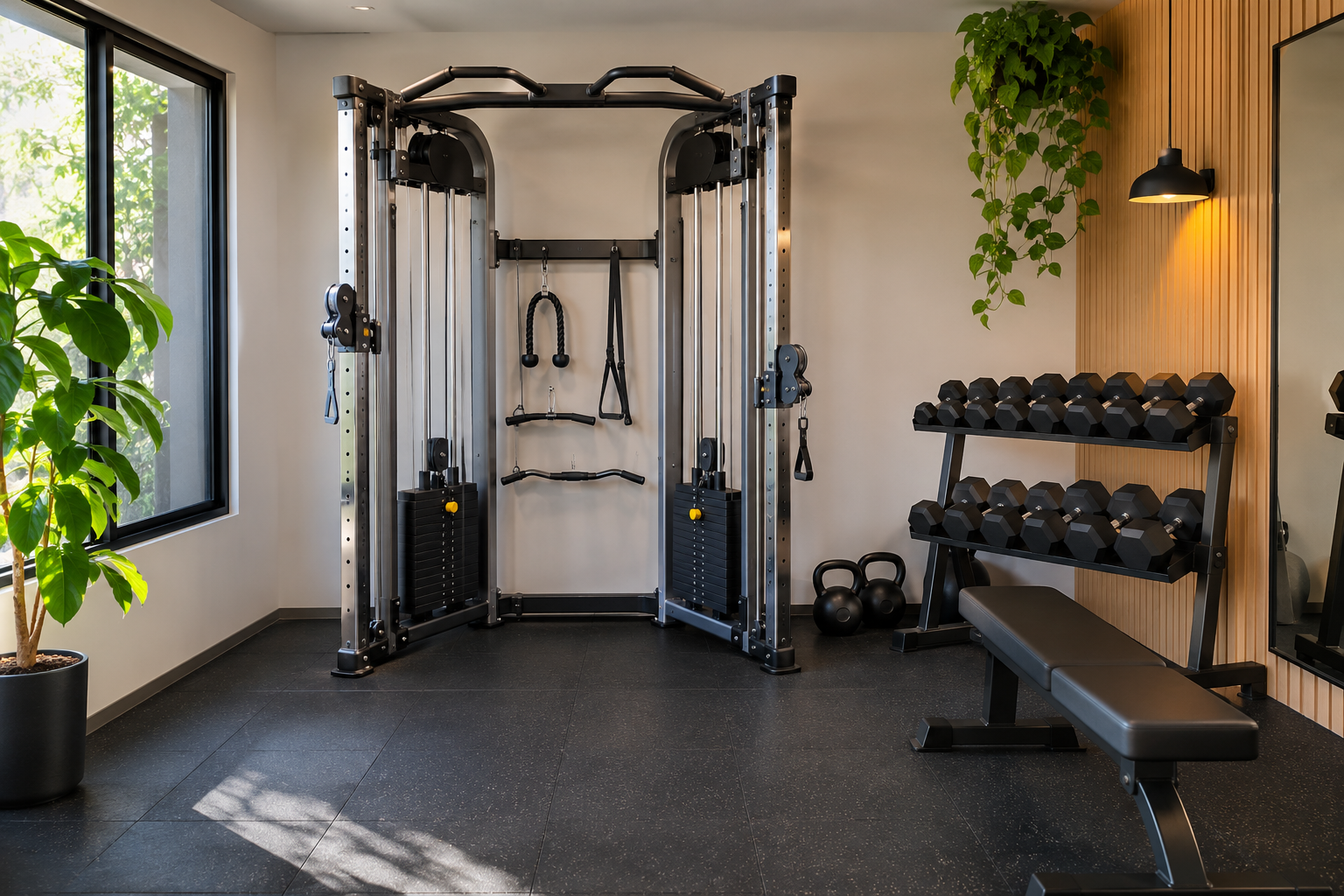
Superfluous second machine in the PT studio: how to identify duplicate exercises and optimize equipment
Setting up a personal training studio requires precise choices, especially when available space and budget demand that you select equipment carefully. One of the most common difficulties concerns the possibility of purchasing machines that, despite having different characteristics, allow for performing exercises that are substantially overlapping. Identifying these situations before making an investment allows you to allocate resources to the functions truly necessary for training programs.
A superfluous second machine in the PT studio is not necessarily identical equipment to what is already present. Two isotonic machines may have different brand names, different adjustment systems, and seemingly complementary configurations, but they may respond to very similar needs for the studio's actual users. At the same time, two pieces of equipment intended for the same muscle group can offer functions that are sufficiently different to justify both stations.
For the personal trainer who owns a studio, the decisive criterion should not be the number of machines available, but the coverage of movements required by the programs, the possibility of adapting exercises to the users, and the management of sessions. This guide proposes a practical method for recognizing functional overlaps, comparing alternatives, and documenting a purchasing choice consistent with the studio's characteristics, without presuming that there is a minimum equipment set valid for every business.
- When a second machine becomes superfluous in the PT studio
- Programs, clients, and the studio's operational context
- Parameters for identifying duplicate exercises
- How to compare the available isotonic machines
- Operational example of comparing two machines
- Evaluation errors and limitations of technical sheets
- Decision matrix and checklist before purchasing
- Investing in functional and sustainable equipment
When a second machine becomes superfluous in the PT studio
A second machine can be considered potentially superfluous when it does not introduce a necessary function, does not solve a documented operational limitation, and does not significantly improve the management of the planned workouts. However, this assessment requires a deeper comparison than simply looking at the similarity between exercises. It is necessary to understand which movements are actually performed, which adjustments are available, and which needs remain unsatisfied by the existing equipment.
The problem is particularly relevant in personal training studios with limited surfaces, where each piece of equipment occupies space that could be allocated to other activities. An additional machine also entails requirements for accessibility, maintenance, and session organization. The decision must therefore consider the entire use of the station and not just its nominal footprint.
A correct assessment distinguishes three situations: functional duplication, complementarity, and need for additional capacity. In the first case, the machines respond essentially to the same need. In the second, they offer different possibilities that are relevant to the programs. In the third, they perform similar functions, but the availability of two stations could be justified by the organization of simultaneous sessions.
Difference between similar exercises and duplicate exercises
Two exercises can involve similar muscle groups without being functionally equivalent. A leg press and a knee extension machine, for example, have different biomechanical characteristics, even if both can involve the quadriceps. Considering them automatically as duplicates just because they affect the same muscle district would lead to an inaccurate classification.
Duplication must be evaluated by considering the movement, the role of the exercise in the program, the adjustments, and the possibilities for progression. If two pieces of equipment satisfy the same operational goal for the same users, the second one might not add a sufficient benefit to justify its purchase.
When two similar stations can be justified
The presence of two machines with overlapping functions can be reasonable when the studio manages simultaneous workouts and a single station creates recurring wait times. In this case, the advantage does not necessarily concern the variety of exercises, but the ability to organize work without interruptions.
Before purchasing, it is still advisable to verify whether the problem can be solved by modifying the sequence of activities or using equipment already available. The need for a second station should emerge from data relating to sessions and not from a generic prediction of greater attendance.
Programs, clients, and the studio's operational context
The starting point for avoiding duplicate purchases is to analyze the programs actually offered. A studio oriented toward individual strength training may have different needs compared to a facility that proposes simultaneous sessions, athletic preparation, or functional circuits. No configuration can be considered universally correct without knowing these characteristics.
The personal trainer should collect information on the movement categories present in the training plans, the frequency with which the stations are used, and any difficulties encountered by users. The data can be organized in an anonymous form, avoiding the use of personal information not necessary for the assessment of the equipment.
This analysis allows for distinguishing essential functions from preferences. An exercise included regularly in programs and not replaceable with the available resources represents a different need compared to a variant used occasionally. Frequency, however, is not the only criterion: some functions can be important even for a limited number of users.
Mapping exercises and training functions
A practical procedure consists of building a table with exercise, goal, equipment used, frequency of use, and available alternatives. For each movement, it is useful to indicate whether the equipment allows for adequate adjustments and if users are able to perform the activity according to the professional's instructions.
The table should be organized by function and not exclusively by the machine's name. This allows for recognizing overlaps that might not emerge by comparing only commercial names and facilitates the identification of movement categories that are still underrepresented.
Considering actual sessions and users
The number of registered clients does not necessarily describe the operational load on the equipment. A studio with appointments spread throughout the day may have different needs compared to one that concentrates multiple sessions in the same time slots. It is therefore useful to observe the occupancy of the stations during actual activities.
It is also necessary to consider the characteristics of the users and the adjustment possibilities of the machines. A piece of equipment that theoretically covers a function might not be suitable for all the people being trained. These limitations must be documented through appropriate practical checks, without attributing therapeutic properties or unproven individual advantages to the machines.
Parameters for identifying duplicate exercises
To recognize duplicate exercises in the personal training studio, it is necessary to adopt comparable criteria. The first concerns the main movement allowed by the equipment. The second considers the function of the exercise within the programming. The third concerns the possibility of adapting the movement to the users' characteristics through adjustments, starting positions, and load ranges.
A machine should not be classified as equivalent to another just because it involves similar muscles. Differences in trajectory, body position, required stabilization, and methods of applying resistance can influence practical use. The relevance of these differences depends on the studio's goals and the characteristics of the specific products.
A further parameter concerns the actual availability of the function. If an exercise can be performed with a machine already present, it is necessary to verify that it allows for the necessary adjustments and progressions. A theoretical replacement is not sufficient when the alternative does not meet the program's operational requirements.
Comparing motor patterns
Classification by motor patterns allows for distinguishing, for example, pushes, pulls, hip-dominant movements, and knee-dominant movements. This organization constitutes a useful initial reference, but it does not exhaust the comparison. Two exercises belonging to the same category can differ in position, trajectory, and execution method.
For each machine, it is appropriate to identify the movement actually allowed, avoiding attributing functions not intended by the manufacturer to it. The comparison should be based on instructions and model characteristics, integrated by a professional evaluation of its application in the programs.
Evaluating adjustments and progression possibilities
Adjustments represent an important element in the functional duplication of isotonic machines. Seats, backrests, grip points, and initial positions can influence the equipment's adaptability. Two seemingly similar machines might offer different possibilities, but such differences must be verified and considered relevant for the studio's users.
The resistance system and the methods for increasing the load also deserve attention. The possibility of performing progressions consistent with the programs can represent a criterion for choice, provided that it is evaluated on the actual product specifications and not on presumed general superiorities of a technology.
How to compare the available isotonic machines
The comparison of equipment should begin with an inventory of the existing equipment. For each machine, it is useful to record brand and model, intended functions, available adjustments, dimensions, and conditions of use. This information allows for identifying any shortcomings without automatically starting from the hypothesis that it is necessary to purchase a new station.
The assessment must then focus on functions not adequately covered. If an existing machine already satisfies the requirements of an exercise, the purchase of a second model should be justified by an additional verifiable need. This could be a different necessary adjustment, a truly complementary function, or a problem of availability during sessions.
To delve deeper into the characteristics of the equipment, you can consult the category of isotonic machines, comparing the sheets of the models actually available. The link to the catalog must serve to verify characteristics and alternatives, without replacing the analysis of programs and spaces.
Functional comparison before price
The purchase price does not allow you to establish whether a machine is necessary. Two pieces of equipment with different costs can respond to the same need, while a more expensive solution could offer pertinent functions that the existing equipment does not cover. The assessment must therefore start from the requirements and only subsequently consider the economic conditions.
It is useful to prepare a comparative sheet with main function, documented secondary functions, adjustments, dimensions, and installation and maintenance requirements. Information not available should be indicated as data to be requested from the supplier, avoiding completing the comparison with assumptions.
Machine footprint and operational space
External dimensions represent only a part of the necessary space. It is necessary to consider access to the station, adjustments, user movement, and maintenance requirements. A machine that fits in the floor plan could prove to be poorly functional if it limits walkways or interferes with other activities.
For this reason, the comparison should be carried out on a dimensioned layout, using the actual dimensions of the model and the manufacturer's instructions. The surface occupied by a second machine must also be evaluated with respect to the alternatives for using the same space, such as an area for bodyweight exercises or for other activities already planned.
Operational example of comparing two machines
Consider a personal training studio that already possesses a vertical pull machine and is evaluating the purchase of a second piece of equipment intended for seemingly similar movements. The example is exclusively illustrative: it does not describe a real studio, it does not refer to specific models, and it does not demonstrate that a particular category of machine is always replaceable.
The owner notes that the existing machine is used in training programs and that the new equipment should expand the possibilities for working on the upper body musculature. Before proceeding, he must clarify which additional exercises he intends to introduce and which functional differences are actually relevant.
The decision cannot be based on the simple fact that both machines involve the dorsal musculature. It is necessary to compare pull direction, user position, adjustments, and the role of the exercises in the programming. Only after this analysis is it possible to establish whether the second station represents a useful integration or an poorly justified overlap.
Comparison between vertical and horizontal pull
A vertical pull machine and a horizontal pull machine can involve partially common muscle groups, but allow for different movements. If the studio does not have an adequate solution for horizontal pulling and this function is required by the programs, a dedicated machine could represent a pertinent integration.
If, on the other hand, the existing equipment already includes tools that allow for adequately performing both movements, the purchase requires additional motivation. The simultaneous availability of the stations or specific adjustments could be relevant, but these advantages must be verified in the real context.
Applying a decision simulation
The owner can assign to each alternative a status for four criteria: function not covered, compatibility with programs, availability during sessions, and compatibility with space. A new machine that does not add necessary functions, does not solve occupancy problems, and significantly reduces the available surface presents weak purchasing motivations.
Conversely, a machine that introduces a required and not adequately available movement may deserve further investigation, even if it involves muscle groups already trained with other equipment. The result of the simulation is not a universal judgment on the product, but a decision conditioned by the information collected.
Evaluation errors and limitations of technical sheets
One of the most frequent errors consists of equating the variety of machines with the completeness of the training offer. A broad catalog can include numerous pieces of equipment dedicated to similar movements, but this does not mean that every studio must possess them all. The equipment should reflect the service actually offered and not an abstract representation of the ideal gym.
A second error consists of considering all machines that report the same muscle groups in commercial descriptions as interchangeable. Product sheets are useful for knowing the declared characteristics, but they do not automatically demonstrate equivalence between exercises. The evaluation requires linking those characteristics to the programs and users.
It is also necessary to distinguish the supplier's declarations from the results verified in the studio. An adjustment described as versatile can represent an interesting characteristic, but its utility depends on real needs. Whenever possible, an appropriate practical test and consultation of the instructions can help clarify aspects that are not sufficiently described.
Do not confuse muscle groups and functions
The classification of equipment by muscle district can simplify consulting a catalog, but it does not constitute a sufficient criterion for identifying duplications. Two machines intended for the lower limbs can have very different functions, while two pieces of equipment with different names can allow for similar movements.
To avoid incorrect interpretations, it is advisable to describe each machine through the allowed movement and its role in the program. This method makes the comparison clearer and reduces the risk of purchasing a station just because it belongs to a category not yet present in the inventory.
Recognizing the limits of commercial data
Technical sheets can report dimensions, adjustments, and construction characteristics, but they do not always describe all the conditions of use relevant to a specific studio. Information on accessibility, maintenance, and installation requirements may require consulting additional documents.
When a characteristic is not documented, it should not be considered as acquired. The manager can request clarifications from the supplier and verify the model's instructions. Any doubts about space compatibility or installation must be explored with competent professionals before making financial commitments.
Decision matrix and checklist before purchasing
A decision matrix for gym equipment allows for comparing alternatives using uniform criteria. For each candidate machine, it is possible to record the main function, any additional functions, the exercises already covered by existing equipment, user needs, and space constraints. This organization makes the motivations for the purchase and the information still missing visible.
The matrix should distinguish essential requirements from optional characteristics. If a function is necessary for programs and cannot be adequately performed with the available equipment, it represents a priority criterion. Conversely, an interesting but unused characteristic should not automatically assume the same weight.
It is useful to classify each requirement as satisfied, not satisfied, or to be verified. This procedure avoids transforming incomplete information into definitive assessments. A machine may appear promising on paper, but require further checks on adjustments, footprint, or installation conditions.
Building a replicable comparison grid
The grid can include five main areas: functional coverage, adaptability to users, simultaneous use, compatibility with the premises, and total cost. For each area, the manager should note the observed or documented data, the source of the information, and any necessary verification.
It is not essential to assign numerical scores. A descriptive classification can be more transparent when available data are limited. If one decides to use a scoring system, the criteria and weights must be defined before the comparison, avoiding modifying them to favor an already preferred machine.
Checklist for verification before purchasing
Before ordering a second machine, the owner should be able to answer some questions: which exercise or function is really missing? Can the existing machine already satisfy that need? What differences are documented? How many users need the new station? Are there recurring wait times? Does the available space allow for correct use? Is the technical information complete?
The answers should derive from anonymous programs, session observations, floor plans, and product documentation. If doubts emerge, the next step can consist of a request for clarification to the supplier, a test of the equipment, or technical investigation. The purchase should be postponed when checks essential for compatibility are missing.
The checklist can be kept together with the inventory and updated periodically. In this way, it becomes a reusable management tool, useful even when the studio modifies the programs or evaluates a future expansion of the equipment.
Investing in functional and sustainable equipment
The choice of a second machine must be evaluated within the scope of the total cost of the equipment. In addition to the initial price, it is necessary to consider transport, installation, any adjustments to the premises, maintenance, and occupied space. These elements can affect the sustainability of the investment, especially when the studio's surface is limited and each station must contribute concretely to the organization of the service.
A machine that introduces a necessary function can represent a coherent investment even when its use is not continuous. Conversely, a frequently used station is not automatically indispensable if the same activity can be organized adequately with resources already available. The economic evaluation must therefore link frequency, function, and alternatives, avoiding conclusions based on a single indicator.
The manager should also consider the opportunity cost of space. A second machine can prevent the introduction of different activities or limit movement between stations. Before committing a surface, it is useful to compare the new configuration with other organizational possibilities, verifying that the layout respects the applicable requirements and the manufacturers' indications.
A progressive investment can be a reasonable choice when programs are still evolving. Instead of immediately purchasing all hypothesized equipment, the studio can monitor operational needs and integrate the equipment when a documentable need emerges. This strategy does not automatically guarantee savings, but allows for connecting decisions to information collected during activity.
The assessment should also include the possibility of modifying the organization of sessions over time. An additional machine may be useful if the studio expects simultaneous activities and has data that support such a need. If, on the other hand, usage remains predominantly individual, it may be more appropriate to first verify if a different exercise scheduling allows for better use of the stations present.
To document the choice, it is useful to prepare a file containing equipment inventory, function map, anonymized reference programs, floor plan, technical sheets, and comparative matrix. This material allows for explaining why a machine has been selected, excluded, or postponed to a later phase, also facilitating any revisions of the equipment.
The final criterion for establishing when a second machine is superfluous consists of verifying if the equipment adds a necessary function, improves the adaptability of the programs, or solves an actually encountered operational problem. When none of these conditions is documented and the functions are already adequately covered, the purchase can be postponed. When, instead, a concrete need emerges, the comparison between technical characteristics, intended use, and studio constraints allows for orienting the investment toward a proportionate and verifiable solution.
Comments (0)