
Trolley
You have no items in your shopping cart

 Budgets
 Dumbers
 Discs
 Benches
 Racks and Rigs
 Weights Holders
 Isotonic machines
 Calisthenics
 Cardio
 Kettlebells
 Flooring
 Gym Set
 Accessories
 Combat
 ARTI MARZIALI
 CONTAINER GYM
 Tug-Of-War
 Used Gym Equipment
 PILATES MACCHINARI
 GINNASTICA ARTISTICA
 CAMPI DA PADEL
 Prodotti in Pronta Consegna
 Informazioni
 IRONMAN
 Gift Card
- Donatif
- General information
- 0 I like it
- 67 Views
- 0 comments
- gym flooring, safety flooring, gym safety, shock-absorbing materials
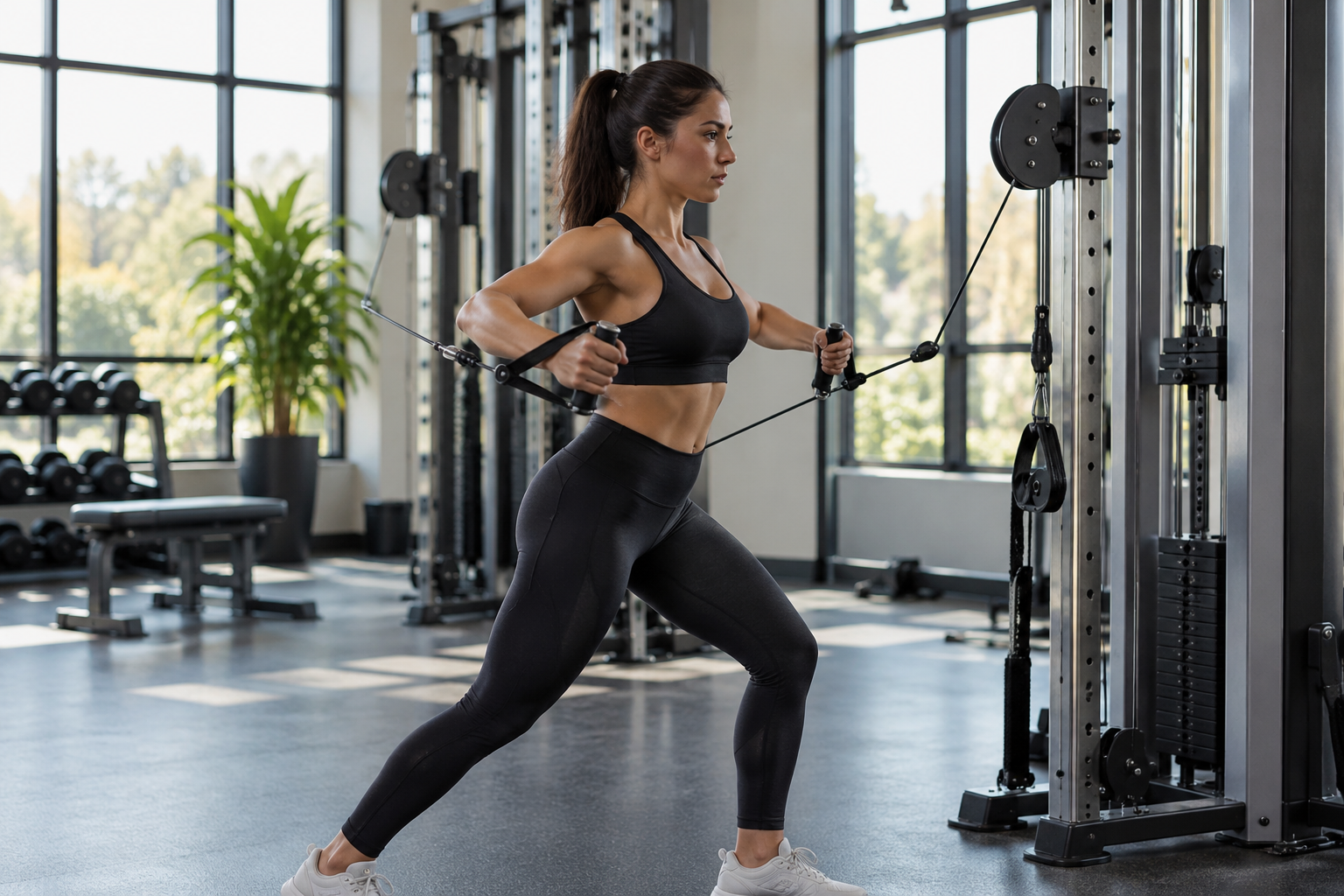
Exercises with a dual adjustable pulley: a practical guide for complete gym workouts
Exercises with a dual adjustable pulley represent a versatile solution for organizing strength, hypertrophy, and motor control training programs within a professional gym. The dual adjustable pulley, also known as a dual pulley station or functional trainer, allows you to change the height of the pull points and use two independent cables to perform movements targeting different muscle groups. This configuration allows you to adapt the direction of resistance to the characteristics of the exercise and the needs of the user.
For a gym manager or purchasing manager, understanding the operational possibilities of this equipment means looking beyond the simple number of exercises stated in sales brochures. The quality of a cable station depends on the structure's geometry, the available range of motion, the adjustment system, the pulley transmission ratio, and stability during use. These elements directly influence the machine's functionality and the possibility of using it for different programs.
In this guide, we analyze the main exercises that can be performed with a dual adjustable pulley, execution methods, and the criteria to consider in the daily management of the fitness room. The goal is to provide accessible technical indications to select the most appropriate movements, organize workstations, and evaluate the equipment's actual utility in relation to the services offered by the facility.
- How a dual adjustable pulley works
- Exercises for the pectorals and pushing muscles
- Exercises for the lats and pulling muscles
- Shoulder and arm training with cables
- Exercises for the lower limbs
- Core training and trunk stability
- Load programming and progression
- Station safety and organization
- Investment criteria for a professional gym
How a dual adjustable pulley works
The dual adjustable pulley is a cable machine characterized by two vertically adjustable pull points, generally located on opposite sides of a structure. Each pull point is connected to a resistance system that can use independent weight stacks or other solutions provided by the manufacturer. Through the pulleys, the cable transmits the force applied by the user to the selected load, allowing movements to be performed in different directions.
The main functional advantage is the possibility of modifying the orientation of the resistance. Unlike many isotonic machines with a guided trajectory, the cable station leaves it up to the athlete to control the path of the handle. This characteristic expands training possibilities but requires adequate technique and correct load selection.
From a management point of view, a dual pulley station can support bilateral exercises, unilateral exercises, and movements involving multiple joints. However, the actual versatility also depends on the width of the structure, the useful length of the cables, and the free space in front of the machine. A compact configuration does not necessarily guarantee the same operational freedom as a model with a greater distance between the columns.
Adjusting pulley height
The position of the pulleys determines the initial direction of the force exerted by the cable. A high setting allows for downward pulling movements, while a low position is frequently used for curls, raises, and certain variations of lower limb exercises. Intermediate settings are particularly useful for presses and rows.
Before starting any exercise, it is necessary to verify that the locking system is fully engaged. Adjustments must be made without abnormal tension on the cable and by respecting the procedures indicated by the manufacturer.
Transmission ratio and effective resistance
The pulley transmission ratio influences the force required at the handle and the distance traveled by the cable. In an ideal system with a 2:1 ratio, the resistance perceived on a single handle is about half of the weight selected on the weight stack, while the available range of motion increases proportionally. Friction and construction characteristics can modify actual behavior.
For this reason, it is not correct to automatically compare the loads indicated on different machines. A technical manager should know the ratio stated by the manufacturer and explain to users that the selected value does not necessarily coincide with the force effectively applied.
Exercises for the pectorals and pushing muscles
Cable exercises for the pectorals allow you to train horizontal shoulder adduction and pushing movements, primarily involving the pectoralis major, anterior deltoid, and, in multi-joint variations, the triceps brachii. The ability to adjust the height of the pulleys allows you to modify the direction of resistance and adapt the movement to the athlete's characteristics.
One of the most common applications is the cable crossover, in which the user brings the handles toward the midline of the body through a controlled movement of the arms. The starting position must allow for adequate tension without forcing excessive shoulder extension. The load is chosen to maintain trunk stability and control throughout the entire range of motion.
The station can also be used for standing cable presses, performed with one or two handles. This variation requires a significant contribution from stabilizing muscles, as the athlete must counteract forces that tend to change the position of the body. It does not necessarily replace barbell or dumbbell presses, but it can effectively complement them.
Cable crossover for pectorals
To perform the cable crossover, the athlete adjusts the pulleys to the desired height, grabs the handles, and assumes a stable position with feet appropriately spaced. The arms are brought forward through a controlled movement, keeping a slight bend in the elbows. The trajectory must be compatible with individual mobility and the training goal.
During the return, it is important to avoid letting the load pull the arms too far back. The eccentric phase must be managed without losing trunk posture. The amplitude of the movement should not be increased at the expense of joint control.
Standing cable chest press
The cable chest press is performed by positioning the pulleys at a height consistent with the desired pushing direction. The athlete starts with hands near the chest and extends the arms forward, maintaining a stable position and controlling trunk rotation.
The unilateral variation can be used to introduce a greater demand for stabilization against rotational forces. The load must be appropriate for the athlete's ability to maintain position, avoiding turning the movement into a push accompanied by excessive compensation.
Exercises for the lats and pulling muscles
The dual adjustable pulley allows for numerous pulling movements aimed at the back muscles. By adjusting the height of the pulleys, it is possible to perform horizontal rows, diagonal pulls, and variations involving different combinations of shoulder and scapular movement. This flexibility makes the machine useful both for general preparation and for complementary strength exercises.
The cable row is one of the easiest applications to organize. The athlete grabs one or two handles and performs a pull toward the trunk, controlling elbow movement and maintaining a stable position. The direction of resistance depends on the pulley position and the user's distance from the structure.
Another application is the face pull, often used in programs dedicated to the upper back and shoulder muscles. The exercise requires attention to elbow position and coordination between scapular movement and humeral rotation. The choice of load must prioritize control over the amount of weight moved.
Standing cable row
For the standing row, the pulleys are positioned at an appropriate height and the athlete assumes a stable position in front of the machine. The handles are pulled toward the trunk through a coordinated movement of the shoulders and elbows, avoiding using torso swings to complete the repetitions.
The return phase must allow for a controlled extension of the arms without losing body position. In unilateral variations, the coach can observe any differences in control between the sides and adapt the program to individual needs.
Face pull and scapular control
The face pull is generally performed with a pulley positioned in the upper part of the structure and a compatible accessory, such as a rope. The athlete pulls the handle toward the upper part of the face, coordinating elbow flexion with shoulder movement.
The technique must avoid compensations through lumbar extension or excessive torso shifting. A moderate load and a controlled trajectory allow the exercise to be used as a supplement in programs dedicated to upper body strength.
Shoulder and arm training with cables
The dual pulley station offers various possibilities for training deltoids, biceps, and triceps. Compared to free weights, the direction of resistance can be modified through the position of the pulley, allowing the stimulus to be distributed along different portions of the movement. This does not mean that muscle tension remains constant in every position, as variations in joint lever arms also come into play.
Cable lateral raises are particularly used to train the middle deltoid. The pulley is generally positioned low, and the athlete lifts the arm laterally while maintaining adequate shoulder control. The trajectory must be adapted to individual mobility, avoiding forced movements or trunk compensation.
For the arms, applications include cable curls and tricep pushdowns. These movements can be performed with different accessories and handles, but the choice should depend on joint comfort and training goals. The availability of numerous variations does not make it necessary to use them all in the same program.
Cable lateral raises
The athlete positions the pulley at the bottom of the structure, grabs the handle, and stands sideways relative to the pull point. The arm is raised through a controlled shoulder movement, keeping the elbow slightly bent and limiting body sway.
The load must allow for a range of motion consistent with individual capacity. It is better to reduce the resistance when the athlete has to tilt their torso excessively or use momentum to complete the repetitions.
Bicep curls and tricep pushdowns
The cable curl is generally performed with the low pulley, flexing the elbow against resistance. The position of the arm relative to the trunk can be modified to change mechanical demands, provided the movement remains controlled.
The tricep pushdown uses a high pulley and involves elbow extension while keeping the arm in a relatively stable position. In both cases, it is important to avoid shoulder compensation movements and to choose a load that allows for technically consistent repetitions.
Exercises for the lower limbs
The dual adjustable pulley can also be used for lower limb exercises, although it does not automatically replace specific leg training equipment. The ability to apply resistance through a cable allows for hip extension, abduction, and adduction movements, as well as some multi-joint variations.
Among the most common applications are standing hip extensions, performed using a compatible ankle strap. The athlete maintains a stable position and brings the lower limb posteriorly against the cable's resistance. The movement must be performed primarily through the hip joint, avoiding excessive compensation of the lumbar spine.
The machine can also be used for some squat and lunge variations with cable resistance. However, the direction of force and the available load can make these variations different from traditional barbell exercises. The choice must be motivated by a precise goal and not simply by the availability of the station.
Hip extensions with the low cable
To perform hip extension, the pulley is adjusted to the bottom, and the cable is connected to a suitable ankle strap. The athlete stands in front of the structure, using a stable support point when necessary, and brings the leg posteriorly through a controlled movement.
Pelvic position must remain sufficiently stable to avoid the movement being achieved through excessive lumbar extension. Resistance is increased only when the athlete maintains consistent technique throughout the entire set.
Hip abduction and adduction
Cable abductions and adductions allow you to train the muscles that control lateral hip movements. The pulley is positioned low, and the athlete stands sideways relative to the machine, using an ankle strap compatible with the system.
The movement must be performed without excessive trunk swaying and with an amplitude compatible with individual mobility. In professional programs, these exercises can be inserted as supplements, evaluating their contribution relative to the total volume of lower limb training.
Core training and trunk stability
One of the most interesting applications of the dual adjustable pulley concerns trunk muscle training. Resistance applied through the cable allows for the creation of forces that tend to produce rotation, lateral flexion, or extension, requiring the athlete to control body position. This approach can be useful in general physical preparation programs and in complementary work for numerous sporting disciplines.
The Pallof press is an example of an anti-rotational exercise. The athlete stands sideways relative to the pulley and keeps the trunk stable while moving hands away from the chest. The cable's resistance tends to produce rotation, which is countered through the coordinated activation of the trunk muscles.
Controlled cable rotations are another possibility, but they require careful management of the trajectory and the distribution of movement between the hips and trunk. It is not advisable to seek excessive lumbar rotation range, especially when using heavy loads.
Pallof press for anti-rotational stability
To perform the Pallof press, the pulley is positioned approximately at chest height. The athlete grabs the handle with both hands, stands sideways to the machine, and slowly moves their arms away from the body, keeping the pelvis and trunk oriented forward.
Difficulty can be modified through load, distance from the pulley, and lower limb position. The goal is to maintain stable control without obvious compensation, not necessarily to use the maximum weight available.
Controlled cable rotations
Cable rotations can be performed with a pulley positioned at an appropriate height relative to the desired trajectory. The athlete performs the movement by coordinating the trunk and hips, maintaining a controlled distribution of the rotation.
The coach must distinguish between exercises that require movement production and those intended to resist it. This difference influences the choice of load, execution speed, and the role of the exercise in the program.
Load programming and progression
Programming cable exercises must be built considering the athlete's goals, experience level, and total training volume. The dual adjustable pulley can be used for main exercises in some general fitness programs or as complementary equipment in paths oriented toward maximal strength with free weights.
For muscle development, many cable exercises can be organized through moderate or high repetition ranges, maintaining a proximity to effort consistent with the user's level. In general strength programs, it is also possible to use lower repetitions, provided the machine allows for adequate resistance and technique remains controlled.
Monitoring must consider the selected load, number of repetitions, pulley position, and accessories used. Changing one of these elements can significantly alter the difficulty of the exercise. To compare results over time, it is therefore useful to maintain repeatable operating conditions.
How to choose the initial load
The initial load should allow the athlete to complete the planned repetitions without losing position and without resorting to excessive compensation. A short warm-up set allows you to verify the actual difficulty, especially when using a machine with a transmission ratio different from the usual one.
In unilateral movements, it is important to separately evaluate control on both sides. Any differences may require adjustments to the load or the number of repetitions, avoiding progressions based solely on the stronger limb.
Technical progression and increased resistance
Progression can be organized by gradually increasing repetitions, load, or execution control. When the athlete consistently reaches the upper limit of the planned range while maintaining proper technique, it is possible to evaluate an increase in resistance.
Not all exercises require frequent load increases. In movements intended for trunk stability or scapular control, greater executive precision can represent a significant progression even without changing the selected weight.
Station safety and organization
Safety in using the dual adjustable pulley depends on correct machine adjustment, component integrity, and management of the surrounding space. Before starting an exercise, it is necessary to verify that weight stack selectors are inserted correctly, that pulleys are locked in the desired position, and that accessories are connected through appropriate attachment systems.
Maintenance must include periodic checks of cables, pulleys, pins, carabiners, and adjustment systems. Any signs of wear, deformation, or irregular operation must be evaluated by competent personnel according to the manufacturer's instructions. A damaged cable should not be kept in service while waiting for failure.
From an organizational point of view, the station must be located in an area that allows users to move away from pull points without interfering with walkways. Some exercises require space in front of the machine, while others involve lateral movements. The actual surface area required may therefore be greater than the structure's footprint.
Pre-use checks
An operational check should verify the visible integrity of the cables, the correct position of the selectors, the functioning of the locks, and the compatibility of accessories. Handles must be free of damaged parts, and connections must remain secure during movement.
Floor staff should also know the procedures for reporting any anomalies and preventing the use of a station that presents technical problems. Recording interventions facilitates scheduled maintenance and the traceability of checks.
Operating spaces and user flows
A dual adjustable pulley can be used by a single athlete with both columns or, when the model and organization allow, by two users working independently. This possibility must be evaluated considering the separation of operational areas and the risk of interference between movements.
For a professional gym, it is useful to define clear indications regarding shared use and accessory management. An orderly arrangement of handles and ankle straps reduces preparation time and limits the accumulation of materials on the floor.
Investment criteria for a professional gym
The evaluation of a dual adjustable pulley should start from the activities the facility intends to offer. A gym oriented toward general training can use the station for complete programs, while a center specialized in athletic preparation might place more importance on freedom of movement, precise pulley adjustment, and the ability to perform unilateral exercises. The choice must therefore be linked to the facility's operational model.
Among the main practical criteria are structure stability, useful cable travel, number of adjustment positions, available resistance, and transmission ratio. The distance between the columns also influences the possibility of performing certain movements. These parameters should be verified through technical documentation and functional tests, when available.
An operational how-to approach to selection involves identifying priority exercises, defining the necessary space, and verifying that the machine allows you to perform them without significant limitations. For example, a facility that frequently proposes crossovers and broad bilateral movements should pay particular attention to the distance between pull points and cable length.
Construction quality plays an important role in high-traffic environments. Smooth-running pulleys, robust adjustment systems, and easily inspectable components contribute to maintaining reliable operating conditions. It is advisable to request information on spare parts availability and maintenance procedures, especially for parts subject to wear.
The economic comparison should not be limited to the initial price. Transport, assembly, maintenance, cable replacement, and support availability affect the total cost of ownership. An apparently affordable machine may be less suitable if it has operational limitations that reduce its actual usage or requires frequent interventions.
The dual adjustable pulley must also be evaluated in the context of other professional fitness equipment present in the gym. Its main function is to expand training possibilities through adjustable and directable resistance, not to indiscriminately replace racks, benches, dumbbells, or dedicated machines. An balanced distribution of equipment allows you to offer more complete programs without creating unnecessary overlaps.
For the purchasing manager, a particularly useful check consists of simulating a normal day of use. You need to consider how many users can access the station, how much time adjustments require, and which exercises are actually performed. This analysis allows you to distinguish the machine's theoretical versatility from its actual productivity within the gym.
The final decision should be based on consistency between technical specifications, space availability, service quality, and management costs. A properly sized dual adjustable pulley included in a structured program can become an important resource for the gym, offering coaches numerous training possibilities and users stable, accessible, and repeatable operating conditions over time.
Comments (0)