
Trolley
You have no items in your shopping cart

 Budgets
 Dumbers
 Discs
 Benches
 Racks and Rigs
 Weights Holders
 Isotonic machines
 Calisthenics
 Cardio
 Kettlebells
 Flooring
 Gym Set
 Accessories
 Combat
 ARTI MARZIALI
 CONTAINER GYM
 Tug-Of-War
 Used Gym Equipment
 PILATES MACCHINARI
 GINNASTICA ARTISTICA
 CAMPI DA PADEL
 Prodotti in Pronta Consegna
 Informazioni
 IRONMAN
 Gift Card
- Donatif
- General information
- 0 I like it
- 56 Views
- 0 comments
- gym flooring, safety flooring, gym safety, shock-absorbing materials
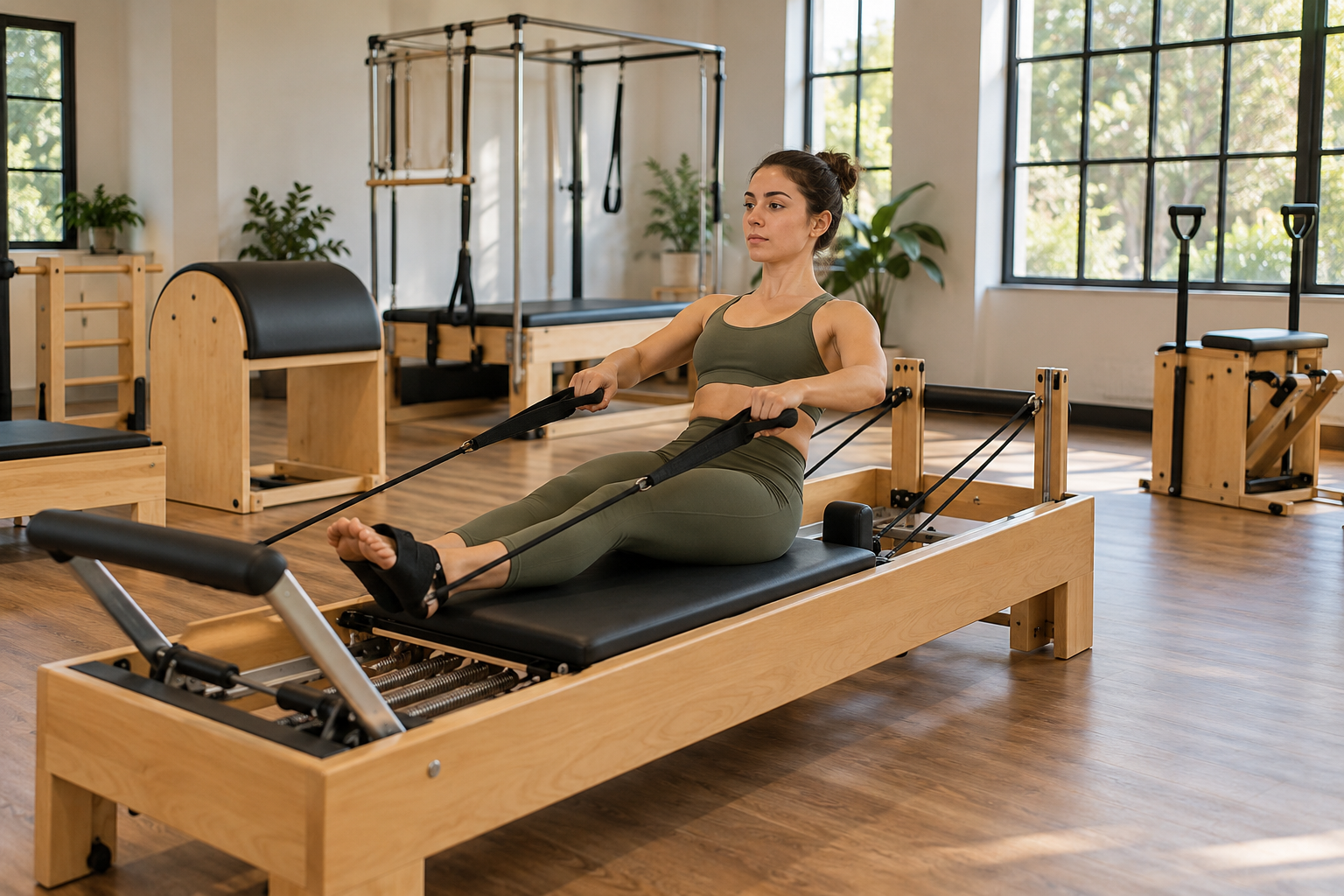
Difference between Reformer and other Pilates apparatus: a guide to choosing for professional studios
Understanding the difference between reformer and other pilates apparatus is essential for owners of Pilates studios and centers dedicated to postural training who want to organize their spaces with equipment consistent with the services offered. Reformer, Cadillac, Tower, Chair, and Ladder Barrel share some principles of the Pilates method, but feature different mechanical characteristics, exercise possibilities, and installation requirements.
The choice of equipment should not depend exclusively on the popularity of a specific apparatus or the number of exercises declared by the manufacturer. For a professional facility, it is necessary to evaluate the type of clientele, the skills of the instructors, the availability of space, and the expected frequency of use. These elements directly affect the quality of the sessions and the sustainability of the investment.
A Reformer can be a versatile solution for individual sessions and small groups, while other apparatus allow for the development of different work modalities, with specific possibilities for support, resistance, and movement organization. This guide offers a technical and decision-making comparison to help studio managers identify the characteristics that really matter, avoiding assessments based solely on price or the appearance of the machines.
- Principles of Pilates apparatus operation
- Reformer features and main applications
- Differences between Reformer, Cadillac, and Tower
- Chair and Barrel: functions and operational differences
- Biomechanical comparison and exercise possibilities
- Space organization and lesson management
- Practical criteria for choosing professional apparatus
- Planning the investment for a Pilates studio
Principles of Pilates apparatus operation
Pilates apparatus are equipment designed to support the execution of exercises based on motor control, coordination, joint mobility, and resistance management. Unlike exclusively floor-based work, these tools introduce mechanical elements that can assist movement, modify its difficulty, or offer useful references for body positioning.
The main differences concern the presence of moving surfaces, springs, pulley systems, pedals, and fixed supports. Each configuration modifies the relationship between the body and the equipment, influencing the direction of applied forces and the possibilities of performing exercises in supine, prone, seated, or standing positions.
For a professional studio owner, it is important to understand that the apparatus are not necessarily interchangeable. A machine with numerous adjustments may offer a wide variety of exercises but also require more technical preparation and longer setup times. The choice must therefore consider both educational possibilities and the daily organization of sessions.
The role of springs in resistance adjustment
Many apparatus use springs to generate an elastic force that varies during movement. The resistance depends on the characteristics of the spring, its extension, and the geometry of the system. It is therefore not correct to interpret the color of the springs as a universal value of difficulty, because codes can change between manufacturers.
Proper adjustment allows the instructor to modify the level of assistance or resistance based on the exercise and the user's abilities. For a professional studio, it is useful to verify that the springs are clearly identifiable, easily replaceable, and accompanied by maintenance instructions.
Support surfaces and movement control
The presence of stable or mobile supports modifies the work required of the user. A sliding surface, such as the Reformer carriage, introduces a dynamic component that must be controlled during the exercise. A fixed structure can instead offer a different reference for movement organization.
The difficulty level does not depend only on the amount of resistance applied. Body position, range of motion, and the number of points of support can make an exercise more or less challenging. This aspect must be considered in lesson planning and instructor training.
Reformer features and main applications
The Reformer is one of the most widespread apparatus in professional Pilates studios. Its structure generally includes a frame, a sliding carriage, resistance springs, a footbar, and systems of straps and pulleys. The interaction between these components allows for the execution of numerous exercises with different body orientations.
The distinctive feature of the Reformer is the movement of the carriage along a track. The user must control the displacement of the support surface while interacting with the springs. This configuration allows for organizing exercises dedicated to the lower limbs, upper limbs, and trunk control, by modifying position and resistance.
From a management point of view, the Reformer can be used in individual sessions and in lessons with multiple participants, provided that the necessary space is respected and adequate supervision is guaranteed. The possibility of standardizing some work sequences represents an organizational advantage, but it does not eliminate the need to adapt exercises to the characteristics of the users.
Sliding carriage and transmission system
The quality of the carriage movement depends on the precision of the tracks, the bearings, and the correct maintenance of the components. Regular smoothness allows for managing the phases of the exercise without abnormal friction or unexpected variations in the trajectory.
For professional use, it is advisable to check the stability of the frame, the noise during movement, and the accessibility of components subject to wear. The locking systems and the initial position adjustments must also be evaluated according to the manufacturer's instructions.
Versatility in individual and group lessons
The Reformer allows instructors to propose exercises with the body in supine, prone, seated, lateral, and, when configured, standing positions. This variety allows instructors to organize different programs without constantly changing equipment.
However, versatility must be linked to the skills of the staff. A complex exercise does not automatically become appropriate because the machine allows it to be performed. The selection of progressions must consider the motor skills, experience, and individual conditions of the user.
Differences between Reformer, Cadillac, and Tower
The comparison between Reformer, Cadillac, and Tower mainly concerns the mechanical structure and the ways in which resistance is applied. The Cadillac, often also called the Trapeze Table, includes a generally fixed work surface and an upper structure to which springs, bars, and other accessories can be attached.
The Tower uses a vertical configuration with attachment points for springs and accessories. It can be integrated into some multifunction structures or installed as part of a dedicated station. Compared to the full Cadillac, it generally has a more compact configuration, although footprint and functionality depend on the model.
The main difference compared to the Reformer concerns the absence, in the traditional Cadillac, of a mobile carriage used as the central element of the exercise. Resistances are applied through elastic systems connected to the structure, allowing for the organization of movements with different pulling directions.
Cadillac and assisted work possibilities
The Cadillac offers numerous attachment points that allow for configuring exercises with springs and supports in different positions. This feature can be useful in individual lessons that require detailed control of movement and specific adjustment of assistance.
The presence of bars and accessories does not mean that any exercise is suitable for every user. Configurations must respect the manufacturer's indications and require instructors trained in the management of elastic forces, connections, and safety procedures.
Tower and multifunction configurations
The Tower can be an interesting solution for studios that want to integrate spring-based exercises without necessarily dedicating the space required by a full Cadillac. Some systems combine Reformer and Tower, allowing the same station to be used for different work modalities.
These configurations must be evaluated considering the time required to switch from one setup to another. A multifunction machine can reduce the number of separate stations, but it does not necessarily allow all activities offered by the individual apparatus to be performed simultaneously.
Chair and Barrel: functions and operational differences
The Pilates Chair and the different types of Barrels complete the range of apparatus most used in professional studios. Compared to the Reformer, they have different dimensions and work modalities. The Chair generally uses one or more pedals connected to springs, while the Barrel mainly leverages curved surfaces and supports to modify body position.
The Chair allows for organizing exercises in seated, standing, and other configurations provided by the method and the model used. The presence of the pedal introduces an elastic resistance that requires control during pressure and return. The Barrel, on the other hand, does not necessarily use mechanical resistance systems and can be used for mobility, control, and postural organization exercises.
For a professional studio, these apparatus can expand educational possibilities without exactly replicating the functions of the Reformer. Their utility depends on the lesson program and the preparation of the instructors, as well as compatibility with available space.
Pilates Chair and movement control
The Chair has a relatively compact structure and a system of pedals that can be connected to springs of different resistance. Some models allow for the use of separate pedals, offering further possibilities for unilateral or coordinated work.
The small size should not be interpreted as an indicator of exercise simplicity. Some configurations require high motor control and adequate balance management. The choice of Chair must therefore be accompanied by an assessment of the technical skills available in the studio.
Ladder Barrel and mobility work
The Ladder Barrel combines a curved surface with a ladder structure that offers various points of support. This configuration allows for organizing exercises dedicated to spinal mobility, trunk control, and body position management.
The distance between the curved part and the ladder can be adjustable in some models, allowing the equipment to be adapted to different anthropometric characteristics. Before purchasing, it is advisable to check the adjustment possibilities, the stability of the structure, and the space required to perform the planned exercises.
Biomechanical comparison and exercise possibilities
The biomechanics of Pilates apparatus varies depending on body position, the direction of resistance, and the constraints imposed by the structure. In the Reformer, the movement of the carriage introduces a dynamic relationship between supports and elastic resistance. In the Cadillac and Tower, on the other hand, springs can apply forces from different attachment points.
The Chair uses the movement of the pedal to create specific work conditions, while the Barrel offers primarily support surfaces that modify the relationship between gravity, posture, and movement. These differences influence the selection of exercises and the possibility of proposing progressions consistent with individual goals.
It is not correct to establish a universal hierarchy among the apparatus. One piece of equipment may be particularly suitable for a certain exercise and less functional for another. The comparison must therefore start from the needs of the facility and the teaching methods adopted.
Resistance direction and motor control
In systems with springs, the direction of force depends on the position of the anchors and the geometry of the exercise. Changing the connection point can significantly modify the required work, even while keeping the same spring.
In the Reformer, resistance is generally connected to the movement of the carriage, while in Tower and Cadillac systems, it can be applied through different pulling configurations. For instructors, it is important to understand these differences before transferring an exercise from one apparatus to another.
Stability, mobility, and exercise adaptation
The presence of a mobile surface can increase control requirements under certain conditions, but it does not automatically make every exercise more difficult. Even a fixed surface can be used for complex movements, especially when support points and body levers change.
The choice of apparatus should consider the user's ability to maintain proper technique. An exercise performed with control on simple equipment can be more appropriate than a complex variant that requires excessive compensation.
Space organization and lesson management
The design of a studio dedicated to Pilates and postural training requires a careful evaluation of dimensions and paths to access the equipment. The dimensions provided in the technical sheets generally indicate the footprint of the structure, but do not always include the space necessary to perform all the planned exercises.
The Reformer requires an adequate longitudinal surface and space to get on, get off, and use any accessories. The Cadillac has a structure that is more developed in height, while the Tower requires an area compatible with the movements of the springs and limbs. Chair and Barrel may occupy smaller surfaces, but they must still be placed in a way that allows for safe use.
For a studio owner, the arrangement of stations also affects supervision. Instructors must be able to observe users, reach equipment quickly, and intervene in adjustments without hindering other activities.
Station sizing and operational paths
Before purchasing new apparatus, it is advisable to prepare a floor plan showing the dimensions of the machines and the necessary operational areas. Access, exits, structural elements, and circulation paths must also be considered, respecting applicable safety requirements.
A layout that is too compact can make managing lessons difficult, even when all the equipment physically fits into the available space. The design should therefore prioritize accessibility and work quality over the simple maximum number of installable stations.
Individual lessons and small groups
Individual lessons generally allow for greater customization of configurations and usage times. In this context, apparatus like the Cadillac and Tower can offer interesting adjustment possibilities, provided they are consistent with the instructor's training.
In group lessons with the Reformer, however, the speed of adjustments, the homogeneity of the stations, and the ability to manage exercises with different progressions become particularly important. Standardizing the equipment can facilitate organization, without replacing the assessment of individual capabilities.
Practical criteria for choosing professional apparatus
The decision-making comparison between Pilates apparatus must be based on verifiable technical and organizational requirements. The first step consists of defining which services the studio intends to offer, distinguishing between individual lessons, small groups, and activities that require particularly personalized supervision.
Subsequently, it is necessary to evaluate the construction characteristics of the equipment. Stability of the frame, quality of the tracks, reliability of the springs, precision of the adjustments, and availability of spare parts represent important elements for continuous professional use.
To compare available configurations, it can be useful to consult professional Pilates equipment, checking the technical specifications for each solution and its compatibility with the operational goals of the studio.
Construction quality and mechanical features
The structure must ensure stability during exercises planned by the manufacturer. Materials, connection systems, and moving components must be evaluated in relation to the frequency of use and operational stresses. Robust construction is an important requirement but must be accompanied by functional adjustments and correct ergonomic design.
For Reformers, it is useful to check the smoothness of the carriage and the quality of the locking systems. For Cadillacs and Towers, the spring attachment points and the stability of the structure become particularly important. For Chairs and Barrels, the operation of the pedals and the solidity of the support surfaces must be examined, respectively.
Ergonomics and adaptability to users
A professional studio welcomes people with different anthropometric characteristics and experience levels. Adjustments must therefore allow for a practical adaptation of the stations, without requiring complex procedures or modifications not provided by the manufacturer.
It is advisable to check the accessibility of handles, the position of supports, and the ease with which configurations can be changed. A technically versatile machine can be less functional when adjustments require excessive time during lessons.
Maintenance, service, and spare parts availability
Springs, sliding systems, straps, and other components subject to wear require checks according to the manufacturer's instructions. The availability of compatible spare parts and technical documentation contributes to the operational continuity of the studio.
Before purchasing, it is advisable to request information on warranty conditions, service procedures, and indicative delivery times for components. These elements must be considered together with the initial price, especially when equipment is used daily.
Planning the investment for a Pilates studio
The choice between Reformer and other Pilates apparatus represents a decision that involves the quality of the educational offering, the organization of space, and the economic sustainability of the studio. An effective investment must start from the analysis of the services actually requested by users and the skills available within the facility.
The Reformer can be a central solution for studios oriented toward individual lessons and small groups, thanks to the variety of configurations available. Cadillac and Tower can expand work possibilities with springs and supports, while Chair and Barrel introduce different exercise modalities. The most suitable combination depends on the organizational model and not on an assumed absolute superiority of one apparatus.
The total cost must include purchase price, transport, potential assembly, scheduled maintenance, and replacement of components subject to wear. For an owner, it is important to distinguish certain expenses from future estimates, using documented information and verifiable commercial conditions.
Another element concerns the ability to actually use the purchased equipment. A particularly versatile machine can be an inefficient investment when the staff does not have the necessary training to exploit its functions or when the lesson schedule does not include regular use.
Planning should also consider the possibility of progressively expanding the studio. An initial configuration with a limited number of Reformers can be subsequently integrated with other apparatus, provided that space and organization have been designed taking into account future needs. This approach allows for distributing investments over time without compromising the consistency of the offering.
To evaluate economic sustainability, it is useful to estimate the frequency of station use, operating costs, and the organizational capacity for lessons. Forecasts must be formulated prudently, avoiding automatically considering every new piece of equipment as a source of revenue increase. Performance depends on actual demand, service quality, and facility management.
The final selection should therefore prioritize practical selection criteria based on mechanical characteristics, ergonomics, versatility, service, and compatibility with the studio's goals. Documenting the reasons for the purchase and comparing homogeneous quotes allows for more transparent decision-making, maintaining control over the budget and the resources necessary for the future management of the apparatus.
Comments (0)