
Trolley
You have no items in your shopping cart

 Budgets
 Dumbers
 Discs
 Benches
 Racks and Rigs
 Weights Holders
 Isotonic machines
 Calisthenics
 Cardio
 Kettlebells
 Flooring
 Gym Set
 Accessories
 Combat
 ARTI MARZIALI
 CONTAINER GYM
 Tug-Of-War
 Used Gym Equipment
 PILATES MACCHINARI
 GINNASTICA ARTISTICA
 CAMPI DA PADEL
 Prodotti in Pronta Consegna
 Informazioni
 IRONMAN
 Gift Card
- Donatif
- General information
- 0 I like it
- 46 Views
- 0 comments
- gym flooring, safety flooring, gym safety, shock-absorbing materials
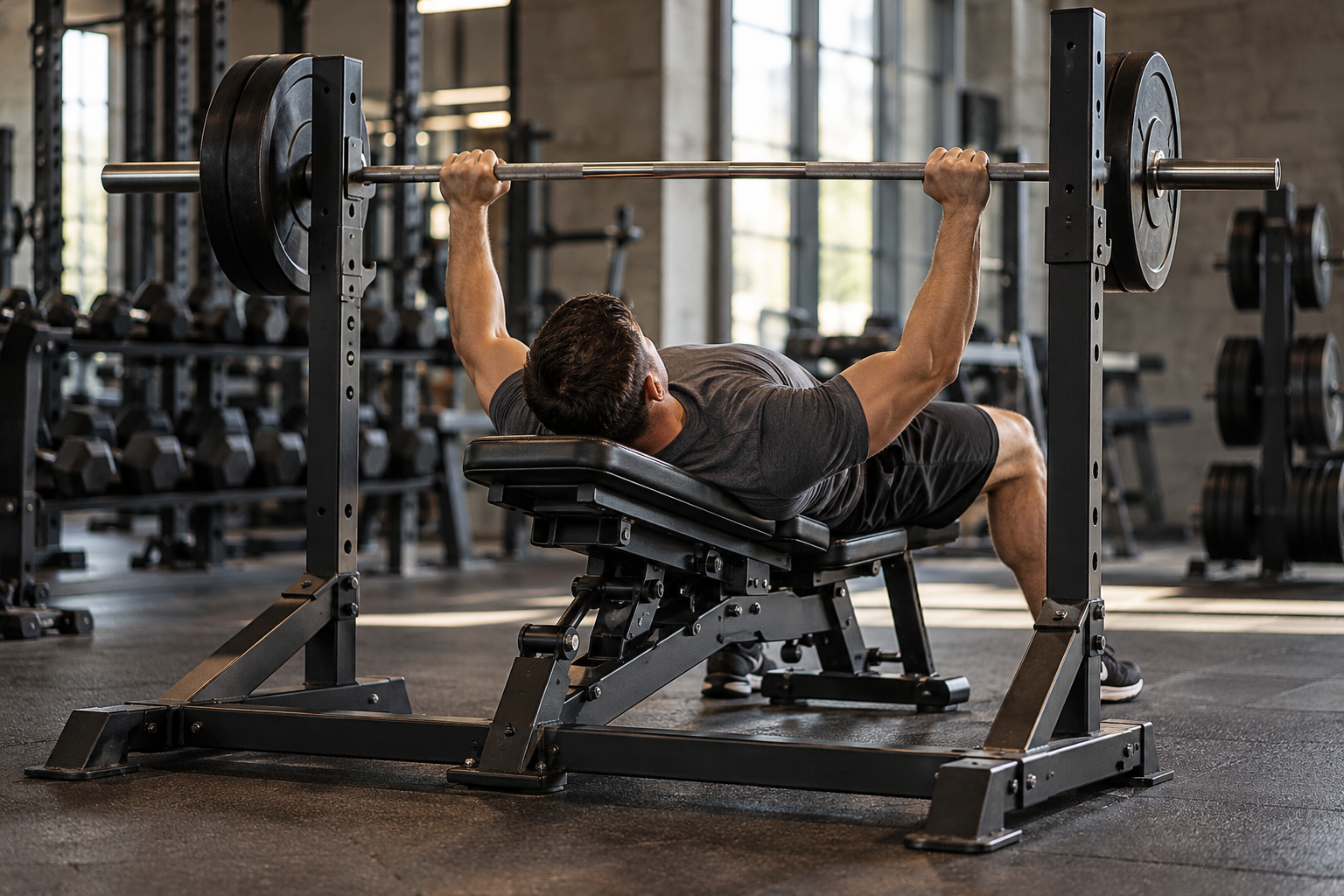
Alternatives to the High Power Bench 560: Choosing a Professional Bench
Looking for an alternative to the High Power Bench 560 starts with identifying the functions your weight room actually needs. Flat benches, adjustable benches and stations with barbell supports may look similar, yet they serve different purposes. A useful comparison begins with exercises, users and room organisation rather than photographs.
The model name alone does not establish load limits, adjustment positions or intended use. Without documentation for the specific version, it would be inappropriate to assign definite specifications to the Bench 560 or declare another product equivalent. This guide therefore explains selection criteria without inventing specifications or rankings of unverified products.
Treat the bench as part of a station: training implements, supports, safety devices, circulation and maintenance all affect the result. The aim is to identify a solution suited to everyday gym operations and compare offers through evidence rather than the word professional or the displayed price.
- Which function must the replacement provide?
- Flat bench, adjustable bench or rack station?
- How should load ratings and intended use be read?
- Stability and everyday adjustments
- Compatibility with barbells and supports
- Space, access and room organisation
- Maintenance and spare parts
- Select an alternative through verifiable criteria
Which function must the replacement provide?
Describe the exercises the station must accommodate. Horizontal dumbbell presses may only require a suitable flat bench. If the programme includes incline presses or other exercises needing different backrest positions, check the adjustments actually available. A station with barbell supports provides a function that the bench surface alone does not. Separating these requirements avoids buying a complex structure when a simple bench is enough, or a versatile bench that lacks essential supports.
Start with the gym programme
List frequent and occasional uses, distinguishing functions that must be immediately available from those provided elsewhere. Consider how many people alternate, their experience and staff supervision. In a busy gym, clear adjustments and limited repositioning can matter more than a rarely used extra. A short list of essential requirements makes supplier discussions more effective and prevents accessories from distracting attention from the intended work.
Flat bench, adjustable bench or rack station?
A flat bench offers a defined configuration and can simplify training when changes of inclination are unnecessary. An adjustable bench changes the support angle but requires attention to joints, locking mechanisms and the relationship between seat and backrest. Rack stations add barbell handling functions and must be assessed as a whole: support height, bench position and safety devices need to work together. No category is best for everyone; the configuration must match actual use.
Assess modularity
An independent bench may serve several positions where the manufacturer permits this and moving it is manageable. An integrated station maintains a more defined arrangement but imposes greater layout constraints. Consider how many operations are needed between exercises and where removed accessories will be stored. Modularity helps when it simplifies operations; it becomes less useful if it creates constant transfers, queues or components left in walkways. Evaluate this before installation.
How should load ratings and intended use be read?
Interpret declared capacity according to the manufacturer's instructions. Do not assume a number refers only to external weights: it may cover the combined user and equipment load or specific conditions. Establish how the limit is defined, which configurations it covers and whether individual components have separate limits. A large number without context does not establish suitability for a commercial gym. Likewise, a sturdy appearance does not demonstrate suitability for frequent shared use.
Compare like-for-like information
Request technical sheets and manuals for the versions actually quoted. Record documented facts and explicitly leave unanswered points open. Comparing a total capacity with a barbell-only rating leads to misleading conclusions. Accessories may also have independent limits. Ask the supplier to explain ambiguous terms and keep the response with the quotation. Avoid interpreting unclear information in a way that artificially increases the stated performance.
Stability and everyday adjustments
The bench must stand on the surface specified by its manufacturer and maintain the required stability during permitted exercises. Examine its contact points, access to adjustments and how each configuration locks. Do not alter feet, spacers or anchors without technical instructions. Wheels and handles support the operations intended by the design; their presence does not mean the bench can be moved with a person or weights on it. Follow the documented method.
Make settings understandable
In a shared gym, different users need to recognise positions and understand when a locking mechanism is properly engaged. Check whether adjustments require unloading and how they should be made. A demonstration can help assess usability and access to controls, but does not replace instructions. Also consider staff checks: a mechanism that is difficult to read can make an incomplete setting harder to detect before exercise.
Compatibility with barbells and supports
When using a bench with a barbell, assess the complete station. Bar dimensions, support position, room for loading plates and movement space must be compatible. A bench does not automatically suit every rack simply because it fits inside. The arrangement must allow the intended exercise and correct use of safety devices under the relevant manuals. Check the actual combination, including interference between the bench base and rack structure.
Build a coherent station
The barbells category can help identify equipment to compare with the station. Before buying, verify dimensions, intended use and compatibility rather than assuming products in the same commercial category work together. Consider plate storage and access for a spotter. A spotter does not replace required safety devices, and safety devices do not eliminate the need for correct settings and appropriate procedures.
Space, access and room organisation
Measuring the bench in its closed position does not describe the space needed during training. Include permitted configurations, training implements and access, adjustment and tidying operations. A dumbbell station operates differently from a barbell station with supports. Avoid universal clearance figures without evidence: minimum conditions come from documentation and applicable facility requirements. The layout must also make routes understandable and separate circulation from exercise as required by the project.
Include delivery and cleaning
Before ordering, check the route from the entrance to the room, package dimensions and assembly work. A structure that fits its final position may not pass an intermediate doorway in its delivery configuration. Clarify whether internal handling and assembly are included. Allow access around the base for cleaning and to inspection points. A layout that only works while everything remains immobile can complicate daily management and planned servicing.
Maintenance and spare parts
For professional use, service continuity also depends on maintenance. Upholstery, fasteners, feet, joints and locking systems require the checks specified by the manufacturer. Do not apply identical intervals to all benches: frequency of use, environment and design influence requirements. Ask which checks staff can perform and which require qualified assistance. Abnormal play, damaged parts or uncertain locking must be managed according to technical instructions rather than continuing to use the bench and hoping the issue disappears.
Consider lifetime costs
Alongside purchase price, compare parts availability, support conditions and the ease of identifying replacements. Replaceable upholstery can be operationally useful on equipment used every day, but availability and supply arrangements need confirmation. Appearance alone cannot establish a material's lifespan. Keep the model reference and documents for future requests. Overall cost includes the work needed to maintain prescribed conditions; assumptions about durability must not become guaranteed savings.
Select an alternative through verifiable criteria
Prepare a comparison of required functions, available configurations, declared limits, dimensions and services. Exclude offers that miss an essential requirement even if they include many accessories. Among suitable options, consider operational simplicity, room organisation and long-term support. Equivalence must be demonstrated against the functions you need to replace rather than proclaimed through a name or price. Request missing information before confirming the choice.
Plan introduction into the gym
Once the configuration is selected, establish its position, assembly, initial checks and user information. Keep the manuals and assign responsibility for prescribed inspections. A suitable bench delivers value when used under the correct conditions with compatible equipment. The final choice therefore connects technical documentation with actual gym activities, rather than seeking a visually identical replacement without the necessary characteristics.
Comments (0)